

Turkey bacon, cooked
Common food
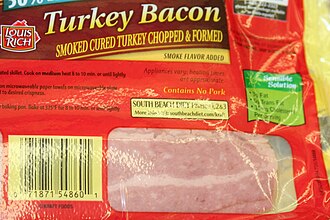
Photo: Wikipedia
Turkey bacon is a leaner, smoky alternative to traditional pork bacon, made from seasoned, cured, and sliced turkey meat. When cooked, it develops a satisfyingly crisp texture with a savory, slightly salty flavor that mimics its pork counterpart. Nutritionally, it offers a high-protein, lower-fat option for breakfast or as a versatile ingredient in various dishes.
Calorie split: 32% protein · 5% carbs · 63% fat
↓ Full nutrition💚 Why it's loved
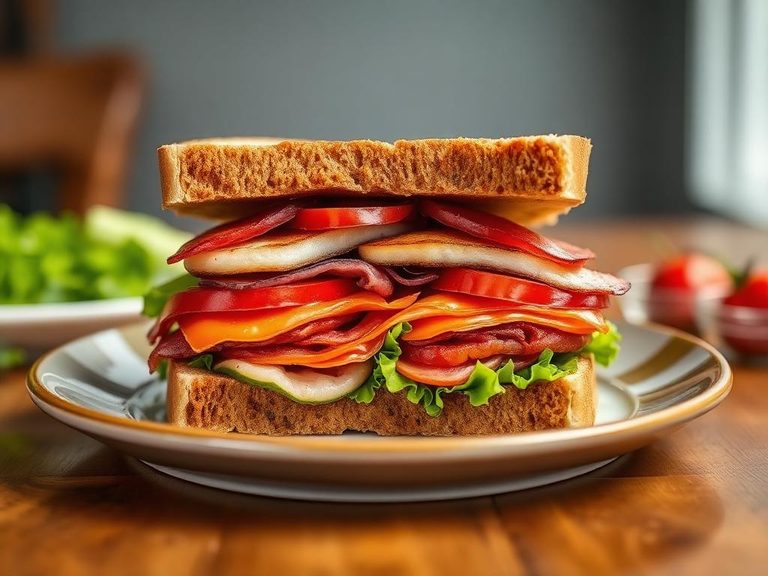
People love turkey bacon for its ability to deliver a familiar, smoky bacon flavor and satisfying crunch with less fat, making it a popular choice for breakfast sandwiches, salads, and as a topping. Its versatility and perceived health benefits have made it a staple in many health-conscious and diverse kitchens.
⚠️ Watch-outs & how to enjoy it better
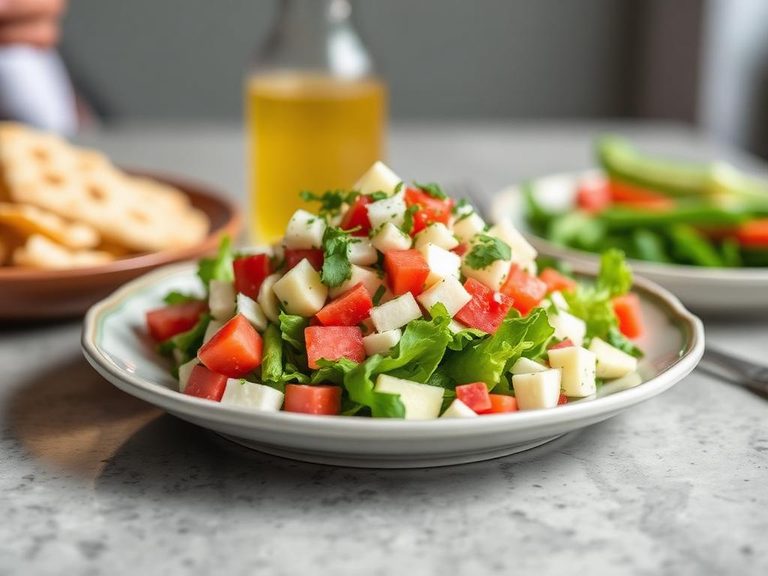
Some find turkey bacon less flavorful or fatty than pork bacon, and its high sodium content can be a concern for those monitoring blood pressure. To counteract this, pair it with potassium-rich foods like avocado or spinach, use it in moderation, and choose low-sodium varieties when available.
Key benefits
- High protein content (29.5g per 100g) supports muscle maintenance.
- Significantly lower in fat (25.87g per 100g) than traditional pork bacon.
- Provides a smoky, savory flavor with fewer calories (368 kcal per 100g).
- Suitable for those reducing pork consumption for dietary or religious reasons.
🍽️ Popular dishes

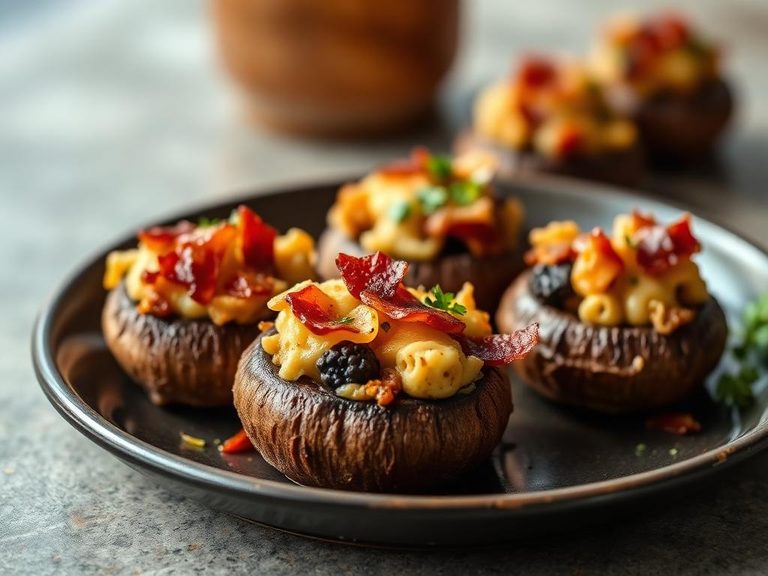
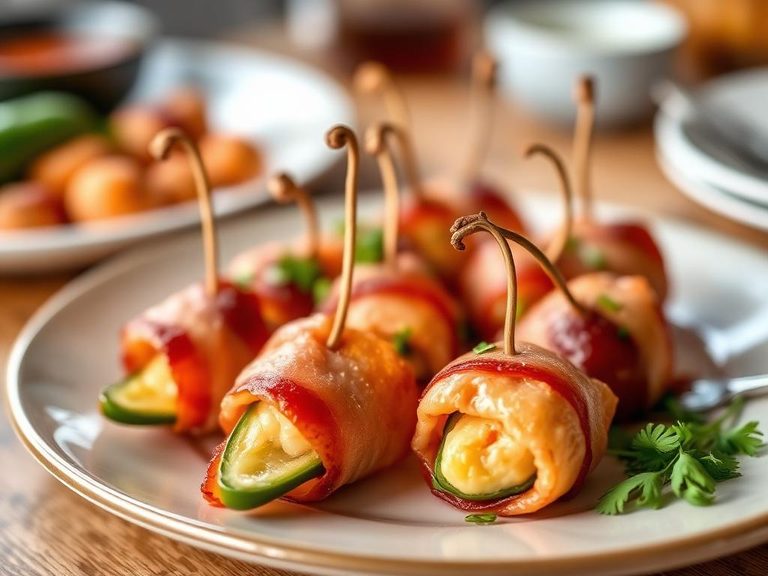
🌍 Where it's eaten
💡 Did you know?
Turkey bacon was first introduced in the 1980s as a lower-fat alternative to pork bacon, but it gained widespread popularity in the 1990s as part of the low-fat diet trend.
Full nutrition (USDA data · scales with serving)
| Water | 34.5 g |
| Energy | 368 kcal |
| Protein | 29.5 g |
| Total lipid (fat) | 25.9 g |
| Carbohydrate, by difference | 4.2 g |
| Fiber, total dietary | 0.00 g |
| Total Sugars | 4.2 g |
| Calcium, Ca | 163 mg |
| Iron, Fe | 2.6 mg |
| Magnesium, Mg | 30.0 mg |
| Phosphorus, P | 416 mg |
| Potassium, K | 666 mg |
| Sodium, Na | 2021 mg |
| Zinc, Zn | 4.7 mg |
| Copper, Cu | 0.12 mg |
| Selenium, Se | 28.5 ug |
| Vitamin C, total ascorbic acid | 0.00 mg |
| Thiamin | 0.05 mg |
| Riboflavin | 0.40 mg |
| Niacin | 8.1 mg |
| Vitamin B-6 | 0.37 mg |
| Folate, total | 15.0 ug |
| Folic acid | 0.00 ug |
| Folate, food | 15.0 ug |
| Folate, DFE | 15.0 ug |
| Choline, total | 87.9 mg |
| Vitamin B-12 | 1.9 ug |
| Vitamin B-12, added | 0.00 ug |
| Vitamin A, RAE | 19.0 ug |
| Retinol | 19.0 ug |
| Carotene, beta | 0.00 ug |
| Carotene, alpha | 0.00 ug |
| Cryptoxanthin, beta | 0.00 ug |
| Lycopene | 0.00 ug |
| Lutein + zeaxanthin | 0.00 ug |
| Vitamin E (alpha-tocopherol) | 0.14 mg |
| Vitamin E, added | 0.00 mg |
| Vitamin D (D2 + D3) | 1.2 ug |
| Vitamin K (phylloquinone) | 0.00 ug |
| Alcohol, ethyl | 0.00 g |
| Caffeine | 0.00 mg |
| Theobromine | 0.00 mg |
Fat & fatty acid profile (per 100g)
| Fatty acids, total saturated | 6.9 g |
| SFA 4:0 | 0.00 g |
| SFA 6:0 | 0.01 g |
| SFA 8:0 | 0.00 g |
| SFA 10:0 | 0.01 g |
| SFA 12:0 | 0.04 g |
| SFA 14:0 | 0.22 g |
| SFA 16:0 | 4.7 g |
| SFA 18:0 | 1.8 g |
| Fatty acids, total monounsaturated | 9.4 g |
| MUFA 16:1 | 0.75 g |
| MUFA 18:1 | 8.4 g |
| MUFA 20:1 | 0.13 g |
| MUFA 22:1 | 0.01 g |
| Fatty acids, total polyunsaturated | 6.9 g |
| PUFA 18:2 | 6.2 g |
| PUFA 18:3 | 0.35 g |
| PUFA 18:4 | 0.00 g |
| PUFA 20:4 | 0.17 g |
| PUFA 20:5 n-3 (EPA) | 0.02 g |
| PUFA 22:5 n-3 (DPA) | 0.02 g |
| PUFA 22:6 n-3 (DHA) | 0.01 g |
| Cholesterol | 153 mg |
Amino acid profile (per 100g)
Estimated from Bacon, turkey, low sodium — USDA does not publish this profile for Turkey bacon.
| Tryptophan | 0.19 g |
| Threonine | 0.65 g |
| Isoleucine | 0.52 g |
| Leucine | 1.3 g |
| Lysine | 1.5 g |
| Methionine | 0.47 g |
| Cystine | 0.17 g |
| Phenylalanine | 0.59 g |
| Tyrosine | 0.53 g |
| Valine | 0.59 g |
| Arginine | 1.1 g |
| Histidine | 0.49 g |
| Alanine | 1.0 g |
| Aspartic acid | 1.5 g |
| Glutamic acid | 2.5 g |
| Glycine | 0.93 g |
| Proline | 1.1 g |
| Serine | 0.72 g |
FAQ
Is turkey bacon healthier than pork bacon?
Turkey bacon is generally lower in fat and calories than pork bacon, but it can be high in sodium. It's a good option for those looking to reduce fat intake, but moderation is key.
How should I cook turkey bacon for the best texture?
For crispiness, cook turkey bacon in a skillet over medium heat, flipping occasionally, or bake it on a sheet pan in the oven at 400°F (200°C) for about 10-15 minutes.
Can I use turkey bacon in recipes that call for pork bacon?
Yes, turkey bacon can often be substituted for pork bacon in most recipes, though it may have a slightly different texture and flavor. Adjust cooking times as needed.
Nutrient density (calculated · NRF9.3)
Nutrient Rich Foods index: beneficial nutrients (protein, fiber, vitamins, minerals) minus saturated fat, added sugar & sodium, per 100 kcal.
NRF9.3 index — Fulgoni, Keast & Drewnowski, 2009. Computed from USDA nutrients.
Weight-loss friendliness (composite index)
Energy density 3.68 kcal/g · 32% calories from protein · 0.0 g fiber · 4.2 g sugar per 100 g.
Composite of energy density (Rolls et al., 1999), protein & fiber satiety, minus sugar. A calculated heuristic — ranks satiety-per-calorie, not a clinical measure.
Dietary load (calculated from USDA values)
Potential renal acid load. Positive = acid-forming, negative = alkaline-forming.
Sodium-to-potassium ratio: 3.03 (lower is better — aim for ≤ 1)
Sodium:potassium per WHO potassium guidance. Computed from USDA nutrients.