

Tea, iced, instant, black, unsweetened
Common food

Photo: Wikipedia
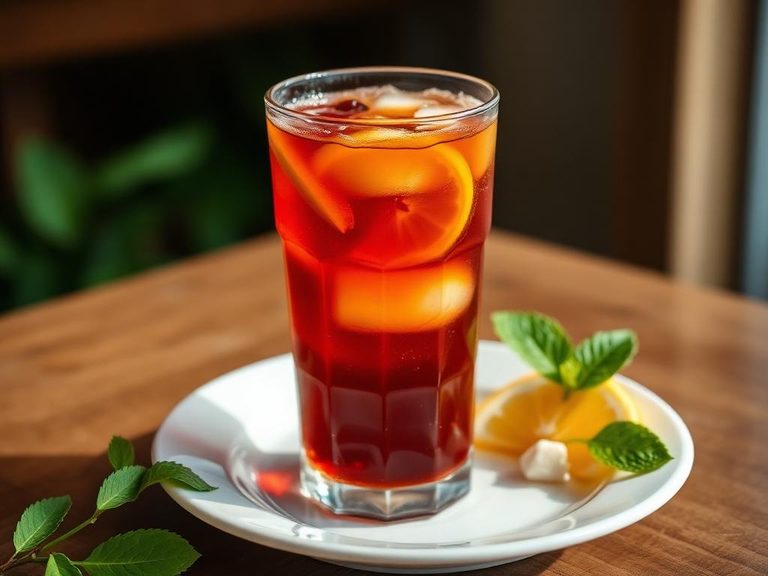
Instant black iced tea is a powdered concentrate that dissolves instantly in cold water, delivering a crisp, refreshing, and slightly tannic brew without any brewing time. Its flavor is a clean, straightforward black tea, often with a subtle malty or citrusy note, and it's virtually calorie-free. Nutritionally, it's a near-zero-calorie beverage, providing hydration with negligible impact on macronutrient intake.
Calorie split: 8% protein · 92% carbs · 0% fat
↓ Full nutrition💚 Why it's loved
People love it for its unparalleled convenience—a refreshing, unsweetened tea in seconds, perfect for busy days or hot weather. Its versatility allows it to be customized with sweeteners, lemon, or mint, and it's a staple in many cultures for a quick, cooling beverage.
⚠️ Watch-outs & how to enjoy it better
Some may find the taste slightly artificial or less nuanced than freshly brewed tea, and the caffeine content can be a concern for sensitive individuals or late in the day. To counteract potential caffeine jitters, consume it earlier or pair it with a protein-rich snack to moderate absorption; for a better taste, try adding a squeeze of fresh lemon or a few mint leaves.
Key benefits
- Extremely low calorie (1 kcal per 100g)
- Provides hydration without sugar or fat
- Contains antioxidants like theaflavins from black tea
- Offers a convenient, no-brew caffeine source
- Can be a zero-calorie alternative to sugary drinks
🍽️ Popular dishes




🌍 Where it's eaten
💡 Did you know?
Instant tea powder was developed in the 1940s, largely to meet the U.S. military's demand for a lightweight, shelf-stable beverage for soldiers in the field.
Full nutrition (USDA data · scales with serving)
| Water | 99.6 g |
| Energy | 1.0 kcal |
| Protein | 0.02 g |
| Total lipid (fat) | 0.00 g |
| Carbohydrate, by difference | 0.23 g |
| Fiber, total dietary | 0.00 g |
| Total Sugars | 0.01 g |
| Calcium, Ca | 3.0 mg |
| Iron, Fe | 0.00 mg |
| Magnesium, Mg | 1.0 mg |
| Phosphorus, P | 0.00 mg |
| Potassium, K | 10.0 mg |
| Sodium, Na | 4.0 mg |
| Zinc, Zn | 0.01 mg |
| Copper, Cu | 0.01 mg |
| Selenium, Se | 0.00 ug |
| Vitamin C, total ascorbic acid | 0.00 mg |
| Thiamin | 0.00 mg |
| Riboflavin | 0.00 mg |
| Niacin | 0.02 mg |
| Vitamin B-6 | 0.00 mg |
| Folate, total | 0.00 ug |
| Folic acid | 0.00 ug |
| Folate, food | 0.00 ug |
| Folate, DFE | 0.00 ug |
| Choline, total | 0.20 mg |
| Vitamin B-12 | 0.00 ug |
| Vitamin B-12, added | 0.00 ug |
| Vitamin A, RAE | 0.00 ug |
| Retinol | 0.00 ug |
| Carotene, beta | 0.00 ug |
| Carotene, alpha | 0.00 ug |
| Cryptoxanthin, beta | 0.00 ug |
| Lycopene | 0.00 ug |
| Lutein + zeaxanthin | 0.00 ug |
| Vitamin E (alpha-tocopherol) | 0.00 mg |
| Vitamin E, added | 0.00 mg |
| Vitamin D (D2 + D3) | 0.00 ug |
| Vitamin K (phylloquinone) | 0.00 ug |
| Alcohol, ethyl | 0.00 g |
| Caffeine | 5.0 mg |
| Theobromine | 0.00 mg |
Fat & fatty acid profile (per 100g)
| Fatty acids, total saturated | 0.00 g |
| SFA 4:0 | 0.00 g |
| SFA 6:0 | 0.00 g |
| SFA 8:0 | 0.00 g |
| SFA 10:0 | 0.00 g |
| SFA 12:0 | 0.00 g |
| SFA 14:0 | 0.00 g |
| SFA 16:0 | 0.00 g |
| SFA 18:0 | 0.00 g |
| Fatty acids, total monounsaturated | 0.00 g |
| MUFA 16:1 | 0.00 g |
| MUFA 18:1 | 0.00 g |
| MUFA 20:1 | 0.00 g |
| MUFA 22:1 | 0.00 g |
| Fatty acids, total polyunsaturated | 0.00 g |
| PUFA 18:2 | 0.00 g |
| PUFA 18:3 | 0.00 g |
| PUFA 18:4 | 0.00 g |
| PUFA 20:4 | 0.00 g |
| PUFA 20:5 n-3 (EPA) | 0.00 g |
| PUFA 22:5 n-3 (DPA) | 0.00 g |
| PUFA 22:6 n-3 (DHA) | 0.00 g |
| Cholesterol | 0.00 mg |
Amino acid profile (per 100g)
Estimated from Cookies, animal crackers (includes arrowroot, tea biscuits) — USDA does not publish this profile for Tea.
| Tryptophan | 0.10 g |
| Threonine | 0.19 g |
| Isoleucine | 0.26 g |
| Leucine | 0.47 g |
| Lysine | 0.24 g |
| Methionine | 0.12 g |
| Cystine | 0.15 g |
| Phenylalanine | 0.32 g |
| Tyrosine | 0.20 g |
| Valine | 0.30 g |
| Arginine | 0.26 g |
| Histidine | 0.14 g |
| Alanine | 0.21 g |
| Aspartic acid | 0.29 g |
| Glutamic acid | 2.3 g |
| Glycine | 0.23 g |
| Proline | 0.76 g |
| Serine | 0.36 g |
FAQ
Is instant iced tea as healthy as brewed tea?
It retains some antioxidants like theaflavins, but the processing can reduce certain delicate compounds. It's still a healthy, sugar-free choice compared to many other beverages.
Why is my instant iced tea cloudy?
This can happen due to 'cream down,' where natural tea solids precipitate in cold water. Using filtered water or adding the powder to warm water first can help prevent it.
Does it contain caffeine?
Yes, it typically contains caffeine from the black tea. The amount varies by brand but is generally less than a cup of brewed coffee.
Nutrient density (calculated · NRF9.3)
Nutrient Rich Foods index: beneficial nutrients (protein, fiber, vitamins, minerals) minus saturated fat, added sugar & sodium, per 100 kcal.
NRF9.3 index — Fulgoni, Keast & Drewnowski, 2009. Computed from USDA nutrients.
Weight-loss friendliness (composite index)
Energy density 0.01 kcal/g · 8% calories from protein · 0.0 g fiber · 0.0 g sugar per 100 g.
Composite of energy density (Rolls et al., 1999), protein & fiber satiety, minus sugar. A calculated heuristic — ranks satiety-per-calorie, not a clinical measure.
Dietary load (calculated from USDA values)
Potential renal acid load. Positive = acid-forming, negative = alkaline-forming.
Sodium-to-potassium ratio: 0.40 (lower is better — aim for ≤ 1)
Sodium:potassium per WHO potassium guidance. Computed from USDA nutrients.