

Tea, iced, instant, black, pre-sweetened with low calorie sweetener
Common food

Photo: Wikipedia
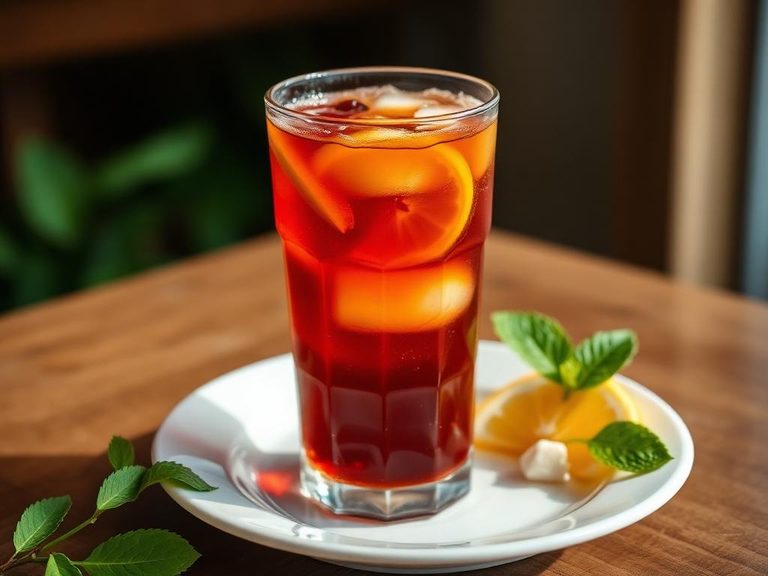
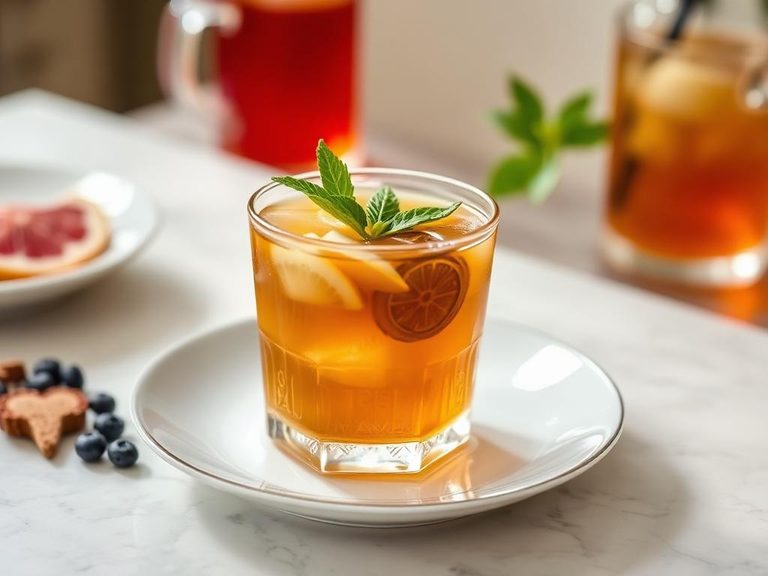
This is a convenient, ready-to-drink iced black tea, pre-sweetened with low-calorie sweeteners like aspartame or sucralose. It offers the familiar, brisk taste of black tea with a sweet profile, but with virtually no calories, sugar, or fat. Its liquid form provides instant hydration with a light, non-viscous texture.
Calorie split: 4% protein · 96% carbs · 0% fat
↓ Full nutrition💚 Why it's loved
People love it for delivering the classic, refreshing taste of sweet iced tea without the guilt of sugar and calories. It's a ubiquitous, thirst-quenching staple in convenience stores and vending machines, perfect for a quick, flavorful pick-me-up.
⚠️ Watch-outs & how to enjoy it better
The artificial sweeteners can leave a distinct aftertaste for some and may trigger cravings in others. Those sensitive to caffeine should be mindful of intake, especially later in the day. To counteract, consider it as an occasional treat, dilute with water or unsweetened tea, or pair it with a protein-rich snack to promote satiety.
Key benefits
- Extremely low calorie (2 kcal per 100ml)
- Zero sugar and zero fat
- Provides hydration and a mild caffeine boost
- Convenient, shelf-stable, and portable
- Offers the antioxidant properties of black tea
🍽️ Popular dishes

🌍 Where it's eaten
💡 Did you know?
The 'instant' aspect often comes from using tea extract or concentrate, which is then spray-dried or freeze-dried to dissolve quickly in water, a process perfected for mass-market beverages in the mid-20th century.
Full nutrition (USDA data · scales with serving)
| Water | 99.4 g |
| Energy | 2.0 kcal |
| Protein | 0.02 g |
| Total lipid (fat) | 0.00 g |
| Carbohydrate, by difference | 0.44 g |
| Fiber, total dietary | 0.00 g |
| Total Sugars | 0.01 g |
| Calcium, Ca | 3.0 mg |
| Iron, Fe | 0.05 mg |
| Magnesium, Mg | 2.0 mg |
| Phosphorus, P | 1.0 mg |
| Potassium, K | 14.0 mg |
| Sodium, Na | 6.0 mg |
| Zinc, Zn | 0.01 mg |
| Copper, Cu | 0.01 mg |
| Selenium, Se | 0.00 ug |
| Vitamin C, total ascorbic acid | 0.00 mg |
| Thiamin | 0.00 mg |
| Riboflavin | 0.00 mg |
| Niacin | 0.02 mg |
| Vitamin B-6 | 0.00 mg |
| Folate, total | 0.00 ug |
| Folic acid | 0.00 ug |
| Folate, food | 0.00 ug |
| Folate, DFE | 0.00 ug |
| Choline, total | 0.20 mg |
| Vitamin B-12 | 0.00 ug |
| Vitamin B-12, added | 0.00 ug |
| Vitamin A, RAE | 0.00 ug |
| Retinol | 0.00 ug |
| Carotene, beta | 0.00 ug |
| Carotene, alpha | 0.00 ug |
| Cryptoxanthin, beta | 0.00 ug |
| Lycopene | 0.00 ug |
| Lutein + zeaxanthin | 0.00 ug |
| Vitamin E (alpha-tocopherol) | 0.00 mg |
| Vitamin E, added | 0.00 mg |
| Vitamin D (D2 + D3) | 0.00 ug |
| Vitamin K (phylloquinone) | 0.00 ug |
| Alcohol, ethyl | 0.00 g |
| Caffeine | 11.0 mg |
| Theobromine | 0.00 mg |
Fat & fatty acid profile (per 100g)
| Fatty acids, total saturated | 0.00 g |
| SFA 4:0 | 0.00 g |
| SFA 6:0 | 0.00 g |
| SFA 8:0 | 0.00 g |
| SFA 10:0 | 0.00 g |
| SFA 12:0 | 0.00 g |
| SFA 14:0 | 0.00 g |
| SFA 16:0 | 0.00 g |
| SFA 18:0 | 0.00 g |
| Fatty acids, total monounsaturated | 0.00 g |
| MUFA 16:1 | 0.00 g |
| MUFA 18:1 | 0.00 g |
| MUFA 20:1 | 0.00 g |
| MUFA 22:1 | 0.00 g |
| Fatty acids, total polyunsaturated | 0.00 g |
| PUFA 18:2 | 0.00 g |
| PUFA 18:3 | 0.00 g |
| PUFA 18:4 | 0.00 g |
| PUFA 20:4 | 0.00 g |
| PUFA 20:5 n-3 (EPA) | 0.00 g |
| PUFA 22:5 n-3 (DPA) | 0.00 g |
| PUFA 22:6 n-3 (DHA) | 0.00 g |
| Cholesterol | 0.00 mg |
Amino acid profile (per 100g)
Estimated from Cookies, animal crackers (includes arrowroot, tea biscuits) — USDA does not publish this profile for Tea.
| Tryptophan | 0.10 g |
| Threonine | 0.19 g |
| Isoleucine | 0.26 g |
| Leucine | 0.47 g |
| Lysine | 0.24 g |
| Methionine | 0.12 g |
| Cystine | 0.15 g |
| Phenylalanine | 0.32 g |
| Tyrosine | 0.20 g |
| Valine | 0.30 g |
| Arginine | 0.26 g |
| Histidine | 0.14 g |
| Alanine | 0.21 g |
| Aspartic acid | 0.29 g |
| Glutamic acid | 2.3 g |
| Glycine | 0.23 g |
| Proline | 0.76 g |
| Serine | 0.36 g |
FAQ
Is this the same as homemade iced tea?
Not exactly. Homemade iced tea is brewed from tea leaves or bags and cooled. This is a processed, shelf-stable product made from tea extracts and pre-mixed with sweeteners and preservatives for consistency and longevity.
Why does it have 0g sugar but is sweet?
The sweetness comes from non-nutritive, low-calorie sweeteners like aspartame, sucralose, or acesulfame potassium, which provide a sweet taste without the calories or glycemic impact of sugar.
Does the instant processing remove the antioxidants from the tea?
While some polyphenols (like catechins) can be degraded during processing and storage, black tea still retains significant antioxidants like theaflavins and thearubigins, which are formed during the oxidation process of making black tea.
Nutrient density (calculated · NRF9.3)
Nutrient Rich Foods index: beneficial nutrients (protein, fiber, vitamins, minerals) minus saturated fat, added sugar & sodium, per 100 kcal.
NRF9.3 index — Fulgoni, Keast & Drewnowski, 2009. Computed from USDA nutrients.
Weight-loss friendliness (composite index)
Energy density 0.02 kcal/g · 4% calories from protein · 0.0 g fiber · 0.0 g sugar per 100 g.
Composite of energy density (Rolls et al., 1999), protein & fiber satiety, minus sugar. A calculated heuristic — ranks satiety-per-calorie, not a clinical measure.
Dietary load (calculated from USDA values)
Potential renal acid load. Positive = acid-forming, negative = alkaline-forming.
Sodium-to-potassium ratio: 0.43 (lower is better — aim for ≤ 1)
Sodium:potassium per WHO potassium guidance. Computed from USDA nutrients.