

Stew, pork
Common food
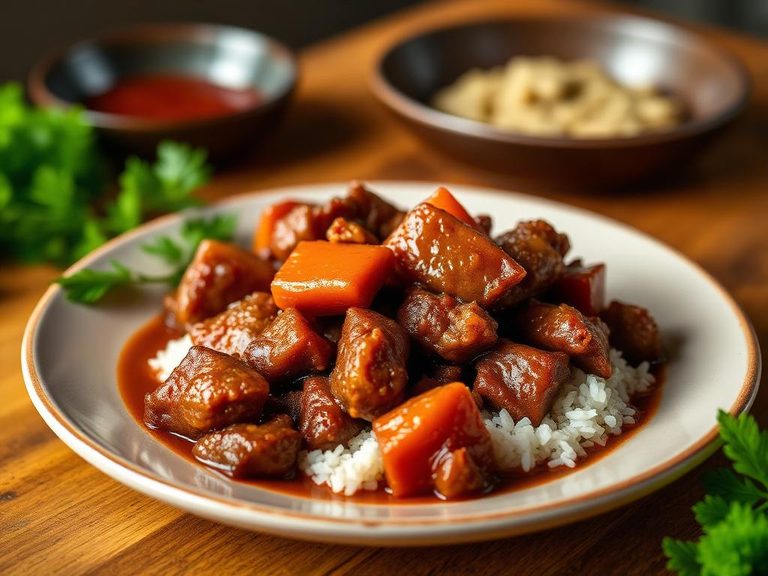
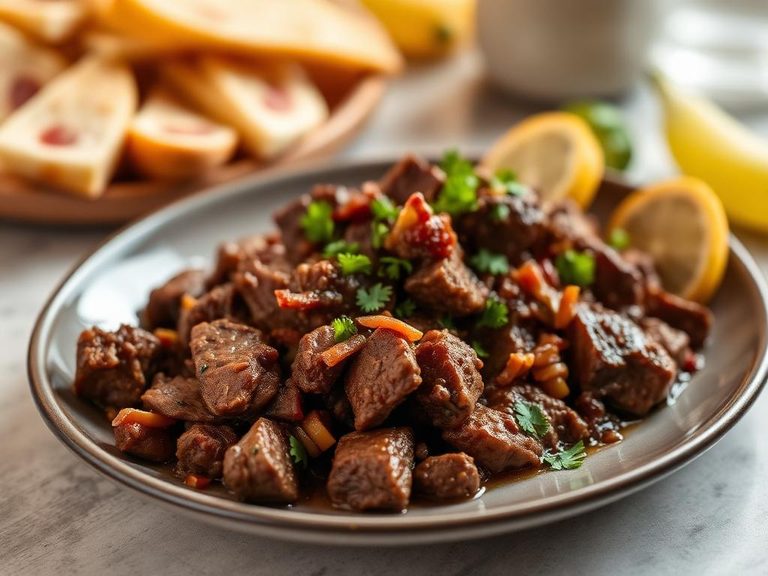
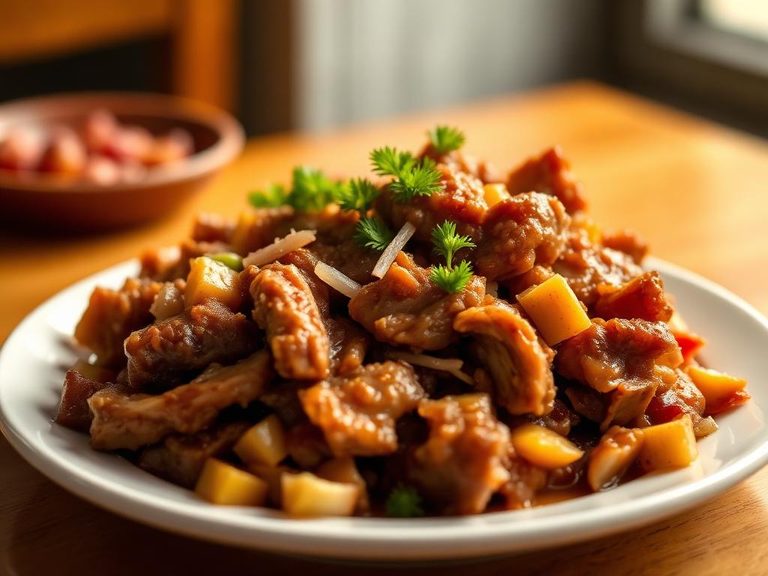
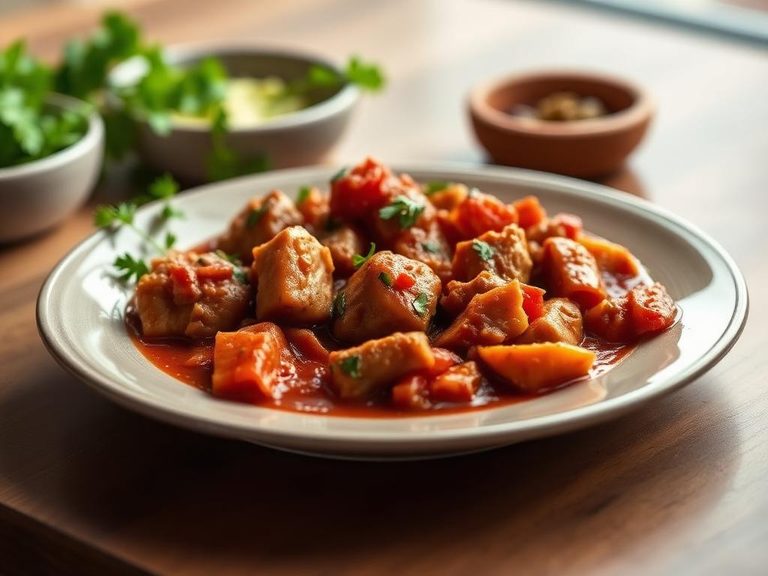
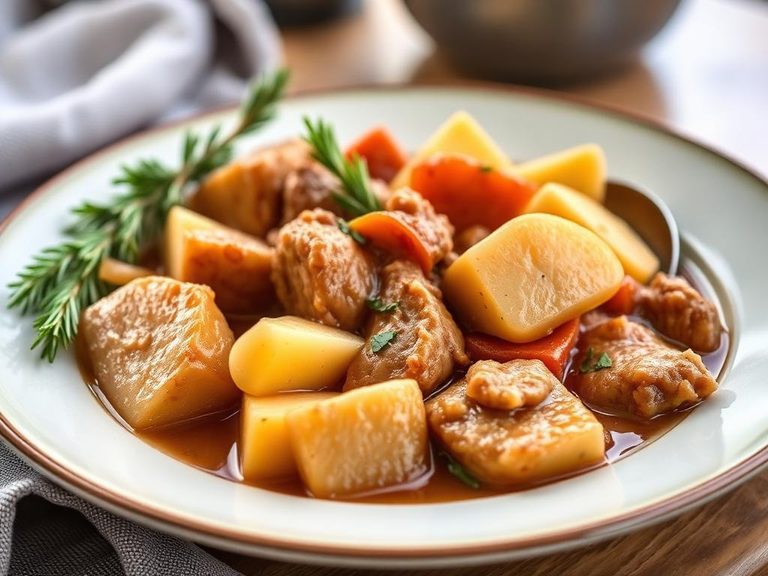
A hearty, savory dish of pork slowly simmered in a flavorful broth or sauce until tender and succulent. The meat becomes melt-in-your-mouth soft, often absorbing the rich, aromatic flavors of its cooking liquid. It provides a solid protein boost with a moderate calorie count, making it a satisfying and nourishing meal component.
Calorie split: 31% protein · 23% carbs · 45% fat
↓ Full nutrition💚 Why it's loved
People love pork stew for its deep, comforting flavors and the way the meat becomes incredibly tender and flavorful from slow cooking. It's a versatile one-pot meal that can be adapted with countless herbs, vegetables, and regional spices.
⚠️ Watch-outs & how to enjoy it better
Pork stew can be high in sodium depending on the broth and seasoning used, which may concern those monitoring blood pressure. To counteract this, use low-sodium broth, limit added salt, and boost flavor with herbs, garlic, and acidic ingredients like tomatoes or vinegar. Ensure the pork is cooked thoroughly to an internal temperature of 145°F (63°C) for safety.
Key benefits
- Excellent source of high-quality protein for muscle maintenance
- Provides essential B vitamins like B12 and niacin for energy metabolism
- Contains minerals such as zinc and selenium for immune function
- Slow cooking can help break down connective tissue, making nutrients more accessible
🍽️ Popular dishes
🌍 Where it's eaten
💡 Did you know?
The collagen in pork connective tissue, when simmered slowly, converts into gelatin, which gives the stew's broth a rich, velvety mouthfeel and helps bind the sauce.
Full nutrition (USDA data · scales with serving)
| Water | 78.2 g |
| Energy | 109 kcal |
| Protein | 8.3 g |
| Total lipid (fat) | 5.4 g |
| Carbohydrate, by difference | 6.3 g |
| Fiber, total dietary | 1.3 g |
| Total Sugars | 1.6 g |
| Calcium, Ca | 19.0 mg |
| Iron, Fe | 0.75 mg |
| Magnesium, Mg | 17.0 mg |
| Phosphorus, P | 86.0 mg |
| Potassium, K | 252 mg |
| Sodium, Na | 304 mg |
| Zinc, Zn | 1.6 mg |
| Copper, Cu | 0.09 mg |
| Selenium, Se | 12.8 ug |
| Vitamin C, total ascorbic acid | 7.0 mg |
| Thiamin | 0.18 mg |
| Riboflavin | 0.14 mg |
| Niacin | 1.7 mg |
| Vitamin B-6 | 0.20 mg |
| Folate, total | 12.0 ug |
| Folic acid | 0.00 ug |
| Folate, food | 12.0 ug |
| Folate, DFE | 12.0 ug |
| Choline, total | 36.7 mg |
| Vitamin B-12 | 0.28 ug |
| Vitamin B-12, added | 0.00 ug |
| Vitamin A, RAE | 129 ug |
| Retinol | 1.0 ug |
| Carotene, beta | 1285 ug |
| Carotene, alpha | 517 ug |
| Cryptoxanthin, beta | 3.0 ug |
| Lycopene | 540 ug |
| Lutein + zeaxanthin | 156 ug |
| Vitamin E (alpha-tocopherol) | 0.22 mg |
| Vitamin E, added | 0.00 mg |
| Vitamin D (D2 + D3) | 0.40 ug |
| Vitamin K (phylloquinone) | 5.4 ug |
| Alcohol, ethyl | 0.00 g |
| Caffeine | 0.00 mg |
| Theobromine | 0.00 mg |
Fat & fatty acid profile (per 100g)
| Fatty acids, total saturated | 2.0 g |
| SFA 4:0 | 0.00 g |
| SFA 6:0 | 0.00 g |
| SFA 8:0 | 0.00 g |
| SFA 10:0 | 0.01 g |
| SFA 12:0 | 0.01 g |
| SFA 14:0 | 0.07 g |
| SFA 16:0 | 1.2 g |
| SFA 18:0 | 0.67 g |
| Fatty acids, total monounsaturated | 2.4 g |
| MUFA 16:1 | 0.12 g |
| MUFA 18:1 | 2.2 g |
| MUFA 20:1 | 0.04 g |
| MUFA 22:1 | 0.00 g |
| Fatty acids, total polyunsaturated | 0.66 g |
| PUFA 18:2 | 0.58 g |
| PUFA 18:3 | 0.03 g |
| PUFA 18:4 | 0.00 g |
| PUFA 20:4 | 0.03 g |
| PUFA 20:5 n-3 (EPA) | 0.00 g |
| PUFA 22:5 n-3 (DPA) | 0.00 g |
| PUFA 22:6 n-3 (DHA) | 0.00 g |
| Cholesterol | 29.0 mg |
Amino acid profile (per 100g)
Estimated from Stew, hominy with mutton (Navajo) — USDA does not publish this profile for Stew.
| Tryptophan | 0.04 g |
| Threonine | 0.24 g |
| Isoleucine | 0.25 g |
| Leucine | 0.54 g |
| Lysine | 0.43 g |
| Methionine | 0.16 g |
| Cystine | 0.07 g |
| Phenylalanine | 0.26 g |
| Tyrosine | 0.18 g |
| Valine | 0.29 g |
| Arginine | 0.39 g |
| Histidine | 0.16 g |
| Alanine | 0.42 g |
| Aspartic acid | 0.53 g |
| Glutamic acid | 0.99 g |
| Glycine | 0.45 g |
| Proline | 0.39 g |
| Serine | 0.25 g |
FAQ
What cut of pork is best for stew?
Tougher, well-marbled cuts with connective tissue are ideal. Pork shoulder (also called pork butt) or pork butt are top choices as they become tender and flavorful with long, slow cooking.
How do I prevent the pork from becoming tough?
Avoid lean cuts like loin. Cook low and slow—simmer gently for 1.5 to 2.5 hours until the meat is fork-tender. Rushing with high heat will tighten the muscle fibers.
Can I make pork stew in a slow cooker?
Absolutely. It's perfect for a slow cooker. Brown the pork first for deeper flavor, then combine with other ingredients and cook on low for 6-8 hours or on high for 3-4 hours.
Nutrient density (calculated · NRF9.3)
Nutrient Rich Foods index: beneficial nutrients (protein, fiber, vitamins, minerals) minus saturated fat, added sugar & sodium, per 100 kcal.
NRF9.3 index — Fulgoni, Keast & Drewnowski, 2009. Computed from USDA nutrients.
Weight-loss friendliness (composite index)
Energy density 1.09 kcal/g · 31% calories from protein · 1.3 g fiber · 1.6 g sugar per 100 g.
Composite of energy density (Rolls et al., 1999), protein & fiber satiety, minus sugar. A calculated heuristic — ranks satiety-per-calorie, not a clinical measure.
Dietary load (calculated from USDA values)
Potential renal acid load. Positive = acid-forming, negative = alkaline-forming.
Sodium-to-potassium ratio: 1.21 (lower is better — aim for ≤ 1)
Sodium:potassium per WHO potassium guidance. Computed from USDA nutrients.