

Soup, vegetable, canned, low sodium, condensed
Whole food · Soups, Sauces, and Gravies

Photo: Wikipedia
This is a pantry staple: a concentrated blend of vegetables like tomatoes, carrots, and celery, simmered into a thick, savory base. Its texture is smooth yet hearty, designed to be diluted with water or broth to create a comforting, full-bodied soup. A standout feature is its impressively low calorie count (just 65 kcal per 100g) and minimal fat, making it a light yet nourishing option.
Calorie split: 13% protein · 74% carbs · 12% fat
↓ Full nutrition💚 Why it's loved
People love it for its incredible convenience and comforting, familiar flavor that serves as a perfect base for countless quick meals. Its versatility allows it to be a standalone light lunch or the foundation for a more elaborate dish, evoking a sense of home cooking with minimal effort.
⚠️ Watch-outs & how to enjoy it better
The condensed, concentrated flavor can sometimes taste overly savory or metallic to some palates, and it may lack the freshness of a homemade soup. For those monitoring blood sugar, the carbohydrates can cause a quicker spike when eaten alone. **Tip:** Pair it with a source of protein (like beans or chicken) and healthy fat (a drizzle of olive oil) to slow digestion and create a more balanced meal.
Key benefits
- Extremely low in calories and fat, supporting weight management.
- Provides dietary fiber (2.1g per 100g) for digestive health.
- A good source of quick, plant-based energy from complex carbohydrates.
- Low-sodium version helps manage blood pressure.
- Offers a convenient, shelf-stable way to consume vegetable servings.
🍽️ Popular dishes
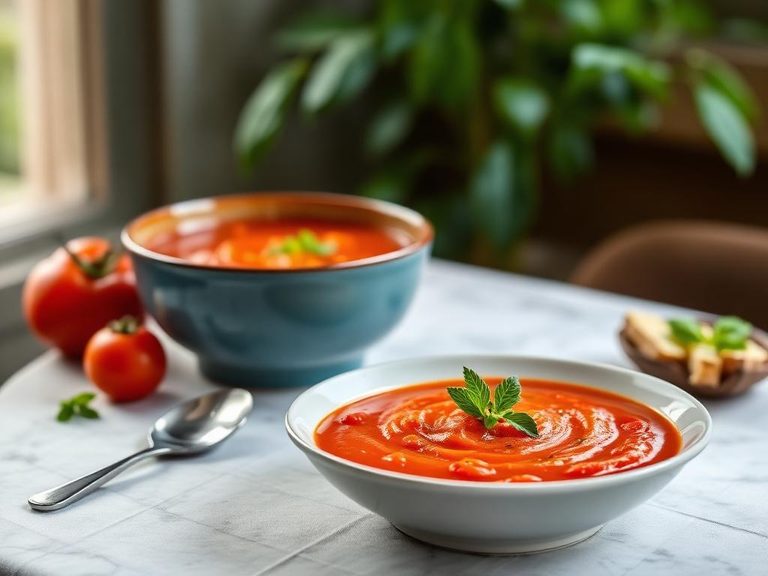
🌍 Where it's eaten
💡 Did you know?
Condensed soup was a revolutionary invention by John T. Dorrance in 1897, who realized that removing the water not only made soup lighter and cheaper to ship but also gave consumers control over the final thickness and flavor.
Full nutrition (USDA data · scales with serving)
| Water | 82.8 g |
| Energy | 65.0 kcal |
| Energy | 273 kj |
| Protein | 2.2 g |
| Total lipid (fat) | 0.90 g |
| Ash | 2.0 g |
| Carbohydrate, by difference | 12.1 g |
| Fiber, total dietary | 2.1 g |
| Total Sugars | 4.3 g |
| Calcium, Ca | 20.0 mg |
| Iron, Fe | 0.66 mg |
| Magnesium, Mg | 25.0 mg |
| Phosphorus, P | 45.0 mg |
| Potassium, K | 433 mg |
| Sodium, Na | 385 mg |
| Zinc, Zn | 0.40 mg |
| Copper, Cu | 0.23 mg |
| Manganese, Mn | 0.25 mg |
| Selenium, Se | 4.0 ug |
| Vitamin C, total ascorbic acid | 0.80 mg |
| Thiamin | 0.11 mg |
| Riboflavin | 0.09 mg |
| Niacin | 1.5 mg |
| Pantothenic acid | 0.35 mg |
| Vitamin B-6 | 0.17 mg |
| Folate, total | 12.0 ug |
| Folic acid | 1.0 ug |
| Folate, food | 12.0 ug |
| Folate, DFE | 13.0 ug |
| Choline, total | 9.0 mg |
| Vitamin B-12 | 0.00 ug |
| Vitamin B-12, added | 0.00 ug |
| Vitamin A, RAE | 86.0 ug |
| Retinol | 0.00 ug |
| Carotene, beta | 875 ug |
| Carotene, alpha | 314 ug |
| Cryptoxanthin, beta | 2.0 ug |
| Vitamin A, IU | 1721 iu |
| Lycopene | 13848 ug |
| Lutein + zeaxanthin | 45.0 ug |
| Vitamin E (alpha-tocopherol) | 1.4 mg |
| Vitamin E, added | 0.00 mg |
| Vitamin D (D2 + D3), International Units | 0.00 iu |
| Vitamin D (D2 + D3) | 0.00 ug |
| Vitamin K (phylloquinone) | 4.2 ug |
| Alcohol, ethyl | 0.00 g |
| Caffeine | 0.00 mg |
| Theobromine | 0.00 mg |
Fat & fatty acid profile (per 100g)
| Fatty acids, total saturated | 0.15 g |
| SFA 4:0 | 0.00 g |
| SFA 6:0 | 0.00 g |
| SFA 8:0 | 0.00 g |
| SFA 10:0 | 0.00 g |
| SFA 12:0 | 0.00 g |
| SFA 14:0 | 0.00 g |
| SFA 16:0 | 0.11 g |
| SFA 18:0 | 0.03 g |
| Fatty acids, total monounsaturated | 0.20 g |
| MUFA 16:1 | 0.00 g |
| MUFA 18:1 | 0.20 g |
| MUFA 20:1 | 0.00 g |
| MUFA 22:1 | 0.00 g |
| Fatty acids, total polyunsaturated | 0.40 g |
| PUFA 18:2 | 0.38 g |
| PUFA 18:3 | 0.02 g |
| PUFA 18:4 | 0.00 g |
| PUFA 20:4 | 0.00 g |
| PUFA 20:5 n-3 (EPA) | 0.00 g |
| PUFA 22:5 n-3 (DPA) | 0.00 g |
| PUFA 22:6 n-3 (DHA) | 0.00 g |
| Cholesterol | 0.00 mg |
Amino acid profile (per 100g)
Estimated from Soup, bean with pork, canned, condensed — USDA does not publish this profile for Soup.
| Tryptophan | 0.06 g |
| Threonine | 0.24 g |
| Isoleucine | 0.29 g |
| Leucine | 0.48 g |
| Lysine | 0.40 g |
| Methionine | 0.07 g |
| Cystine | 0.07 g |
| Phenylalanine | 0.33 g |
| Tyrosine | 0.18 g |
| Valine | 0.32 g |
| Arginine | 0.31 g |
| Histidine | 0.15 g |
| Alanine | 0.29 g |
| Aspartic acid | 0.66 g |
| Glutamic acid | 1.1 g |
| Glycine | 0.28 g |
| Proline | 0.27 g |
| Serine | 0.29 g |
FAQ
How do I use condensed soup?
Simply mix the concentrate with an equal volume of water, milk, or broth, then heat. It's also a ready-to-use ingredient for sauces, casseroles, and stews without dilution.
Is it healthy?
The low-sodium, low-fat version is a nutritious, low-calorie food. However, it's processed, so check labels for additives. It's best viewed as a convenient component of a balanced diet, not a primary vegetable source.
Can I make it taste better?
Absolutely. Sauté fresh garlic and onions before adding the diluted soup, stir in herbs like thyme or basil, or finish with a splash of cream or a swirl of pesto for a richer flavor.
Nutrient density (calculated · NRF9.3)
Nutrient Rich Foods index: beneficial nutrients (protein, fiber, vitamins, minerals) minus saturated fat, added sugar & sodium, per 100 kcal.
NRF9.3 index — Fulgoni, Keast & Drewnowski, 2009. Computed from USDA nutrients.
Weight-loss friendliness (composite index)
Energy density 0.65 kcal/g · 14% calories from protein · 2.1 g fiber · 4.3 g sugar per 100 g.
Composite of energy density (Rolls et al., 1999), protein & fiber satiety, minus sugar. A calculated heuristic — ranks satiety-per-calorie, not a clinical measure.
Dietary load (calculated from USDA values)
Potential renal acid load. Positive = acid-forming, negative = alkaline-forming.
Sodium-to-potassium ratio: 0.89 (lower is better — aim for ≤ 1)
Sodium:potassium per WHO potassium guidance. Computed from USDA nutrients.