

Soup, pozole
Common food

Photo: Wikipedia
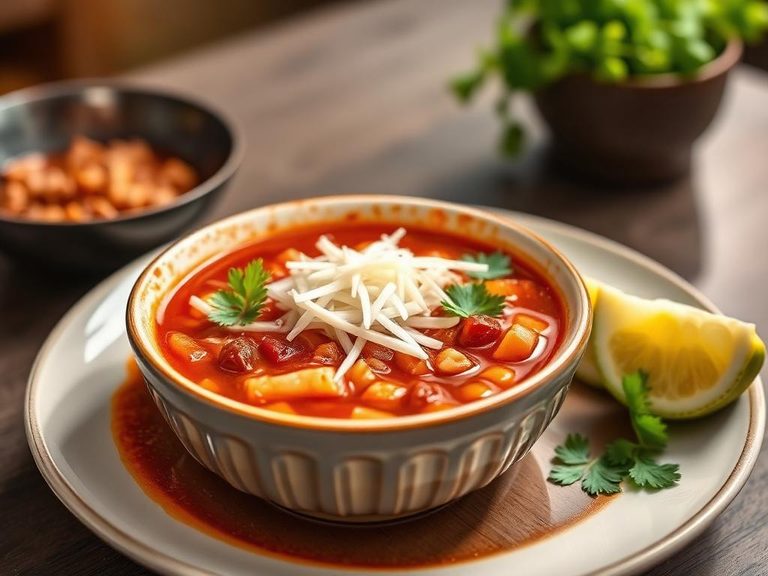
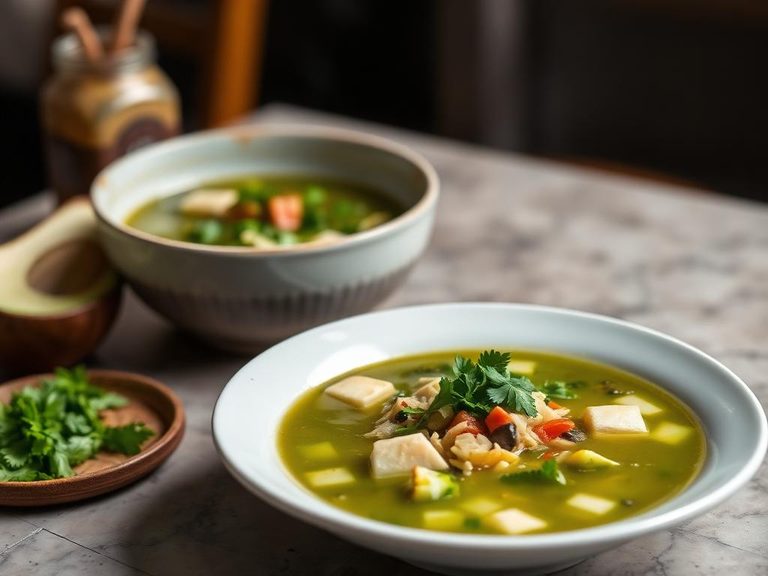
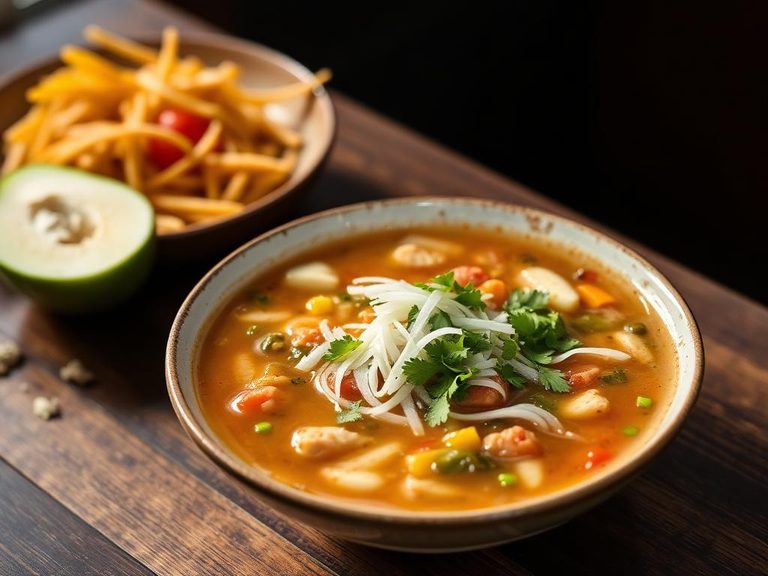
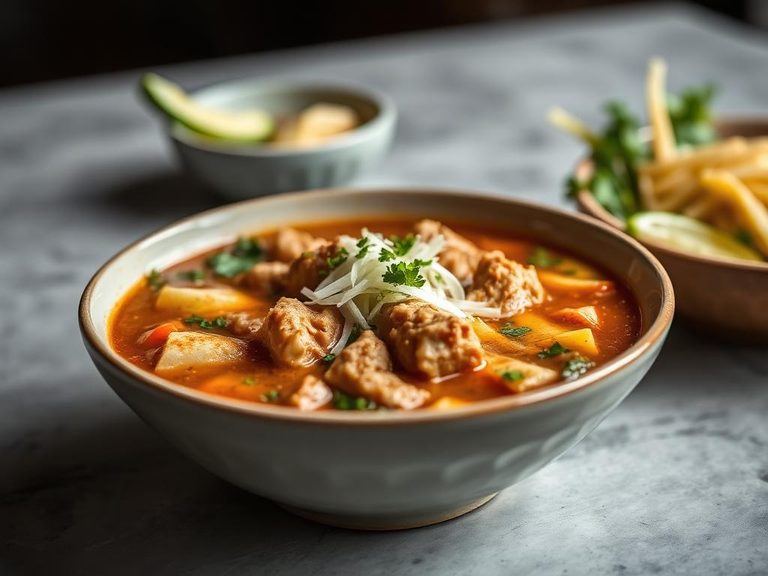
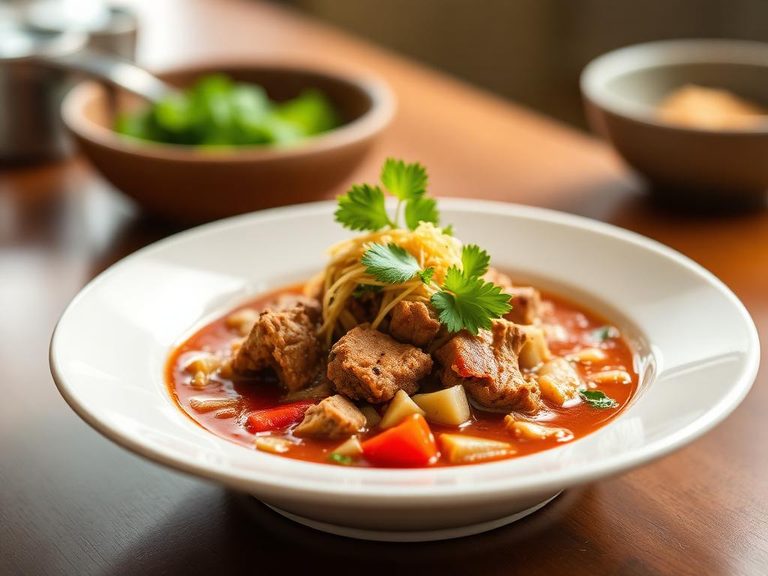
Pozole is a traditional Mexican hominy soup, featuring a rich, savory broth with tender corn kernels (hominy) and typically pork or chicken. Its texture is uniquely satisfying, with the plump, chewy hominy contrasting with the tender meat and a flavorful, often chili-infused broth. Nutritionally, it is a light yet filling option, providing a good balance of protein and carbohydrates with minimal fat.
Calorie split: 31% protein · 43% carbs · 26% fat
↓ Full nutrition💚 Why it's loved
People love pozole for its deep, comforting flavor and its central role in Mexican celebrations and family gatherings, making it a dish rich in both taste and cultural significance. Its versatility allows for many regional variations and personal touches in toppings.
⚠️ Watch-outs & how to enjoy it better
Pozole can be high in sodium from the broth and added seasonings, which may be a concern for those monitoring salt intake. To counteract this, use low-sodium broth, limit added salt, and balance the meal with fresh, low-sodium toppings like lime, radish, and lettuce.
Key benefits
- High in protein from traditional meat additions
- Good source of complex carbohydrates from hominy
- Low in fat, especially in broth-based preparations
- Contains dietary fiber from hominy and vegetables
- Often includes vitamins from added herbs and vegetables
🍽️ Popular dishes
🌍 Where it's eaten
💡 Did you know?
The word 'pozole' comes from the Nahuatl word 'pozolli,' meaning 'foamy,' referring to the froth that forms on the surface when hominy is cooked.
Full nutrition (USDA data · scales with serving)
| Water | 90.0 g |
| Energy | 43.0 kcal |
| Protein | 3.4 g |
| Total lipid (fat) | 1.2 g |
| Carbohydrate, by difference | 4.6 g |
| Fiber, total dietary | 0.90 g |
| Total Sugars | 0.98 g |
| Calcium, Ca | 10.0 mg |
| Iron, Fe | 0.26 mg |
| Magnesium, Mg | 10.0 mg |
| Phosphorus, P | 39.0 mg |
| Potassium, K | 103 mg |
| Sodium, Na | 248 mg |
| Zinc, Zn | 0.37 mg |
| Copper, Cu | 0.03 mg |
| Selenium, Se | 3.4 ug |
| Vitamin C, total ascorbic acid | 3.7 mg |
| Thiamin | 0.02 mg |
| Riboflavin | 0.03 mg |
| Niacin | 0.96 mg |
| Vitamin B-6 | 0.10 mg |
| Folate, total | 7.0 ug |
| Folic acid | 0.00 ug |
| Folate, food | 7.0 ug |
| Folate, DFE | 7.0 ug |
| Choline, total | 12.4 mg |
| Vitamin B-12 | 0.03 ug |
| Vitamin B-12, added | 0.00 ug |
| Vitamin A, RAE | 28.0 ug |
| Retinol | 1.0 ug |
| Carotene, beta | 275 ug |
| Carotene, alpha | 91.0 ug |
| Cryptoxanthin, beta | 2.0 ug |
| Lycopene | 114 ug |
| Lutein + zeaxanthin | 141 ug |
| Vitamin E (alpha-tocopherol) | 0.17 mg |
| Vitamin E, added | 0.00 mg |
| Vitamin D (D2 + D3) | 0.00 ug |
| Vitamin K (phylloquinone) | 7.7 ug |
| Alcohol, ethyl | 0.00 g |
| Caffeine | 0.00 mg |
| Theobromine | 0.00 mg |
Fat & fatty acid profile (per 100g)
| Fatty acids, total saturated | 0.28 g |
| SFA 4:0 | 0.00 g |
| SFA 6:0 | 0.00 g |
| SFA 8:0 | 0.00 g |
| SFA 10:0 | 0.00 g |
| SFA 12:0 | 0.00 g |
| SFA 14:0 | 0.01 g |
| SFA 16:0 | 0.21 g |
| SFA 18:0 | 0.05 g |
| Fatty acids, total monounsaturated | 0.47 g |
| MUFA 16:1 | 0.04 g |
| MUFA 18:1 | 0.42 g |
| MUFA 20:1 | 0.01 g |
| MUFA 22:1 | 0.00 g |
| Fatty acids, total polyunsaturated | 0.35 g |
| PUFA 18:2 | 0.31 g |
| PUFA 18:3 | 0.03 g |
| PUFA 18:4 | 0.00 g |
| PUFA 20:4 | 0.01 g |
| PUFA 20:5 n-3 (EPA) | 0.00 g |
| PUFA 22:5 n-3 (DPA) | 0.00 g |
| PUFA 22:6 n-3 (DHA) | 0.00 g |
| Cholesterol | 12.0 mg |
Amino acid profile (per 100g)
Estimated from Restaurant, Latino, black bean soup — USDA does not publish this profile for Soup.
| Tryptophan | 0.04 g |
| Threonine | 0.17 g |
| Isoleucine | 0.16 g |
| Leucine | 0.32 g |
| Lysine | 0.27 g |
| Methionine | 0.10 g |
| Cystine | 0.04 g |
| Phenylalanine | 0.16 g |
| Tyrosine | 0.13 g |
| Valine | 0.20 g |
| Arginine | 0.35 g |
| Histidine | 0.09 g |
| Alanine | 0.35 g |
| Aspartic acid | 0.38 g |
| Glutamic acid | 0.72 g |
| Glycine | 0.58 g |
| Proline | 0.36 g |
| Serine | 0.20 g |
FAQ
What is hominy?
Hominy is corn that has been treated with an alkali in a process called nixtamalization, which removes the hull and germ, giving it a distinctive puffy texture and enhanced nutritional profile.
Is pozole gluten-free?
Traditional pozole is gluten-free as it is made with corn (hominy) and meat, but always check for cross-contamination or added thickeners if you have celiac disease.
Can pozole be made vegetarian?
Yes, pozole can be made vegetarian by using vegetable broth and omitting meat, often adding beans or extra vegetables for substance.
Nutrient density (calculated · NRF9.3)
Nutrient Rich Foods index: beneficial nutrients (protein, fiber, vitamins, minerals) minus saturated fat, added sugar & sodium, per 100 kcal.
NRF9.3 index — Fulgoni, Keast & Drewnowski, 2009. Computed from USDA nutrients.
Weight-loss friendliness (composite index)
Energy density 0.43 kcal/g · 31% calories from protein · 0.9 g fiber · 1.0 g sugar per 100 g.
Composite of energy density (Rolls et al., 1999), protein & fiber satiety, minus sugar. A calculated heuristic — ranks satiety-per-calorie, not a clinical measure.
Dietary load (calculated from USDA values)
Potential renal acid load. Positive = acid-forming, negative = alkaline-forming.
Sodium-to-potassium ratio: 2.41 (lower is better — aim for ≤ 1)
Sodium:potassium per WHO potassium guidance. Computed from USDA nutrients.