

Soup, miso or tofu
Common food

Photo: Wikipedia
Miso soup is a savory, cloudy Japanese broth made from fermented soybean paste (miso) dissolved in dashi stock, often containing small cubes of silken tofu and seaweed. It has a deeply umami, salty, and slightly sweet flavor with a light, watery texture punctuated by soft tofu. Nutritionally, it's a low-calorie, plant-based source of protein and probiotics from fermentation.
Calorie split: 34% protein · 36% carbs · 30% fat
↓ Full nutrition💚 Why it's loved
People love it for its comforting, umami-rich warmth that serves as a perfect starter or light meal, and its deep roots in Japanese cuisine and culture, symbolizing simplicity and nourishment.
⚠️ Watch-outs & how to enjoy it better
It can be high in sodium, which may be a concern for those with high blood pressure, and miso contains soy, a common allergen. To counteract, use low-sodium miso, add extra water to dilute, and pair it with unsalted sides like plain rice or steamed vegetables.
Key benefits
- Rich in probiotics from fermented miso paste
- Good source of plant-based protein from tofu and miso
- Low in calories and fat, suitable for weight management
- Contains essential minerals like manganese and zinc
- May support gut health and digestion
🍽️ Popular dishes
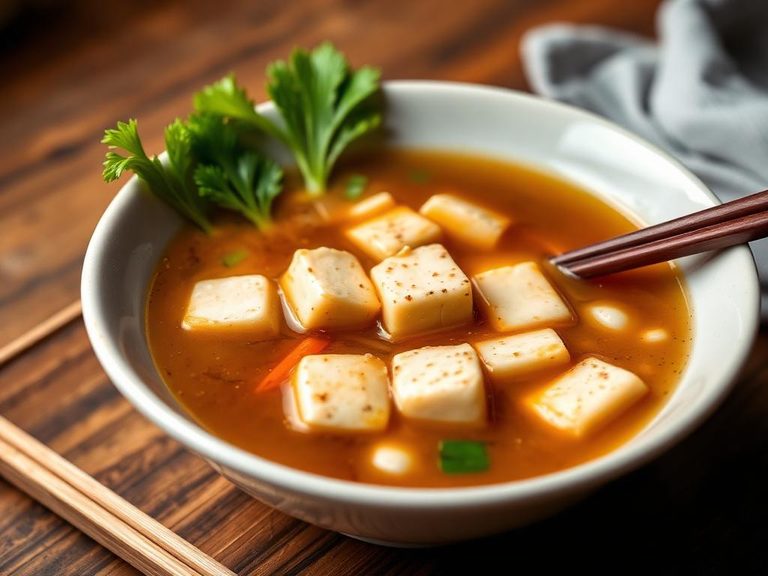
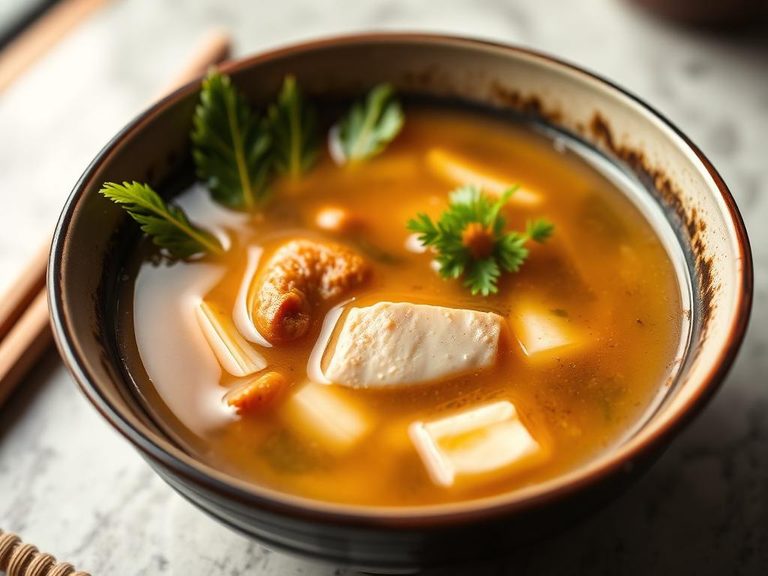
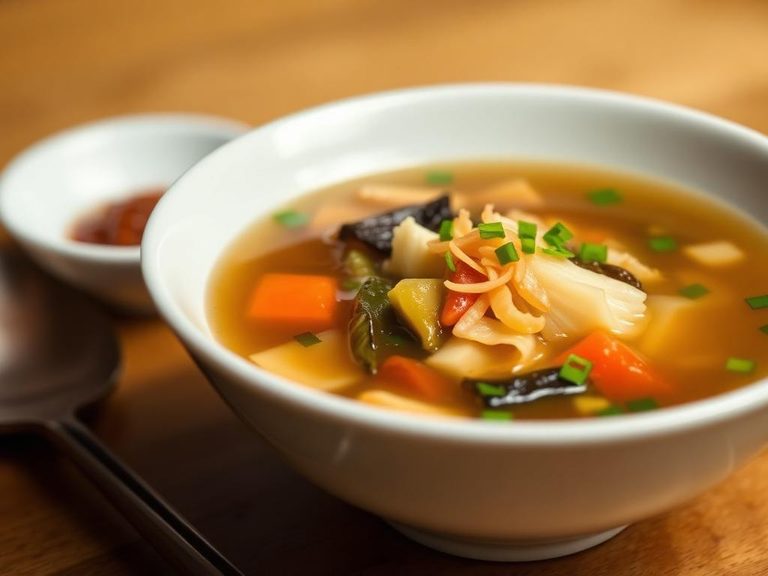
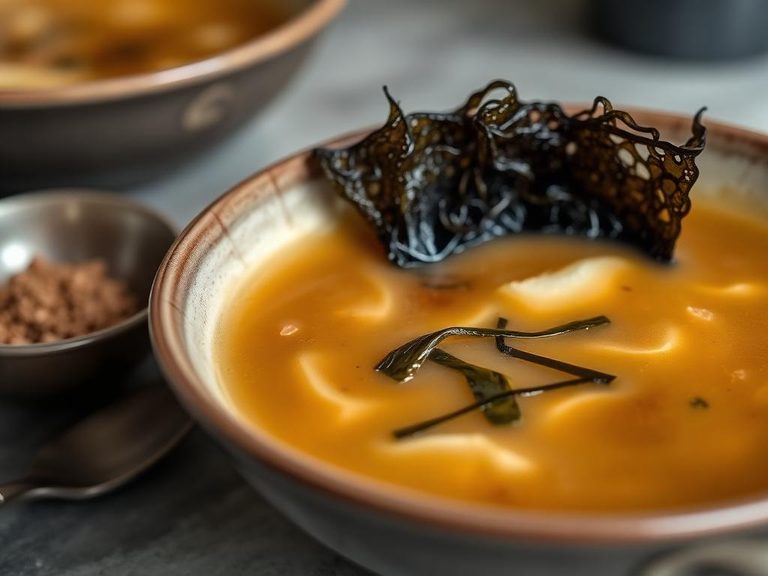
🌍 Where it's eaten
💡 Did you know?
Traditional miso soup is never boiled after adding the miso paste, as high heat kills the beneficial probiotics and alters the delicate flavor.
Full nutrition (USDA data · scales with serving)
| Water | 93.1 g |
| Energy | 24.0 kcal |
| Protein | 2.2 g |
| Total lipid (fat) | 0.85 g |
| Carbohydrate, by difference | 2.3 g |
| Fiber, total dietary | 0.60 g |
| Total Sugars | 0.77 g |
| Calcium, Ca | 25.0 mg |
| Iron, Fe | 0.47 mg |
| Magnesium, Mg | 8.0 mg |
| Phosphorus, P | 27.0 mg |
| Potassium, K | 77.0 mg |
| Sodium, Na | 467 mg |
| Zinc, Zn | 0.26 mg |
| Copper, Cu | 0.05 mg |
| Selenium, Se | 1.7 ug |
| Vitamin C, total ascorbic acid | 1.9 mg |
| Thiamin | 0.02 mg |
| Riboflavin | 0.05 mg |
| Niacin | 0.53 mg |
| Vitamin B-6 | 0.03 mg |
| Folate, total | 12.0 ug |
| Folic acid | 0.00 ug |
| Folate, food | 12.0 ug |
| Folate, DFE | 12.0 ug |
| Choline, total | 8.4 mg |
| Vitamin B-12 | 0.04 ug |
| Vitamin B-12, added | 0.00 ug |
| Vitamin A, RAE | 5.0 ug |
| Retinol | 0.00 ug |
| Carotene, beta | 63.0 ug |
| Carotene, alpha | 0.00 ug |
| Cryptoxanthin, beta | 0.00 ug |
| Lycopene | 0.00 ug |
| Lutein + zeaxanthin | 114 ug |
| Vitamin E (alpha-tocopherol) | 0.07 mg |
| Vitamin E, added | 0.00 mg |
| Vitamin D (D2 + D3) | 0.00 ug |
| Vitamin K (phylloquinone) | 22.4 ug |
| Alcohol, ethyl | 0.00 g |
| Caffeine | 0.00 mg |
| Theobromine | 0.00 mg |
Fat & fatty acid profile (per 100g)
| Fatty acids, total saturated | 0.15 g |
| SFA 4:0 | 0.00 g |
| SFA 6:0 | 0.00 g |
| SFA 8:0 | 0.00 g |
| SFA 10:0 | 0.00 g |
| SFA 12:0 | 0.00 g |
| SFA 14:0 | 0.01 g |
| SFA 16:0 | 0.10 g |
| SFA 18:0 | 0.04 g |
| Fatty acids, total monounsaturated | 0.18 g |
| MUFA 16:1 | 0.01 g |
| MUFA 18:1 | 0.17 g |
| MUFA 20:1 | 0.00 g |
| MUFA 22:1 | 0.00 g |
| Fatty acids, total polyunsaturated | 0.37 g |
| PUFA 18:2 | 0.32 g |
| PUFA 18:3 | 0.04 g |
| PUFA 18:4 | 0.00 g |
| PUFA 20:4 | 0.00 g |
| PUFA 20:5 n-3 (EPA) | 0.00 g |
| PUFA 22:5 n-3 (DPA) | 0.00 g |
| PUFA 22:6 n-3 (DHA) | 0.00 g |
| Cholesterol | 1.0 mg |
Amino acid profile (per 100g)
Estimated from Restaurant, Latino, black bean soup — USDA does not publish this profile for Soup.
| Tryptophan | 0.04 g |
| Threonine | 0.17 g |
| Isoleucine | 0.16 g |
| Leucine | 0.32 g |
| Lysine | 0.27 g |
| Methionine | 0.10 g |
| Cystine | 0.04 g |
| Phenylalanine | 0.16 g |
| Tyrosine | 0.13 g |
| Valine | 0.20 g |
| Arginine | 0.35 g |
| Histidine | 0.09 g |
| Alanine | 0.35 g |
| Aspartic acid | 0.38 g |
| Glutamic acid | 0.72 g |
| Glycine | 0.58 g |
| Proline | 0.36 g |
| Serine | 0.20 g |
FAQ
Is miso soup vegan?
It can be, but traditional dashi stock often contains bonito (fish flakes). For a vegan version, use kombu (kelp) and shiitake mushroom dashi.
Can I reheat miso soup?
Yes, but gently. Avoid boiling it, especially after adding fresh miso paste, to preserve its probiotic benefits and nuanced flavor.
What is the white stuff in miso soup?
The cloudy white substance is the miso paste itself, which is a fermented mixture of soybeans, salt, and a koji culture (usually from rice or barley).
Nutrient density (calculated · NRF9.3)
Nutrient Rich Foods index: beneficial nutrients (protein, fiber, vitamins, minerals) minus saturated fat, added sugar & sodium, per 100 kcal.
NRF9.3 index — Fulgoni, Keast & Drewnowski, 2009. Computed from USDA nutrients.
Weight-loss friendliness (composite index)
Energy density 0.24 kcal/g · 37% calories from protein · 0.6 g fiber · 0.8 g sugar per 100 g.
Composite of energy density (Rolls et al., 1999), protein & fiber satiety, minus sugar. A calculated heuristic — ranks satiety-per-calorie, not a clinical measure.
Dietary load (calculated from USDA values)
Potential renal acid load. Positive = acid-forming, negative = alkaline-forming.
Sodium-to-potassium ratio: 6.06 (lower is better — aim for ≤ 1)
Sodium:potassium per WHO potassium guidance. Computed from USDA nutrients.