

Soup, hot and sour
Common food

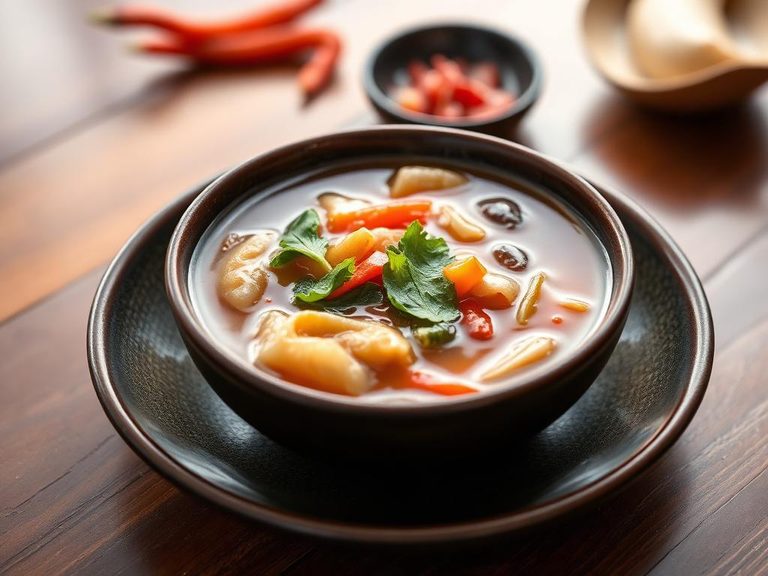
Photo: Wikipedia
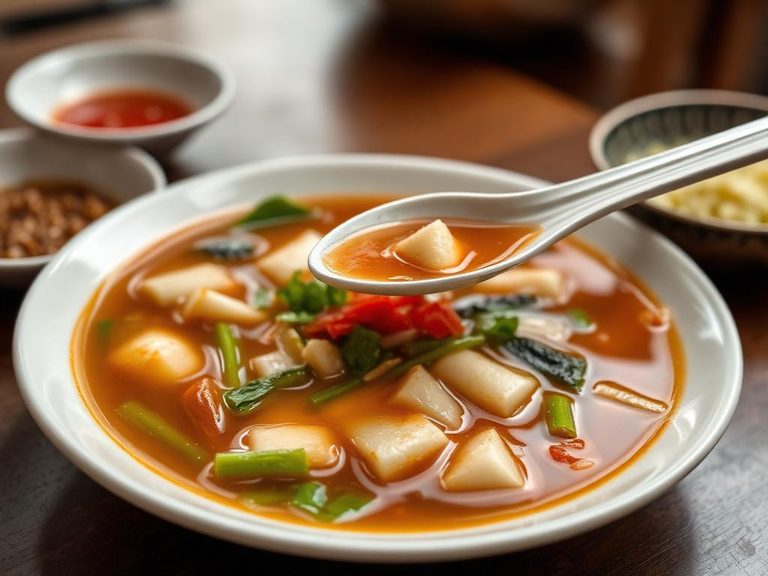
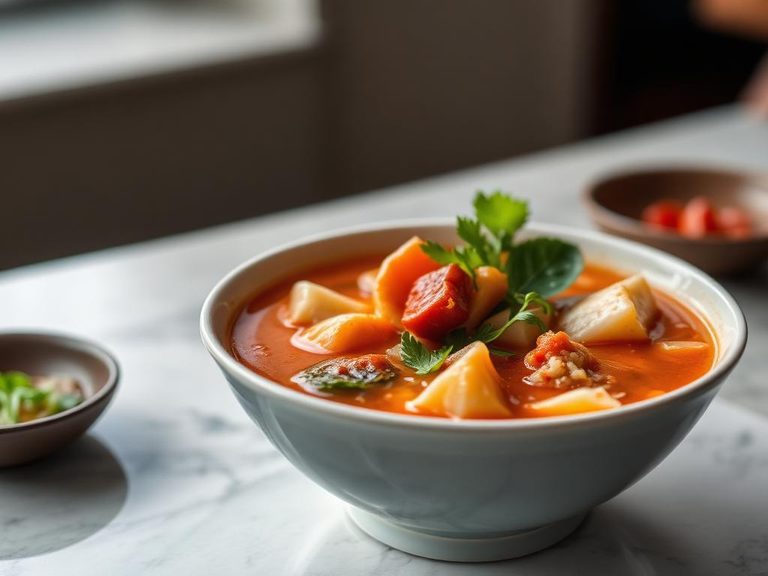
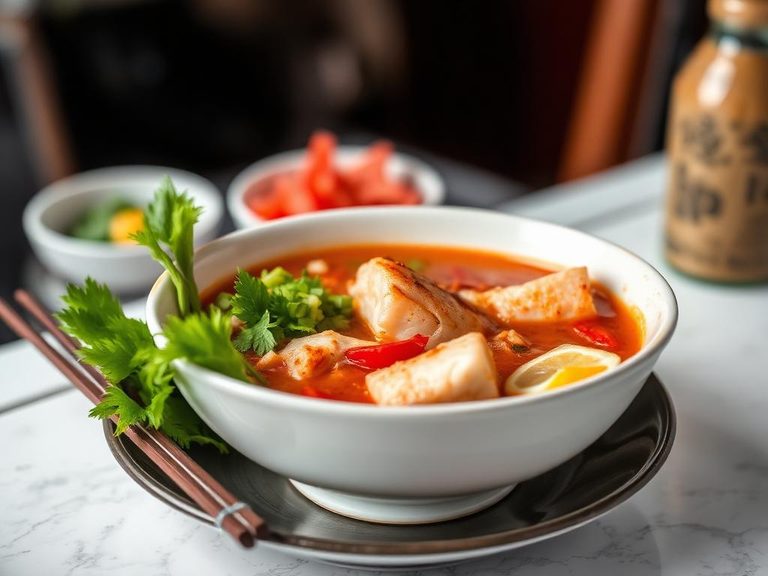
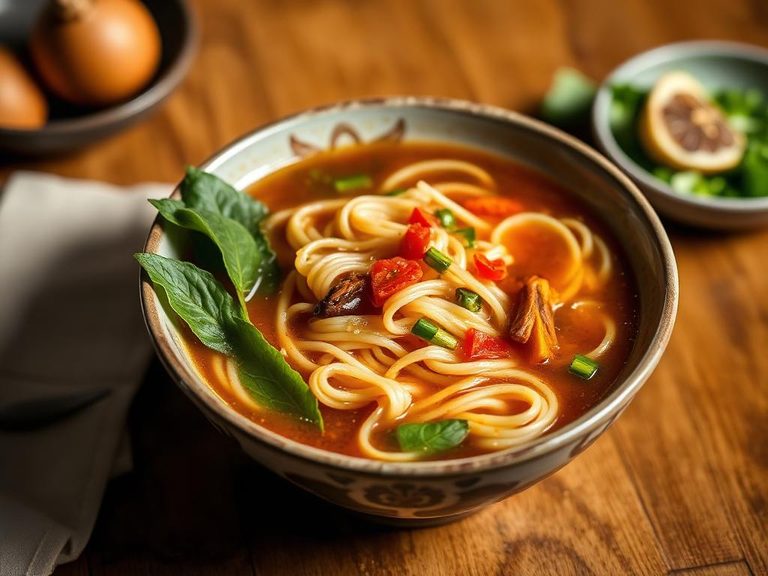
Hot and sour soup is a classic Chinese broth that masterfully balances fiery chili heat with a sharp, tangy vinegar kick. Its silky, slightly thickened texture comes from a cornstarch slurry, often studded with tofu, wood ear mushrooms, and bamboo shoots. Nutritionally, it's a light yet flavorful starter, delivering a modest 39 calories per 100g with a decent protein punch from its tofu and egg components.
Calorie split: 27% protein · 45% carbs · 28% fat
↓ Full nutrition💚 Why it's loved
People adore it for the intense, complex flavor profile that awakens the senses—the perfect interplay of spicy and sour is deeply satisfying. It's also a versatile comfort food, enjoyed as a restorative soup when feeling under the weather or as a robust appetizer in a feast.
⚠️ Watch-outs & how to enjoy it better
The primary concern is its typically high sodium content from soy sauce and broth, which can be problematic for those managing blood pressure. The vinegar's acidity may also aggravate acid reflux or sensitive stomachs. To counteract sodium, opt for a low-sodium soy sauce version and pair it with a low-salt main dish; for acidity, enjoy a smaller portion and avoid consuming it on an empty stomach.
Key benefits
- Low-calorie, flavorful starter or light meal option
- Contains plant-based protein from tofu and eggs
- Capsaicin from chilies may support metabolism
- Vinegar can aid in blood sugar regulation post-meal
- Hydrating broth base with electrolytes from soy sauce
🍽️ Popular dishes
🌍 Where it's eaten
💡 Did you know?
The 'hot' in hot and sour soup traditionally comes from white pepper, not just chilies, which provides a unique, warming heat that's distinct from the sharp burn of fresh peppers.
Full nutrition (USDA data · scales with serving)
| Water | 90.7 g |
| Energy | 39.0 kcal |
| Protein | 2.6 g |
| Total lipid (fat) | 1.2 g |
| Carbohydrate, by difference | 4.3 g |
| Fiber, total dietary | 0.50 g |
| Total Sugars | 0.42 g |
| Calcium, Ca | 19.0 mg |
| Iron, Fe | 0.64 mg |
| Magnesium, Mg | 9.0 mg |
| Phosphorus, P | 32.0 mg |
| Potassium, K | 55.0 mg |
| Sodium, Na | 376 mg |
| Zinc, Zn | 0.22 mg |
| Copper, Cu | 0.03 mg |
| Selenium, Se | 0.40 ug |
| Vitamin C, total ascorbic acid | 0.00 mg |
| Thiamin | 0.03 mg |
| Riboflavin | 0.03 mg |
| Niacin | 0.51 mg |
| Vitamin B-6 | 0.06 mg |
| Folate, total | 8.0 ug |
| Folic acid | 0.00 ug |
| Folate, food | 8.0 ug |
| Folate, DFE | 8.0 ug |
| Choline, total | 39.9 mg |
| Vitamin B-12 | 0.10 ug |
| Vitamin B-12, added | 0.00 ug |
| Vitamin A, RAE | 9.0 ug |
| Retinol | 9.0 ug |
| Carotene, beta | 1.0 ug |
| Carotene, alpha | 0.00 ug |
| Cryptoxanthin, beta | 1.0 ug |
| Lycopene | 0.00 ug |
| Lutein + zeaxanthin | 22.0 ug |
| Vitamin E (alpha-tocopherol) | 0.39 mg |
| Vitamin E, added | 0.00 mg |
| Vitamin D (D2 + D3) | 0.10 ug |
| Vitamin K (phylloquinone) | 1.1 ug |
| Alcohol, ethyl | 0.00 g |
| Caffeine | 0.00 mg |
| Theobromine | 0.00 mg |
Fat & fatty acid profile (per 100g)
| Fatty acids, total saturated | 0.23 g |
| SFA 4:0 | 0.00 g |
| SFA 6:0 | 0.00 g |
| SFA 8:0 | 0.00 g |
| SFA 10:0 | 0.02 g |
| SFA 12:0 | 0.00 g |
| SFA 14:0 | 0.00 g |
| SFA 16:0 | 0.16 g |
| SFA 18:0 | 0.04 g |
| Fatty acids, total monounsaturated | 0.29 g |
| MUFA 16:1 | 0.01 g |
| MUFA 18:1 | 0.27 g |
| MUFA 20:1 | 0.00 g |
| MUFA 22:1 | 0.00 g |
| Fatty acids, total polyunsaturated | 0.31 g |
| PUFA 18:2 | 0.27 g |
| PUFA 18:3 | 0.03 g |
| PUFA 18:4 | 0.00 g |
| PUFA 20:4 | 0.01 g |
| PUFA 20:5 n-3 (EPA) | 0.00 g |
| PUFA 22:5 n-3 (DPA) | 0.00 g |
| PUFA 22:6 n-3 (DHA) | 0.00 g |
| Cholesterol | 21.0 mg |
Amino acid profile (per 100g)
Estimated from Restaurant, Latino, black bean soup — USDA does not publish this profile for Soup.
| Tryptophan | 0.04 g |
| Threonine | 0.17 g |
| Isoleucine | 0.16 g |
| Leucine | 0.32 g |
| Lysine | 0.27 g |
| Methionine | 0.10 g |
| Cystine | 0.04 g |
| Phenylalanine | 0.16 g |
| Tyrosine | 0.13 g |
| Valine | 0.20 g |
| Arginine | 0.35 g |
| Histidine | 0.09 g |
| Alanine | 0.35 g |
| Aspartic acid | 0.38 g |
| Glutamic acid | 0.72 g |
| Glycine | 0.58 g |
| Proline | 0.36 g |
| Serine | 0.20 g |
FAQ
Is hot and sour soup spicy?
Yes, it is characteristically spicy from white pepper and/or chilies, and sour from vinegar. The heat level can vary widely by restaurant or recipe.
What gives it its thick texture?
The classic, slightly viscous texture is achieved by adding a cornstarch slurry (cornstarch mixed with water) to the broth during cooking.
Is it gluten-free?
Not traditionally, as it usually contains soy sauce (which often has wheat) and sometimes wheat starch as a thickener. Gluten-free versions can be made with tamari and cornstarch.
Nutrient density (calculated · NRF9.3)
Nutrient Rich Foods index: beneficial nutrients (protein, fiber, vitamins, minerals) minus saturated fat, added sugar & sodium, per 100 kcal.
NRF9.3 index — Fulgoni, Keast & Drewnowski, 2009. Computed from USDA nutrients.
Weight-loss friendliness (composite index)
Energy density 0.39 kcal/g · 26% calories from protein · 0.5 g fiber · 0.4 g sugar per 100 g.
Composite of energy density (Rolls et al., 1999), protein & fiber satiety, minus sugar. A calculated heuristic — ranks satiety-per-calorie, not a clinical measure.
Dietary load (calculated from USDA values)
Potential renal acid load. Positive = acid-forming, negative = alkaline-forming.
Sodium-to-potassium ratio: 6.84 (lower is better — aim for ≤ 1)
Sodium:potassium per WHO potassium guidance. Computed from USDA nutrients.