

Shrimp and vegetables including carrots, broccoli, and/or dark-green leafy; no potatoes, no sauce
Common food
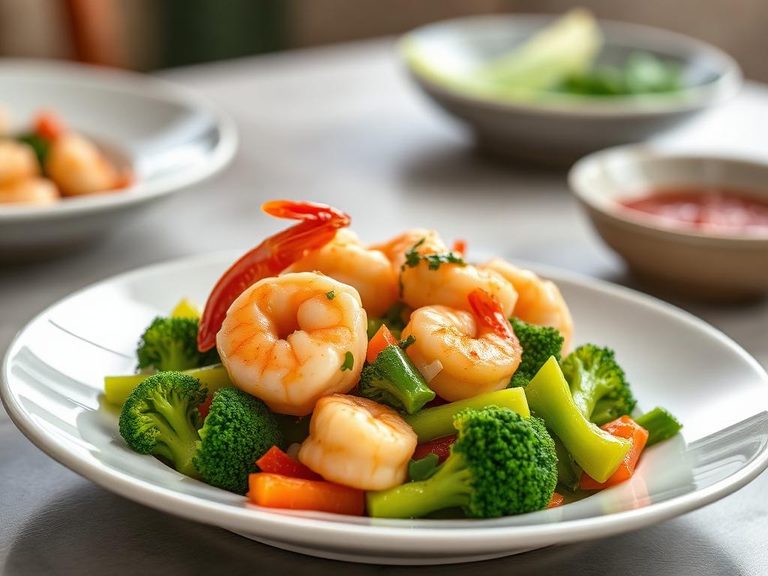
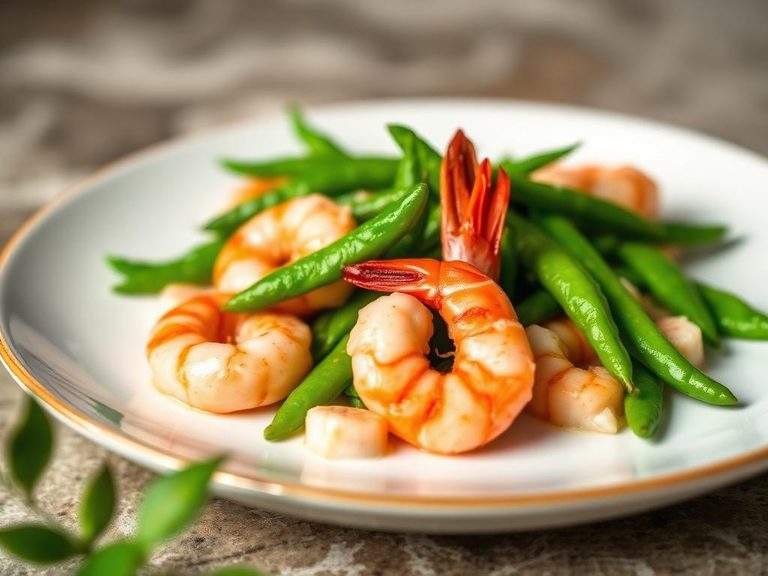
A vibrant stir-fry of succulent shrimp and crisp vegetables, this dish delivers a clean, savory flavor with a satisfying crunch from the broccoli and carrots. At just 118 calories per 100g, it's a protein-packed, low-carb option that feels both light and nourishing. The natural sweetness of the vegetables and the umami of the shrimp shine without any heavy sauces.
Calorie split: 32% protein · 13% carbs · 55% fat
↓ Full nutrition💚 Why it's loved
People love it for its fresh, clean taste and the satisfying contrast between tender shrimp and crisp-tender vegetables. It's incredibly versatile, easily adapting to various cuisines from Chinese stir-fries to Mediterranean sautés.
⚠️ Watch-outs & how to enjoy it better
Shrimp is a common shellfish allergen, and some may find the natural sulfurous notes of broccoli or the slight bitterness of dark greens unappealing. To counteract, ensure thorough cooking to mellow flavors and always check for allergies; pairing with a squeeze of lemon can brighten any residual bitterness.
Key benefits
- High-quality protein supports muscle maintenance.
- Low in carbohydrates, suitable for low-carb diets.
- Rich in fiber from broccoli and leafy greens.
- Good source of vitamins A and C from carrots and broccoli.
- Low-calorie density helps with portion control.
🍽️ Popular dishes
🌍 Where it's eaten
💡 Did you know?
The protein in shrimp is so efficient that it contains all nine essential amino acids and is often used in studies as a benchmark for high-quality protein digestibility.
Full nutrition (USDA data · scales with serving)
| Water | 78.3 g |
| Energy | 118 kcal |
| Protein | 9.3 g |
| Total lipid (fat) | 7.3 g |
| Carbohydrate, by difference | 3.8 g |
| Fiber, total dietary | 1.6 g |
| Total Sugars | 1.4 g |
| Calcium, Ca | 51.0 mg |
| Iron, Fe | 0.41 mg |
| Magnesium, Mg | 20.0 mg |
| Phosphorus, P | 133 mg |
| Potassium, K | 146 mg |
| Sodium, Na | 59.0 mg |
| Zinc, Zn | 0.76 mg |
| Copper, Cu | 0.13 mg |
| Selenium, Se | 18.7 ug |
| Vitamin C, total ascorbic acid | 10.5 mg |
| Thiamin | 0.03 mg |
| Riboflavin | 0.04 mg |
| Niacin | 1.2 mg |
| Vitamin B-6 | 0.14 mg |
| Folate, total | 25.0 ug |
| Folic acid | 0.00 ug |
| Folate, food | 25.0 ug |
| Folate, DFE | 25.0 ug |
| Choline, total | 56.3 mg |
| Vitamin B-12 | 0.62 ug |
| Vitamin B-12, added | 0.00 ug |
| Vitamin A, RAE | 255 ug |
| Retinol | 33.0 ug |
| Carotene, beta | 2173 ug |
| Carotene, alpha | 923 ug |
| Cryptoxanthin, beta | 0.00 ug |
| Lycopene | 0.00 ug |
| Lutein + zeaxanthin | 438 ug |
| Vitamin E (alpha-tocopherol) | 2.6 mg |
| Vitamin E, added | 0.00 mg |
| Vitamin D (D2 + D3) | 0.00 ug |
| Vitamin K (phylloquinone) | 31.7 ug |
| Alcohol, ethyl | 0.00 g |
| Caffeine | 0.00 mg |
| Theobromine | 0.00 mg |
Fat & fatty acid profile (per 100g)
| Fatty acids, total saturated | 1.1 g |
| SFA 4:0 | 0.00 g |
| SFA 6:0 | 0.00 g |
| SFA 8:0 | 0.00 g |
| SFA 10:0 | 0.00 g |
| SFA 12:0 | 0.01 g |
| SFA 14:0 | 0.01 g |
| SFA 16:0 | 0.75 g |
| SFA 18:0 | 0.24 g |
| Fatty acids, total monounsaturated | 2.9 g |
| MUFA 16:1 | 0.04 g |
| MUFA 18:1 | 2.7 g |
| MUFA 20:1 | 0.05 g |
| MUFA 22:1 | 0.00 g |
| Fatty acids, total polyunsaturated | 2.8 g |
| PUFA 18:2 | 2.3 g |
| PUFA 18:3 | 0.31 g |
| PUFA 18:4 | 0.00 g |
| PUFA 20:4 | 0.03 g |
| PUFA 20:5 n-3 (EPA) | 0.05 g |
| PUFA 22:5 n-3 (DPA) | 0.00 g |
| PUFA 22:6 n-3 (DHA) | 0.05 g |
| Cholesterol | 78.0 mg |
Amino acid profile (per 100g)
Estimated from Restaurant, Chinese, shrimp and vegetables — USDA does not publish this profile for Shrimp and vegetables including carrots.
| Tryptophan | 0.06 g |
| Threonine | 0.21 g |
| Isoleucine | 0.22 g |
| Leucine | 0.40 g |
| Lysine | 0.43 g |
| Methionine | 0.15 g |
| Cystine | 0.06 g |
| Phenylalanine | 0.21 g |
| Tyrosine | 0.18 g |
| Valine | 0.24 g |
| Arginine | 0.47 g |
| Histidine | 0.12 g |
| Alanine | 0.31 g |
| Aspartic acid | 0.59 g |
| Glutamic acid | 1.2 g |
| Glycine | 0.29 g |
| Proline | 0.25 g |
| Serine | 0.22 g |
FAQ
Is this dish suitable for a keto diet?
Yes, with 3.8g of carbs per 100g (and 1.6g fiber), it fits well within keto macros, especially when avoiding sugary sauces.
How can I reduce the 'fishy' taste of the shrimp?
Marinate briefly in lemon juice or vinegar before cooking, and ensure it's fresh. Cooking with aromatics like garlic and ginger also helps mask any strong seafood notes.
Are the nutrients in the vegetables lost if overcooked?
Some heat-sensitive vitamins like vitamin C can degrade, but cooking also makes other nutrients like beta-carotene in carrots more bioavailable. Aim for crisp-tender texture to balance both.
Nutrient density (calculated · NRF9.3)
Nutrient Rich Foods index: beneficial nutrients (protein, fiber, vitamins, minerals) minus saturated fat, added sugar & sodium, per 100 kcal.
NRF9.3 index — Fulgoni, Keast & Drewnowski, 2009. Computed from USDA nutrients.
Weight-loss friendliness (composite index)
Energy density 1.18 kcal/g · 32% calories from protein · 1.6 g fiber · 1.4 g sugar per 100 g.
Composite of energy density (Rolls et al., 1999), protein & fiber satiety, minus sugar. A calculated heuristic — ranks satiety-per-calorie, not a clinical measure.
Dietary load (calculated from USDA values)
Potential renal acid load. Positive = acid-forming, negative = alkaline-forming.
Sodium-to-potassium ratio: 0.40 (lower is better — aim for ≤ 1)
Sodium:potassium per WHO potassium guidance. Computed from USDA nutrients.