

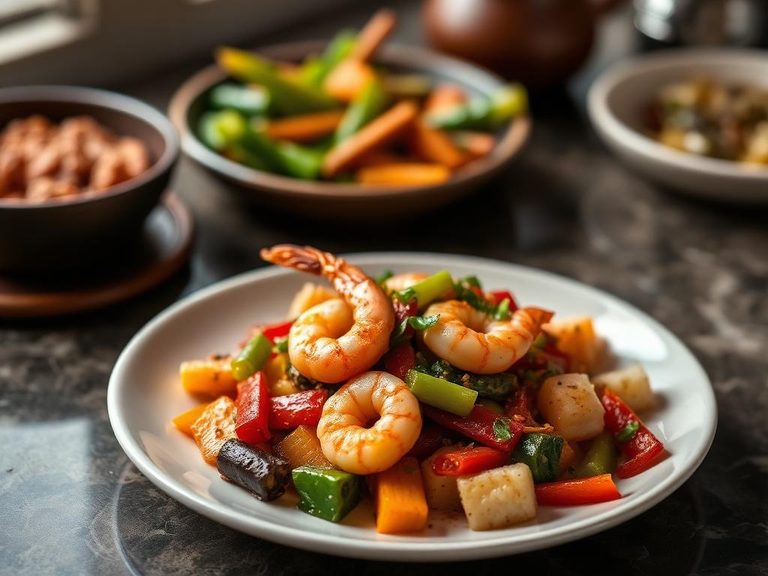
Shrimp and vegetables including carrots, broccoli, and/or dark-green leafy; no potatoes, soy-based sauce
Common food
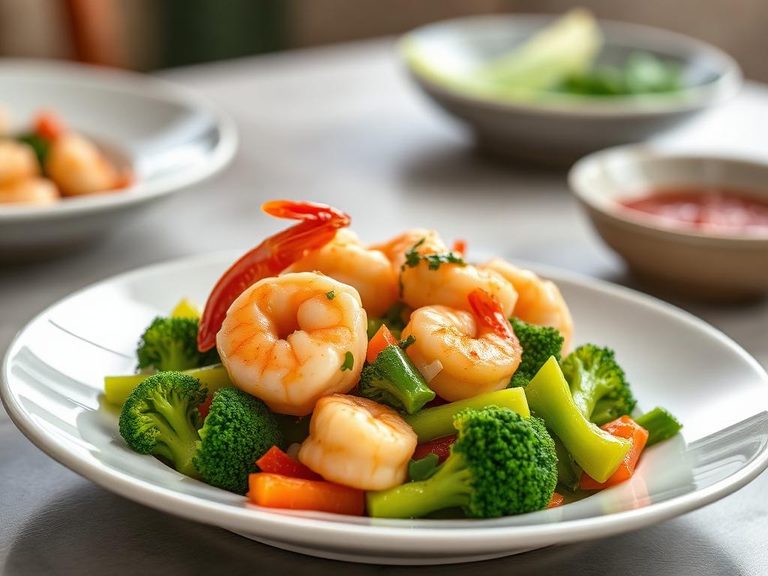
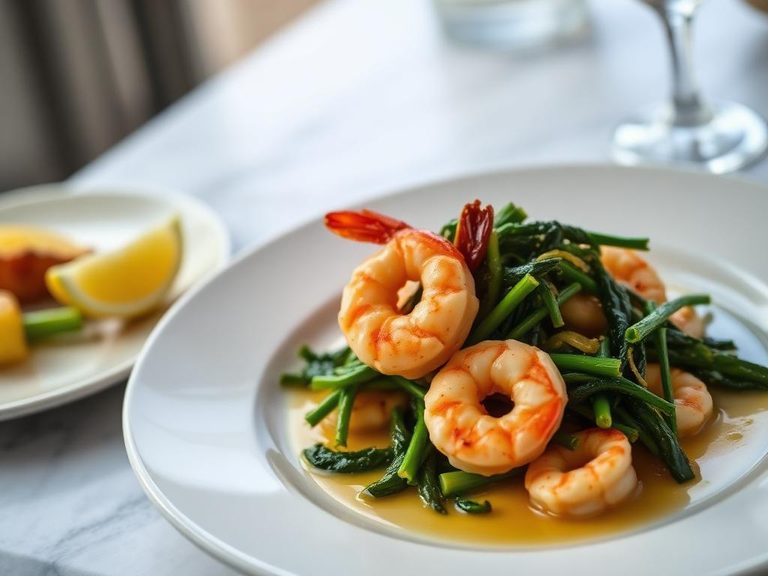
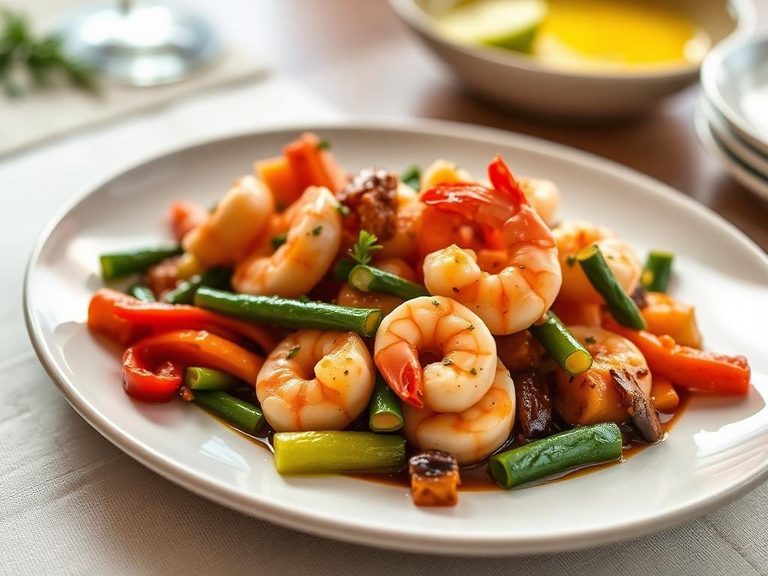
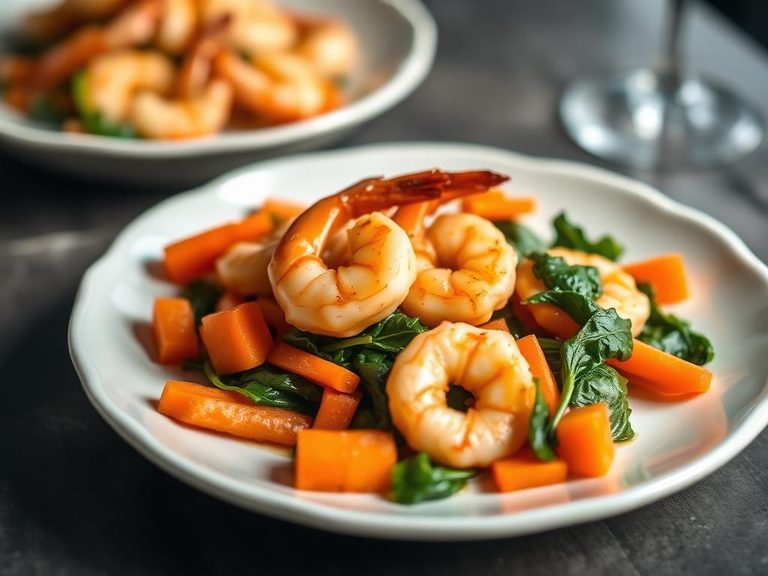
A vibrant, light stir-fry or sauté where sweet, plump shrimp mingle with the crisp snap of broccoli, the earthy sweetness of carrots, and the tender bite of dark greens. The dish is defined by its clean, savory flavors and a satisfying contrast of textures, with the shrimp providing a protein-rich base. It's a nutritionally dense, low-calorie option that delivers a solid protein punch with minimal carbs and healthy fats.
Calorie split: 32% protein · 18% carbs · 50% fat
↓ Full nutrition💚 Why it's loved
People love this combination for its quick cooking time, fresh flavors, and remarkable versatility—it can be adapted to almost any cuisine with a simple change of seasoning. It's a go-to for health-conscious eaters who don't want to sacrifice taste or texture for a nutritious meal.
⚠️ Watch-outs & how to enjoy it better
Shrimp is a common allergen, and the dish can be high in sodium if prepared with salty sauces or broths. To counteract this, use low-sodium soy sauce alternatives (like coconut aminos) or season with herbs, garlic, and ginger instead. If concerned about cholesterol, enjoy in moderation and pair with high-fiber vegetables to help manage absorption.
Key benefits
- High protein-to-calorie ratio supports muscle maintenance and satiety.
- Rich in fiber and micronutrients like vitamin A (from carrots) and vitamin K (from greens).
- Low in sugar and carbohydrates, making it suitable for low-carb or blood-sugar-conscious diets.
- Contains healthy unsaturated fats from cooking oil and shrimp.
🍽️ Popular dishes
🌍 Where it's eaten
💡 Did you know?
Shrimp are one of the most sustainably farmed seafoods, with some farms producing shrimp in closed-loop systems that recycle water and reduce environmental impact.
Full nutrition (USDA data · scales with serving)
| Water | 77.6 g |
| Energy | 116 kcal |
| Protein | 9.2 g |
| Total lipid (fat) | 6.4 g |
| Carbohydrate, by difference | 5.2 g |
| Fiber, total dietary | 1.2 g |
| Total Sugars | 1.5 g |
| Calcium, Ca | 54.0 mg |
| Iron, Fe | 0.46 mg |
| Magnesium, Mg | 24.0 mg |
| Phosphorus, P | 140 mg |
| Potassium, K | 217 mg |
| Sodium, Na | 247 mg |
| Zinc, Zn | 0.75 mg |
| Copper, Cu | 0.13 mg |
| Selenium, Se | 17.5 ug |
| Vitamin C, total ascorbic acid | 14.7 mg |
| Thiamin | 0.05 mg |
| Riboflavin | 0.06 mg |
| Niacin | 1.4 mg |
| Vitamin B-6 | 0.18 mg |
| Folate, total | 24.0 ug |
| Folic acid | 0.00 ug |
| Folate, food | 24.0 ug |
| Folate, DFE | 24.0 ug |
| Choline, total | 53.3 mg |
| Vitamin B-12 | 0.65 ug |
| Vitamin B-12, added | 0.00 ug |
| Vitamin A, RAE | 166 ug |
| Retinol | 31.0 ug |
| Carotene, beta | 1328 ug |
| Carotene, alpha | 584 ug |
| Cryptoxanthin, beta | 0.00 ug |
| Lycopene | 0.00 ug |
| Lutein + zeaxanthin | 270 ug |
| Vitamin E (alpha-tocopherol) | 2.0 mg |
| Vitamin E, added | 0.00 mg |
| Vitamin D (D2 + D3) | 0.00 ug |
| Vitamin K (phylloquinone) | 34.3 ug |
| Alcohol, ethyl | 0.00 g |
| Caffeine | 0.00 mg |
| Theobromine | 0.00 mg |
Fat & fatty acid profile (per 100g)
| Fatty acids, total saturated | 0.97 g |
| SFA 4:0 | 0.00 g |
| SFA 6:0 | 0.00 g |
| SFA 8:0 | 0.00 g |
| SFA 10:0 | 0.00 g |
| SFA 12:0 | 0.00 g |
| SFA 14:0 | 0.01 g |
| SFA 16:0 | 0.67 g |
| SFA 18:0 | 0.22 g |
| Fatty acids, total monounsaturated | 2.5 g |
| MUFA 16:1 | 0.04 g |
| MUFA 18:1 | 2.4 g |
| MUFA 20:1 | 0.04 g |
| MUFA 22:1 | 0.00 g |
| Fatty acids, total polyunsaturated | 2.4 g |
| PUFA 18:2 | 2.0 g |
| PUFA 18:3 | 0.25 g |
| PUFA 18:4 | 0.00 g |
| PUFA 20:4 | 0.02 g |
| PUFA 20:5 n-3 (EPA) | 0.05 g |
| PUFA 22:5 n-3 (DPA) | 0.01 g |
| PUFA 22:6 n-3 (DHA) | 0.05 g |
| Cholesterol | 72.0 mg |
Amino acid profile (per 100g)
Estimated from Restaurant, Chinese, shrimp and vegetables — USDA does not publish this profile for Shrimp and vegetables including carrots.
| Tryptophan | 0.06 g |
| Threonine | 0.21 g |
| Isoleucine | 0.22 g |
| Leucine | 0.40 g |
| Lysine | 0.43 g |
| Methionine | 0.15 g |
| Cystine | 0.06 g |
| Phenylalanine | 0.21 g |
| Tyrosine | 0.18 g |
| Valine | 0.24 g |
| Arginine | 0.47 g |
| Histidine | 0.12 g |
| Alanine | 0.31 g |
| Aspartic acid | 0.59 g |
| Glutamic acid | 1.2 g |
| Glycine | 0.29 g |
| Proline | 0.25 g |
| Serine | 0.22 g |
FAQ
Is this dish suitable for a low-carb diet?
Yes, with only 5.15g of carbs per 100g, it's an excellent low-carb option, especially if you avoid starchy vegetables like potatoes.
Can I make this dish ahead of time?
Absolutely. It stores well in the fridge for 2-3 days, though the vegetables may lose some crispness. Reheat gently to preserve texture.
What's the best way to cook the shrimp to keep them tender?
Cook shrimp quickly over high heat until they just turn pink and opaque. Overcooking makes them rubbery; remove them from the pan as soon as they're done.
Nutrient density (calculated · NRF9.3)
Nutrient Rich Foods index: beneficial nutrients (protein, fiber, vitamins, minerals) minus saturated fat, added sugar & sodium, per 100 kcal.
NRF9.3 index — Fulgoni, Keast & Drewnowski, 2009. Computed from USDA nutrients.
Weight-loss friendliness (composite index)
Energy density 1.16 kcal/g · 32% calories from protein · 1.2 g fiber · 1.5 g sugar per 100 g.
Composite of energy density (Rolls et al., 1999), protein & fiber satiety, minus sugar. A calculated heuristic — ranks satiety-per-calorie, not a clinical measure.
Dietary load (calculated from USDA values)
Potential renal acid load. Positive = acid-forming, negative = alkaline-forming.
Sodium-to-potassium ratio: 1.14 (lower is better — aim for ≤ 1)
Sodium:potassium per WHO potassium guidance. Computed from USDA nutrients.