

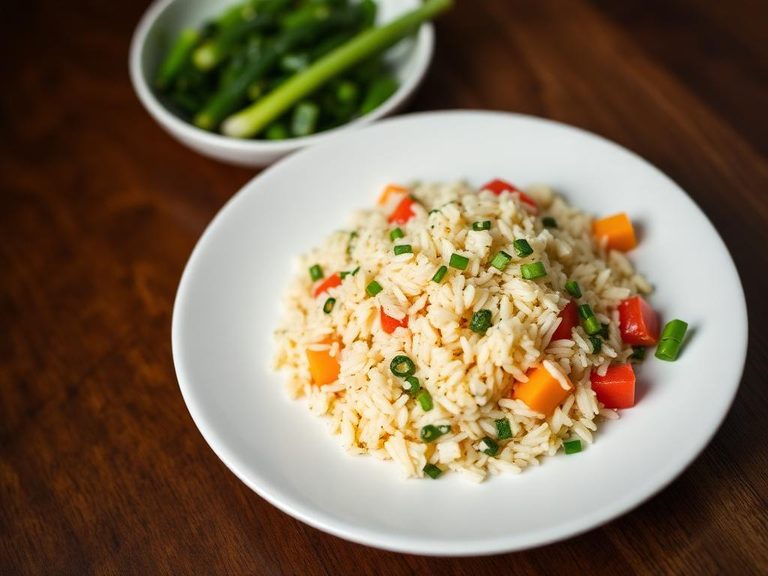
Rice, white, with vegetables, soy-based sauce, NS as to fat
Common food
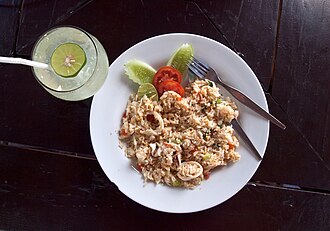
Photo: Wikipedia
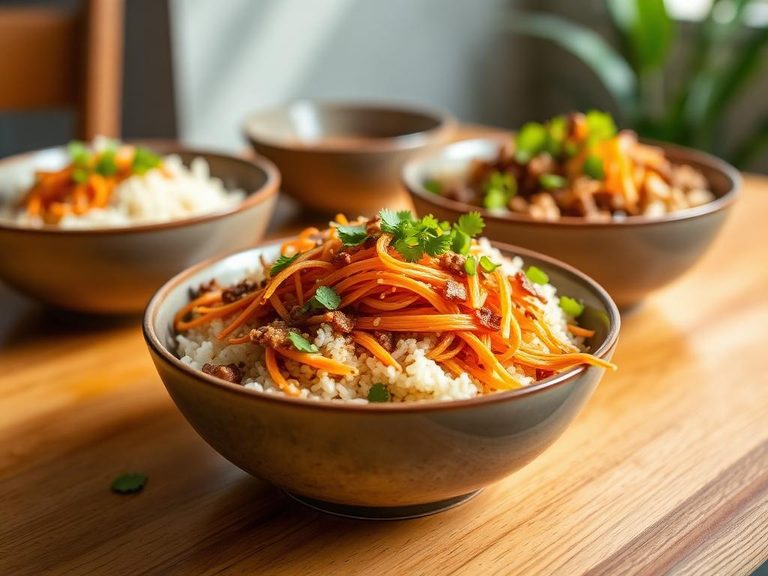
This is a savory, stir-fried or tossed dish of white rice mixed with small vegetable pieces and a soy-based sauce, offering a soft, slightly chewy texture with a salty, umami-rich flavor profile. Nutritionally, it is a moderate-energy, carbohydrate-dominant food with a low fat content, making it a light yet filling option. The dish's simplicity and familiar taste make it a staple in many households and quick-service settings.
Calorie split: 8% protein · 76% carbs · 15% fat
↓ Full nutrition💚 Why it's loved
People love it for its comforting, savory umami flavor from the soy sauce and the satisfying, soft texture of the rice, which pairs well with a wide variety of main dishes. Its cultural familiarity and ease of preparation make it a go-to comfort food across many Asian-inspired cuisines.
⚠️ Watch-outs & how to enjoy it better
The high carbohydrate and low fiber content can lead to rapid blood sugar spikes, especially for those with insulin sensitivity or diabetes. To mitigate this, pair it with a source of protein (like tofu, chicken, or eggs) and healthy fat (like avocado or nuts) to slow digestion, and consider portion control by limiting to a half-cup serving. Additionally, soy-based sauces may contain sodium and common allergens, so choose low-sodium versions if needed.
Key benefits
- Provides quick energy from carbohydrates
- Low in fat, suitable for low-fat dietary patterns
- Contains some dietary fiber from vegetables
- Versatile base that can be paired with protein-rich dishes
- Easy to digest for most individuals
🍽️ Popular dishes
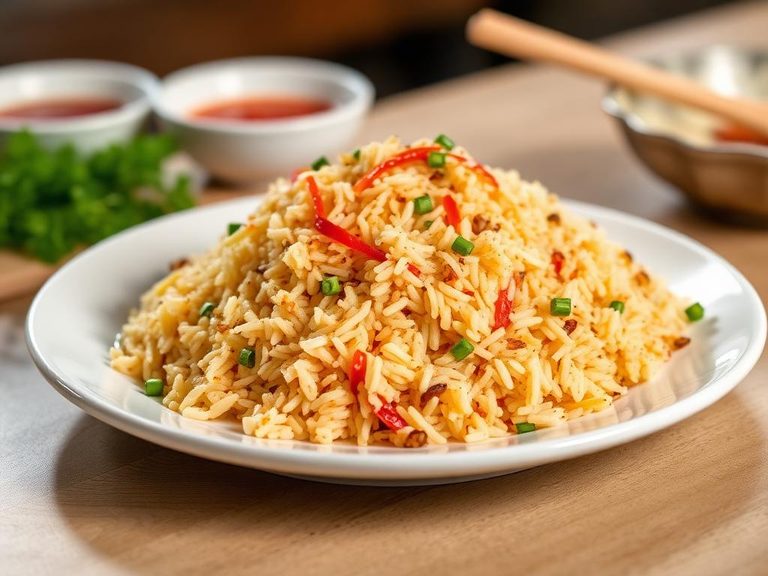
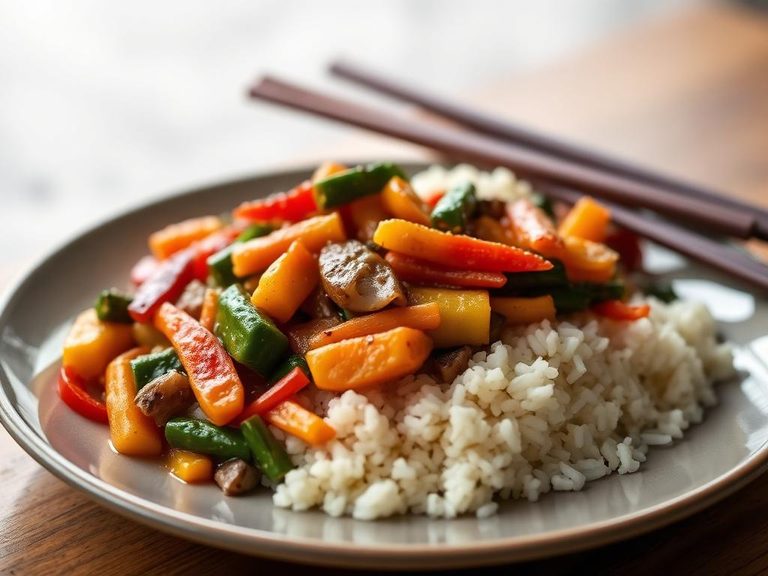
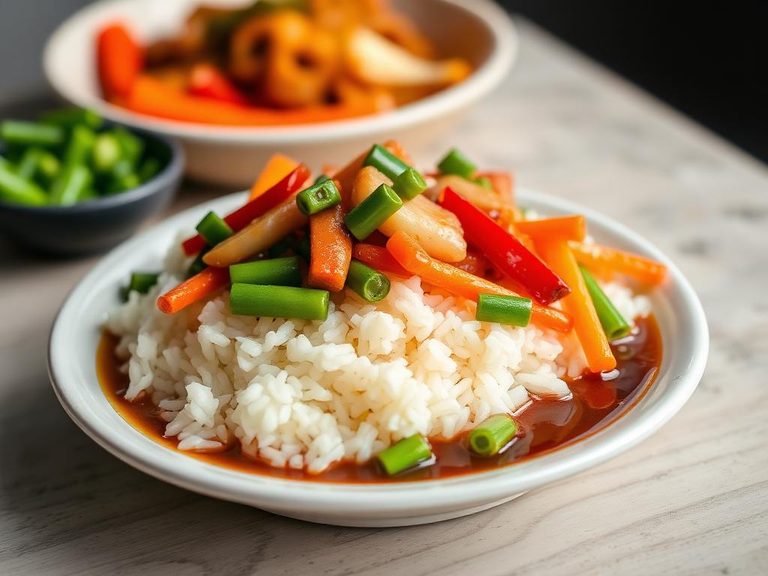
🌍 Where it's eaten
💡 Did you know?
Soy sauce, a key component of this dish, has been fermented for over 2,000 years and is one of the world's oldest condiments, originally used as a preservative in ancient China.
Full nutrition (USDA data · scales with serving)
| Water | 74.9 g |
| Energy | 106 kcal |
| Protein | 2.2 g |
| Total lipid (fat) | 1.8 g |
| Carbohydrate, by difference | 19.8 g |
| Fiber, total dietary | 1.1 g |
| Total Sugars | 1.6 g |
| Calcium, Ca | 12.0 mg |
| Iron, Fe | 0.82 mg |
| Magnesium, Mg | 12.0 mg |
| Phosphorus, P | 37.0 mg |
| Potassium, K | 60.0 mg |
| Sodium, Na | 393 mg |
| Zinc, Zn | 0.36 mg |
| Copper, Cu | 0.06 mg |
| Selenium, Se | 4.2 ug |
| Vitamin C, total ascorbic acid | 0.60 mg |
| Thiamin | 0.10 mg |
| Riboflavin | 0.04 mg |
| Niacin | 0.99 mg |
| Vitamin B-6 | 0.07 mg |
| Folate, total | 34.0 ug |
| Folic acid | 29.0 ug |
| Folate, food | 6.0 ug |
| Folate, DFE | 55.0 ug |
| Choline, total | 7.0 mg |
| Vitamin B-12 | 0.01 ug |
| Vitamin B-12, added | 0.00 ug |
| Vitamin A, RAE | 43.0 ug |
| Retinol | 0.00 ug |
| Carotene, beta | 415 ug |
| Carotene, alpha | 193 ug |
| Cryptoxanthin, beta | 0.00 ug |
| Lycopene | 0.00 ug |
| Lutein + zeaxanthin | 127 ug |
| Vitamin E (alpha-tocopherol) | 0.40 mg |
| Vitamin E, added | 0.00 mg |
| Vitamin D (D2 + D3) | 0.00 ug |
| Vitamin K (phylloquinone) | 6.3 ug |
| Alcohol, ethyl | 0.00 g |
| Caffeine | 0.00 mg |
| Theobromine | 0.00 mg |
Fat & fatty acid profile (per 100g)
| Fatty acids, total saturated | 0.28 g |
| SFA 4:0 | 0.00 g |
| SFA 6:0 | 0.00 g |
| SFA 8:0 | 0.00 g |
| SFA 10:0 | 0.00 g |
| SFA 12:0 | 0.00 g |
| SFA 14:0 | 0.00 g |
| SFA 16:0 | 0.21 g |
| SFA 18:0 | 0.06 g |
| Fatty acids, total monounsaturated | 0.73 g |
| MUFA 16:1 | 0.01 g |
| MUFA 18:1 | 0.71 g |
| MUFA 20:1 | 0.01 g |
| MUFA 22:1 | 0.00 g |
| Fatty acids, total polyunsaturated | 0.65 g |
| PUFA 18:2 | 0.57 g |
| PUFA 18:3 | 0.08 g |
| PUFA 18:4 | 0.00 g |
| PUFA 20:4 | 0.00 g |
| PUFA 20:5 n-3 (EPA) | 0.00 g |
| PUFA 22:5 n-3 (DPA) | 0.00 g |
| PUFA 22:6 n-3 (DHA) | 0.00 g |
| Cholesterol | 0.00 mg |
Amino acid profile (per 100g)
Estimated from Snacks, rice cakes, brown rice, sesame seed — USDA does not publish this profile for Rice.
| Tryptophan | 0.10 g |
| Threonine | 0.28 g |
| Isoleucine | 0.32 g |
| Leucine | 0.63 g |
| Lysine | 0.29 g |
| Methionine | 0.17 g |
| Cystine | 0.09 g |
| Phenylalanine | 0.39 g |
| Tyrosine | 0.29 g |
| Valine | 0.44 g |
| Arginine | 0.59 g |
| Histidine | 0.19 g |
| Alanine | 0.44 g |
| Aspartic acid | 0.71 g |
| Glutamic acid | 1.6 g |
| Glycine | 0.38 g |
| Proline | 0.35 g |
| Serine | 0.39 g |
FAQ
Is this dish suitable for a gluten-free diet?
Not necessarily, as soy sauce typically contains wheat. For a gluten-free version, use tamari or a gluten-free soy sauce alternative.
How can I reduce the sodium content?
Use low-sodium soy sauce or dilute the sauce with water or broth, and limit the amount of added salt during cooking.
Can this dish be made vegan?
Yes, it is typically vegan if the soy sauce is plant-based and no animal-derived ingredients are added. Check labels for any hidden animal products.
Nutrient density (calculated · NRF9.3)
Nutrient Rich Foods index: beneficial nutrients (protein, fiber, vitamins, minerals) minus saturated fat, added sugar & sodium, per 100 kcal.
NRF9.3 index — Fulgoni, Keast & Drewnowski, 2009. Computed from USDA nutrients.
Weight-loss friendliness (composite index)
Energy density 1.06 kcal/g · 8% calories from protein · 1.1 g fiber · 1.6 g sugar per 100 g.
Composite of energy density (Rolls et al., 1999), protein & fiber satiety, minus sugar. A calculated heuristic — ranks satiety-per-calorie, not a clinical measure.
Dietary load (calculated from USDA values)
Potential renal acid load. Positive = acid-forming, negative = alkaline-forming.
Sodium-to-potassium ratio: 6.55 (lower is better — aim for ≤ 1)
Sodium:potassium per WHO potassium guidance. Computed from USDA nutrients.