

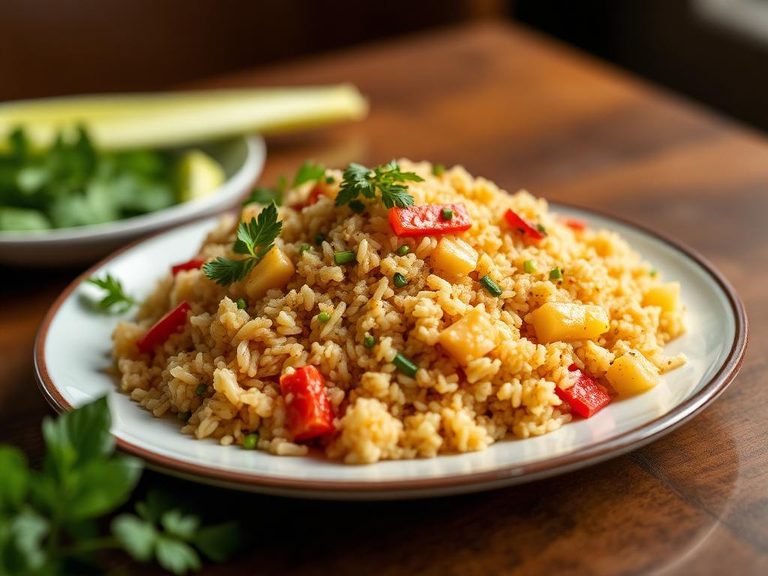
Rice, white, with vegetables, soy-based sauce, no added fat
Common food

Photo: Wikipedia
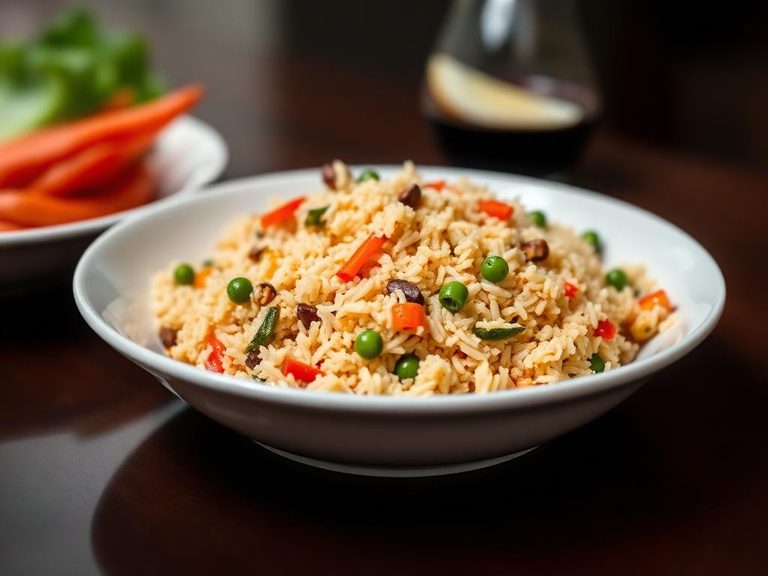
This is a light, savory dish of steamed white rice tossed with finely diced vegetables like carrots, peas, and corn, all coated in a mild, salty-sweet soy-based sauce. The texture is soft and slightly sticky, with a gentle umami flavor that makes it a comforting, easy-to-eat staple. Nutritionally, it's a low-fat, low-calorie source of quick energy from carbohydrates, with a modest protein boost from the soy sauce and vegetables.
Calorie split: 10% protein · 88% carbs · 3% fat
↓ Full nutrition💚 Why it's loved
People love it for its simple, savory comfort—it's the ultimate pantry-staple meal that feels warm and satisfying without being heavy. Its mild flavor and soft texture make it a universal crowd-pleaser, especially for children or those recovering from illness.
⚠️ Watch-outs & how to enjoy it better
The main downside is its high glycemic load from white rice, which can cause rapid blood sugar spikes, making it less ideal for diabetics or those managing insulin resistance. The soy sauce also contributes significant sodium, which can be a concern for individuals with high blood pressure. To counteract this, pair it with a source of protein (like tofu, chicken, or egg) and non-starchy vegetables (like broccoli or spinach) to slow digestion and add nutrients. Opting for low-sodium soy sauce or using it sparingly can also help manage salt intake.
Key benefits
- Low in fat and calories, suitable for light meals.
- Provides quick-release energy from carbohydrates.
- Contains some dietary fiber from the mixed vegetables.
- Soy sauce adds a small amount of plant-based protein.
- Versatile base that can be paired with many proteins.
🍽️ Popular dishes
🌍 Where it's eaten
💡 Did you know?
The practice of stir-frying leftover rice with vegetables and soy sauce is a classic 'waste-not' technique in East Asian cuisines, believed to have originated as a way to use up day-old rice, which is actually ideal for frying because its lower moisture content prevents clumping.
Full nutrition (USDA data · scales with serving)
| Water | 76.1 g |
| Energy | 94.0 kcal |
| Protein | 2.2 g |
| Total lipid (fat) | 0.26 g |
| Carbohydrate, by difference | 20.1 g |
| Fiber, total dietary | 1.1 g |
| Total Sugars | 1.7 g |
| Calcium, Ca | 12.0 mg |
| Iron, Fe | 0.83 mg |
| Magnesium, Mg | 12.0 mg |
| Phosphorus, P | 38.0 mg |
| Potassium, K | 61.0 mg |
| Sodium, Na | 399 mg |
| Zinc, Zn | 0.37 mg |
| Copper, Cu | 0.06 mg |
| Selenium, Se | 4.3 ug |
| Vitamin C, total ascorbic acid | 0.60 mg |
| Thiamin | 0.10 mg |
| Riboflavin | 0.04 mg |
| Niacin | 1.0 mg |
| Vitamin B-6 | 0.07 mg |
| Folate, total | 35.0 ug |
| Folic acid | 29.0 ug |
| Folate, food | 6.0 ug |
| Folate, DFE | 55.0 ug |
| Choline, total | 7.1 mg |
| Vitamin B-12 | 0.01 ug |
| Vitamin B-12, added | 0.00 ug |
| Vitamin A, RAE | 43.0 ug |
| Retinol | 0.00 ug |
| Carotene, beta | 422 ug |
| Carotene, alpha | 196 ug |
| Cryptoxanthin, beta | 0.00 ug |
| Lycopene | 0.00 ug |
| Lutein + zeaxanthin | 129 ug |
| Vitamin E (alpha-tocopherol) | 0.12 mg |
| Vitamin E, added | 0.00 mg |
| Vitamin D (D2 + D3) | 0.00 ug |
| Vitamin K (phylloquinone) | 4.8 ug |
| Alcohol, ethyl | 0.00 g |
| Caffeine | 0.00 mg |
| Theobromine | 0.00 mg |
Fat & fatty acid profile (per 100g)
| Fatty acids, total saturated | 0.08 g |
| SFA 4:0 | 0.00 g |
| SFA 6:0 | 0.00 g |
| SFA 8:0 | 0.00 g |
| SFA 10:0 | 0.00 g |
| SFA 12:0 | 0.00 g |
| SFA 14:0 | 0.00 g |
| SFA 16:0 | 0.06 g |
| SFA 18:0 | 0.02 g |
| Fatty acids, total monounsaturated | 0.08 g |
| MUFA 16:1 | 0.00 g |
| MUFA 18:1 | 0.07 g |
| MUFA 20:1 | 0.00 g |
| MUFA 22:1 | 0.00 g |
| Fatty acids, total polyunsaturated | 0.06 g |
| PUFA 18:2 | 0.05 g |
| PUFA 18:3 | 0.01 g |
| PUFA 18:4 | 0.00 g |
| PUFA 20:4 | 0.00 g |
| PUFA 20:5 n-3 (EPA) | 0.00 g |
| PUFA 22:5 n-3 (DPA) | 0.00 g |
| PUFA 22:6 n-3 (DHA) | 0.00 g |
| Cholesterol | 0.00 mg |
Amino acid profile (per 100g)
Estimated from Snacks, rice cakes, brown rice, sesame seed — USDA does not publish this profile for Rice.
| Tryptophan | 0.10 g |
| Threonine | 0.28 g |
| Isoleucine | 0.32 g |
| Leucine | 0.63 g |
| Lysine | 0.29 g |
| Methionine | 0.17 g |
| Cystine | 0.09 g |
| Phenylalanine | 0.39 g |
| Tyrosine | 0.29 g |
| Valine | 0.44 g |
| Arginine | 0.59 g |
| Histidine | 0.19 g |
| Alanine | 0.44 g |
| Aspartic acid | 0.71 g |
| Glutamic acid | 1.6 g |
| Glycine | 0.38 g |
| Proline | 0.35 g |
| Serine | 0.39 g |
FAQ
Is this dish gluten-free?
Not typically, as standard soy sauce is brewed with wheat. To make it gluten-free, use tamari (a gluten-free soy sauce) or coconut aminos.
Can I add more protein to make it a complete meal?
Absolutely. Scrambled eggs, diced tofu, shredded chicken, or shrimp are excellent additions that boost the protein content and make it more satiating.
Why is my rice mushy when I try to make this?
Using freshly cooked, hot rice often leads to mushiness. For the best texture, use day-old, refrigerated rice that has dried out slightly, or spread freshly cooked rice on a tray to cool and dry before stir-frying.
Nutrient density (calculated · NRF9.3)
Nutrient Rich Foods index: beneficial nutrients (protein, fiber, vitamins, minerals) minus saturated fat, added sugar & sodium, per 100 kcal.
NRF9.3 index — Fulgoni, Keast & Drewnowski, 2009. Computed from USDA nutrients.
Weight-loss friendliness (composite index)
Energy density 0.94 kcal/g · 9% calories from protein · 1.1 g fiber · 1.7 g sugar per 100 g.
Composite of energy density (Rolls et al., 1999), protein & fiber satiety, minus sugar. A calculated heuristic — ranks satiety-per-calorie, not a clinical measure.
Dietary load (calculated from USDA values)
Potential renal acid load. Positive = acid-forming, negative = alkaline-forming.
Sodium-to-potassium ratio: 6.54 (lower is better — aim for ≤ 1)
Sodium:potassium per WHO potassium guidance. Computed from USDA nutrients.