

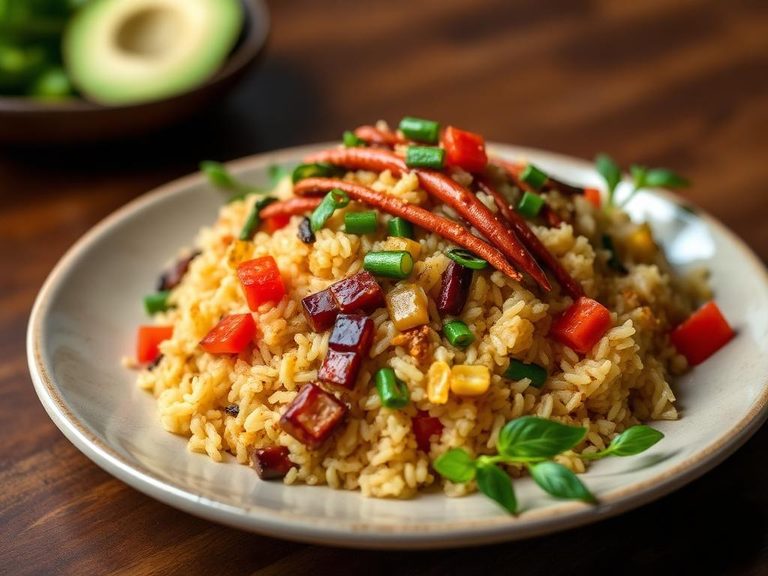
Rice, brown, with vegetables, soy-based sauce, fat added
Common food

Photo: Wikipedia
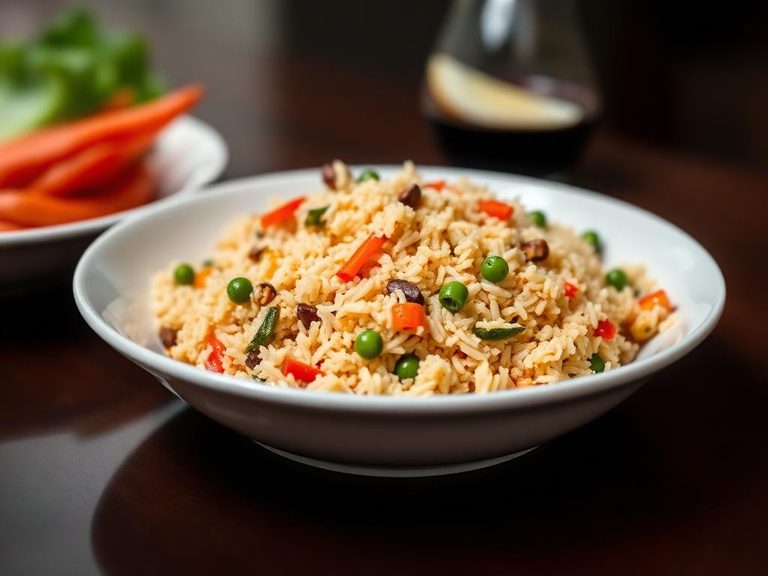
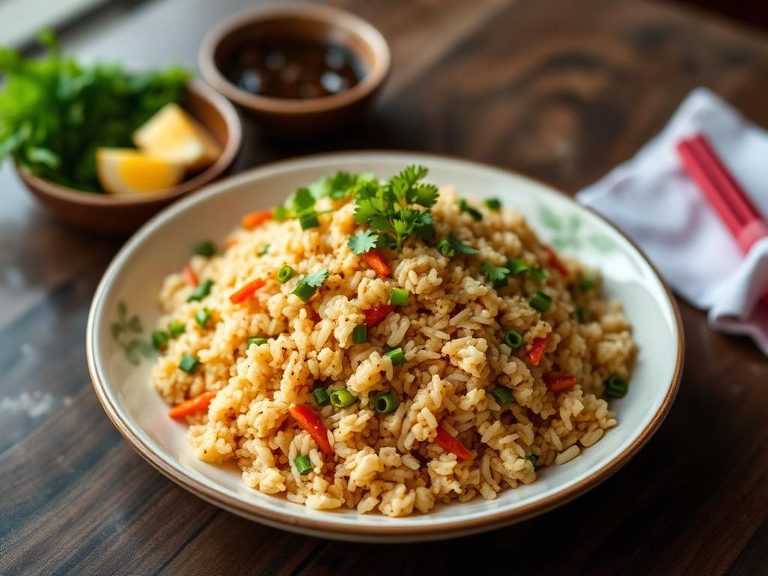
This is a savory, stir-fried or tossed dish where nutty brown rice is coated in a glossy, umami-rich soy-based sauce and studded with tender-crisp vegetables. The texture is satisfyingly chewy with a slight bite from the veggies, offering a balanced flavor profile of salty, sweet, and savory. Nutritionally, it provides a modest calorie count with a good source of complex carbohydrates and fiber for sustained energy.
Calorie split: 9% protein · 74% carbs · 17% fat
↓ Full nutrition💚 Why it's loved
People love it for its deeply satisfying umami flavor from the soy sauce and the comforting, hearty texture of brown rice. It's a versatile, one-bowl meal that feels both wholesome and indulgent, often evoking the familiar, comforting tastes of home-style Asian cooking.
⚠️ Watch-outs & how to enjoy it better
The soy-based sauce can be high in sodium, which may concern those monitoring salt intake, and the dish can cause blood-sugar spikes if not paired with protein or fat. To counteract this, add a side of tofu, chicken, or a handful of nuts, and control portion sizes to keep the glycemic load manageable.
Key benefits
- Provides complex carbohydrates for steady energy release
- Contains dietary fiber from brown rice and vegetables
- Low in fat per serving, making it a light meal option
- Offers a balanced mix of plant-based nutrients
- Quick and convenient for meal prep or fast meals
🍽️ Popular dishes
🌍 Where it's eaten
💡 Did you know?
Brown rice retains its bran and germ layers, which are often removed in white rice, making it a whole grain that takes about 45 minutes to cook compared to 15 minutes for white rice.
Full nutrition (USDA data · scales with serving)
| Water | 75.3 g |
| Energy | 105 kcal |
| Protein | 2.3 g |
| Total lipid (fat) | 2.0 g |
| Carbohydrate, by difference | 19.2 g |
| Fiber, total dietary | 1.7 g |
| Total Sugars | 1.6 g |
| Calcium, Ca | 8.0 mg |
| Iron, Fe | 0.50 mg |
| Magnesium, Mg | 28.0 mg |
| Phosphorus, P | 72.0 mg |
| Potassium, K | 87.0 mg |
| Sodium, Na | 352 mg |
| Zinc, Zn | 0.50 mg |
| Copper, Cu | 0.08 mg |
| Selenium, Se | 3.6 ug |
| Vitamin C, total ascorbic acid | 0.60 mg |
| Thiamin | 0.12 mg |
| Riboflavin | 0.06 mg |
| Niacin | 1.7 mg |
| Vitamin B-6 | 0.09 mg |
| Folate, total | 9.0 ug |
| Folic acid | 0.00 ug |
| Folate, food | 9.0 ug |
| Folate, DFE | 9.0 ug |
| Choline, total | 10.5 mg |
| Vitamin B-12 | 0.01 ug |
| Vitamin B-12, added | 0.00 ug |
| Vitamin A, RAE | 38.0 ug |
| Retinol | 0.00 ug |
| Carotene, beta | 370 ug |
| Carotene, alpha | 172 ug |
| Cryptoxanthin, beta | 0.00 ug |
| Lycopene | 0.00 ug |
| Lutein + zeaxanthin | 113 ug |
| Vitamin E (alpha-tocopherol) | 0.44 mg |
| Vitamin E, added | 0.00 mg |
| Vitamin D (D2 + D3) | 0.00 ug |
| Vitamin K (phylloquinone) | 5.7 ug |
| Alcohol, ethyl | 0.00 g |
| Caffeine | 0.00 mg |
| Theobromine | 0.00 mg |
Fat & fatty acid profile (per 100g)
| Fatty acids, total saturated | 0.37 g |
| SFA 4:0 | 0.00 g |
| SFA 6:0 | 0.00 g |
| SFA 8:0 | 0.00 g |
| SFA 10:0 | 0.01 g |
| SFA 12:0 | 0.00 g |
| SFA 14:0 | 0.01 g |
| SFA 16:0 | 0.27 g |
| SFA 18:0 | 0.06 g |
| Fatty acids, total monounsaturated | 0.82 g |
| MUFA 16:1 | 0.01 g |
| MUFA 18:1 | 0.80 g |
| MUFA 20:1 | 0.01 g |
| MUFA 22:1 | 0.00 g |
| Fatty acids, total polyunsaturated | 0.75 g |
| PUFA 18:2 | 0.68 g |
| PUFA 18:3 | 0.07 g |
| PUFA 18:4 | 0.00 g |
| PUFA 20:4 | 0.00 g |
| PUFA 20:5 n-3 (EPA) | 0.00 g |
| PUFA 22:5 n-3 (DPA) | 0.00 g |
| PUFA 22:6 n-3 (DHA) | 0.00 g |
| Cholesterol | 0.00 mg |
Amino acid profile (per 100g)
Estimated from Snacks, rice cakes, brown rice, sesame seed — USDA does not publish this profile for Rice.
| Tryptophan | 0.10 g |
| Threonine | 0.28 g |
| Isoleucine | 0.32 g |
| Leucine | 0.63 g |
| Lysine | 0.29 g |
| Methionine | 0.17 g |
| Cystine | 0.09 g |
| Phenylalanine | 0.39 g |
| Tyrosine | 0.29 g |
| Valine | 0.44 g |
| Arginine | 0.59 g |
| Histidine | 0.19 g |
| Alanine | 0.44 g |
| Aspartic acid | 0.71 g |
| Glutamic acid | 1.6 g |
| Glycine | 0.38 g |
| Proline | 0.35 g |
| Serine | 0.39 g |
FAQ
Is this dish gluten-free?
It depends on the soy sauce used. Traditional soy sauce contains wheat, but gluten-free tamari can be substituted to make it safe for those with gluten sensitivities.
How can I reduce the sodium content?
Use low-sodium soy sauce or tamari, and add flavor with garlic, ginger, or a splash of rice vinegar instead of extra salt.
Can I make this ahead of time?
Yes, it stores well in the refrigerator for 3-4 days. Reheat gently in a pan or microwave, adding a splash of water or broth to prevent drying out.
What vegetables work best in this dish?
Common choices include carrots, bell peppers, broccoli, snap peas, and cabbage, but any firm, quick-cooking vegetable will work well.
Nutrient density (calculated · NRF9.3)
Nutrient Rich Foods index: beneficial nutrients (protein, fiber, vitamins, minerals) minus saturated fat, added sugar & sodium, per 100 kcal.
NRF9.3 index — Fulgoni, Keast & Drewnowski, 2009. Computed from USDA nutrients.
Weight-loss friendliness (composite index)
Energy density 1.05 kcal/g · 9% calories from protein · 1.7 g fiber · 1.6 g sugar per 100 g.
Composite of energy density (Rolls et al., 1999), protein & fiber satiety, minus sugar. A calculated heuristic — ranks satiety-per-calorie, not a clinical measure.
Dietary load (calculated from USDA values)
Potential renal acid load. Positive = acid-forming, negative = alkaline-forming.
Sodium-to-potassium ratio: 4.05 (lower is better — aim for ≤ 1)
Sodium:potassium per WHO potassium guidance. Computed from USDA nutrients.