

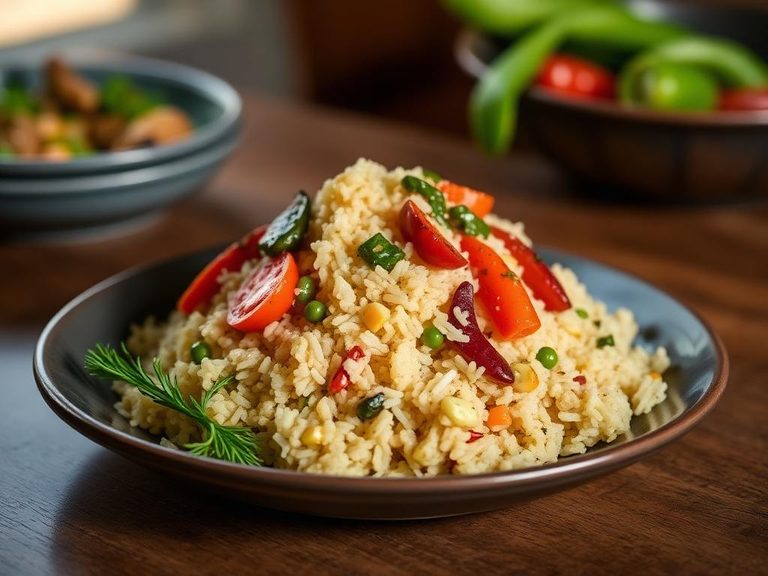
Rice, white, with vegetables, soy-based sauce, fat added
Common food

Photo: Wikipedia
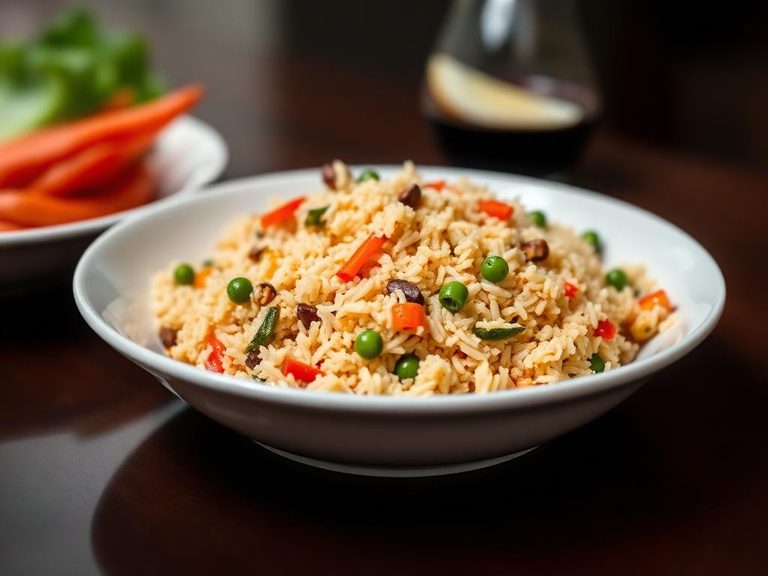
A comforting bowl of fluffy white rice tossed with a colorful medley of vegetables—like carrots, peas, and corn—all lightly coated in a savory, umami-rich soy-based sauce. The texture is soft and satisfying, with a slight bite from the vegetables and a glossy sheen from the added fat. It's a low-calorie, carb-forward dish that provides quick energy and a touch of fiber.
Calorie split: 8% protein · 76% carbs · 15% fat
↓ Full nutrition💚 Why it's loved
People adore this dish for its savory, satisfying flavor and the comforting, familiar texture of rice. It's a beloved staple for its incredible versatility—it works as a quick weeknight side, a simple main, or a canvas for leftovers.
⚠️ Watch-outs & how to enjoy it better
The white rice base can cause a rapid blood-sugar spike, and the soy sauce contributes significant sodium. To counteract this, pair it with a source of protein (like tofu, chicken, or egg) and a healthy fat (like avocado or sesame oil) to slow digestion. Opt for low-sodium soy sauce or use it sparingly.
Key benefits
- Provides quick-release energy from carbohydrates
- Contains a modest amount of plant-based protein
- Includes dietary fiber from the vegetable mix
- Low in fat per serving
- Versatile base that can be customized with other ingredients
🍽️ Popular dishes
🌍 Where it's eaten
💡 Did you know?
The technique of stir-frying rice with vegetables and sauce, which defines this dish, is believed to have been popularized in China during the Sui Dynasty (589–618 AD) as a way to use leftover rice.
Full nutrition (USDA data · scales with serving)
| Water | 74.9 g |
| Energy | 106 kcal |
| Protein | 2.2 g |
| Total lipid (fat) | 1.8 g |
| Carbohydrate, by difference | 19.8 g |
| Fiber, total dietary | 1.1 g |
| Total Sugars | 1.6 g |
| Calcium, Ca | 12.0 mg |
| Iron, Fe | 0.82 mg |
| Magnesium, Mg | 12.0 mg |
| Phosphorus, P | 37.0 mg |
| Potassium, K | 60.0 mg |
| Sodium, Na | 393 mg |
| Zinc, Zn | 0.36 mg |
| Copper, Cu | 0.06 mg |
| Selenium, Se | 4.2 ug |
| Vitamin C, total ascorbic acid | 0.60 mg |
| Thiamin | 0.10 mg |
| Riboflavin | 0.04 mg |
| Niacin | 0.99 mg |
| Vitamin B-6 | 0.07 mg |
| Folate, total | 34.0 ug |
| Folic acid | 29.0 ug |
| Folate, food | 6.0 ug |
| Folate, DFE | 55.0 ug |
| Choline, total | 7.0 mg |
| Vitamin B-12 | 0.01 ug |
| Vitamin B-12, added | 0.00 ug |
| Vitamin A, RAE | 43.0 ug |
| Retinol | 0.00 ug |
| Carotene, beta | 415 ug |
| Carotene, alpha | 193 ug |
| Cryptoxanthin, beta | 0.00 ug |
| Lycopene | 0.00 ug |
| Lutein + zeaxanthin | 127 ug |
| Vitamin E (alpha-tocopherol) | 0.40 mg |
| Vitamin E, added | 0.00 mg |
| Vitamin D (D2 + D3) | 0.00 ug |
| Vitamin K (phylloquinone) | 6.3 ug |
| Alcohol, ethyl | 0.00 g |
| Caffeine | 0.00 mg |
| Theobromine | 0.00 mg |
Fat & fatty acid profile (per 100g)
| Fatty acids, total saturated | 0.28 g |
| SFA 4:0 | 0.00 g |
| SFA 6:0 | 0.00 g |
| SFA 8:0 | 0.00 g |
| SFA 10:0 | 0.00 g |
| SFA 12:0 | 0.00 g |
| SFA 14:0 | 0.00 g |
| SFA 16:0 | 0.21 g |
| SFA 18:0 | 0.06 g |
| Fatty acids, total monounsaturated | 0.73 g |
| MUFA 16:1 | 0.01 g |
| MUFA 18:1 | 0.71 g |
| MUFA 20:1 | 0.01 g |
| MUFA 22:1 | 0.00 g |
| Fatty acids, total polyunsaturated | 0.65 g |
| PUFA 18:2 | 0.57 g |
| PUFA 18:3 | 0.08 g |
| PUFA 18:4 | 0.00 g |
| PUFA 20:4 | 0.00 g |
| PUFA 20:5 n-3 (EPA) | 0.00 g |
| PUFA 22:5 n-3 (DPA) | 0.00 g |
| PUFA 22:6 n-3 (DHA) | 0.00 g |
| Cholesterol | 0.00 mg |
Amino acid profile (per 100g)
Estimated from Snacks, rice cakes, brown rice, sesame seed — USDA does not publish this profile for Rice.
| Tryptophan | 0.10 g |
| Threonine | 0.28 g |
| Isoleucine | 0.32 g |
| Leucine | 0.63 g |
| Lysine | 0.29 g |
| Methionine | 0.17 g |
| Cystine | 0.09 g |
| Phenylalanine | 0.39 g |
| Tyrosine | 0.29 g |
| Valine | 0.44 g |
| Arginine | 0.59 g |
| Histidine | 0.19 g |
| Alanine | 0.44 g |
| Aspartic acid | 0.71 g |
| Glutamic acid | 1.6 g |
| Glycine | 0.38 g |
| Proline | 0.35 g |
| Serine | 0.39 g |
FAQ
Is this dish gluten-free?
Not typically. Traditional soy sauce contains wheat. To make it gluten-free, use tamari or a certified gluten-free soy sauce alternative.
Can I reduce the glycemic impact?
Yes. Mix in some cauliflower rice, use brown rice instead, or ensure the meal includes a good source of protein and fat to help stabilize blood sugar response.
What vegetables are most commonly used?
Common additions include diced carrots, peas, corn, bell peppers, and green beans. The mix is often whatever is fresh or available.
Nutrient density (calculated · NRF9.3)
Nutrient Rich Foods index: beneficial nutrients (protein, fiber, vitamins, minerals) minus saturated fat, added sugar & sodium, per 100 kcal.
NRF9.3 index — Fulgoni, Keast & Drewnowski, 2009. Computed from USDA nutrients.
Weight-loss friendliness (composite index)
Energy density 1.06 kcal/g · 8% calories from protein · 1.1 g fiber · 1.6 g sugar per 100 g.
Composite of energy density (Rolls et al., 1999), protein & fiber satiety, minus sugar. A calculated heuristic — ranks satiety-per-calorie, not a clinical measure.
Dietary load (calculated from USDA values)
Potential renal acid load. Positive = acid-forming, negative = alkaline-forming.
Sodium-to-potassium ratio: 6.55 (lower is better — aim for ≤ 1)
Sodium:potassium per WHO potassium guidance. Computed from USDA nutrients.