

Rice, white, with soy-based sauce, NS as to fat
Common food
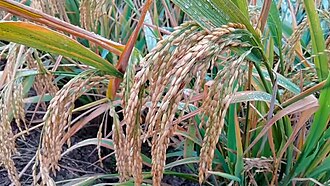
Photo: Wikipedia
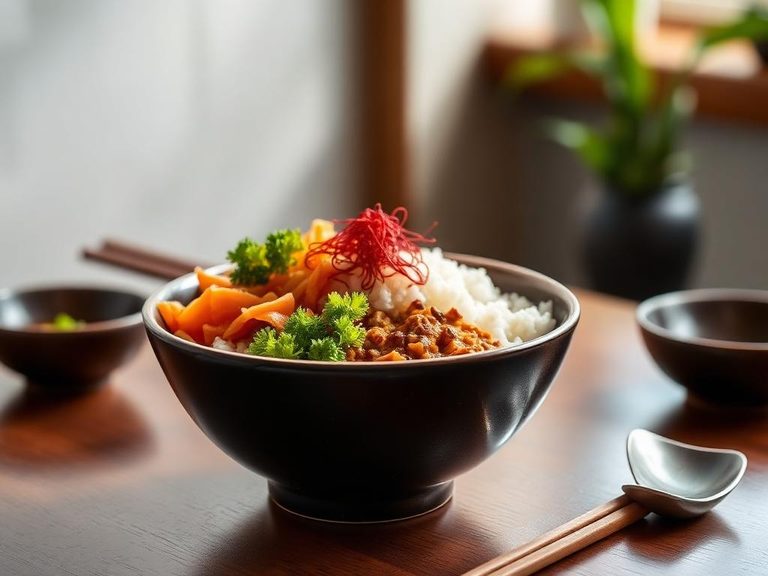
This is a simple, comforting bowl of plain white rice seasoned with a savory soy-based sauce. The sauce coats each grain, adding a salty, umami depth to the mild, starchy base. Nutritionally, it's a quick source of energy from carbohydrates with a modest protein boost from the soy.
Calorie split: 7% protein · 76% carbs · 17% fat
↓ Full nutrition💚 Why it's loved
People love it for its comforting simplicity and the satisfying, savory flavor the soy sauce imparts. It's a blank canvas that can be a quick standalone snack or the foundation for a more elaborate meal.
⚠️ Watch-outs & how to enjoy it better
The primary concern is the high sodium content from the soy sauce, which can be problematic for those monitoring salt intake. The white rice is also a high-glycemic food, potentially causing blood sugar spikes. To counteract, pair it with fiber-rich vegetables and a source of protein or healthy fat (like an egg or avocado) to slow digestion. Opt for low-sodium soy sauce or use it sparingly.
Key benefits
- Provides quick, easily digestible energy from carbohydrates.
- The soy sauce adds umami flavor and a small amount of protein.
- A versatile, neutral base that pairs well with many proteins and vegetables.
- A staple comfort food in many cultures, often used in recovery or simple meals.
🍽️ Popular dishes
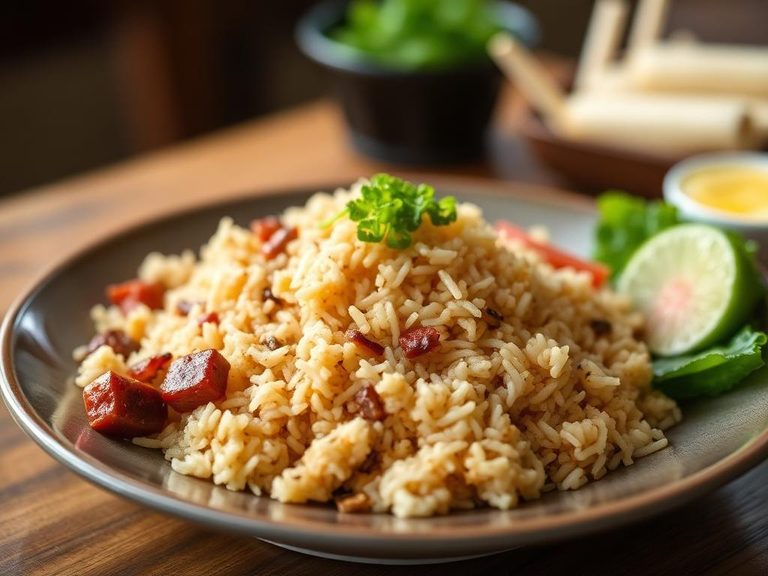
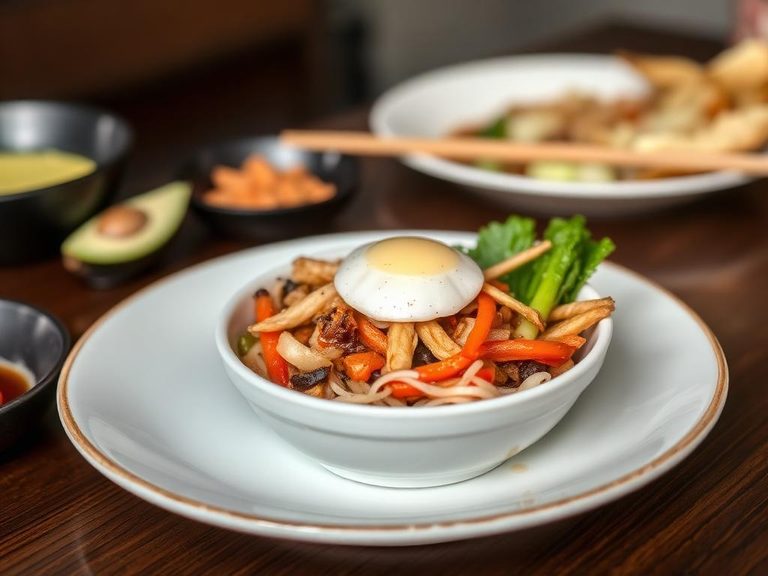
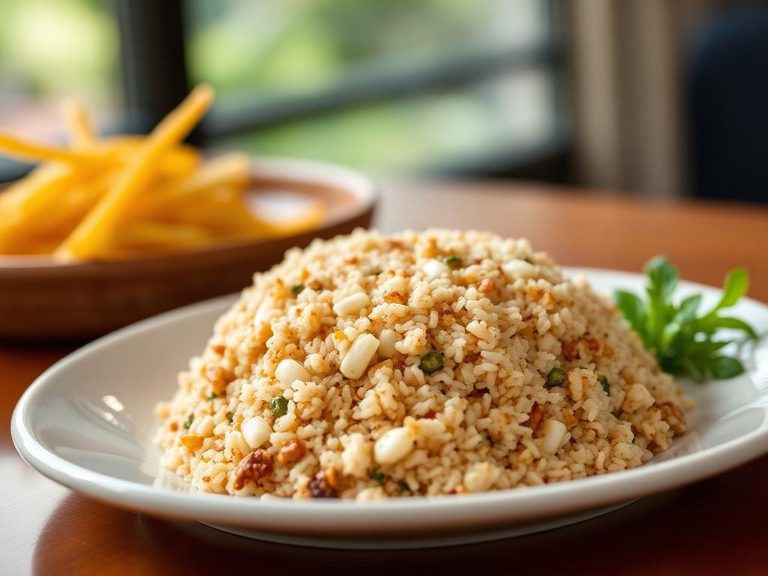
🌍 Where it's eaten
💡 Did you know?
The 'NS as to fat' in its database name means 'Not Specified as to fat,' indicating the exact fat content can vary based on how much oil was used in cooking the rice or preparing the sauce.
Full nutrition (USDA data · scales with serving)
| Water | 72.9 g |
| Energy | 117 kcal |
| Protein | 2.0 g |
| Total lipid (fat) | 2.2 g |
| Carbohydrate, by difference | 21.5 g |
| Fiber, total dietary | 0.30 g |
| Total Sugars | 1.3 g |
| Calcium, Ca | 9.0 mg |
| Iron, Fe | 0.82 mg |
| Magnesium, Mg | 10.0 mg |
| Phosphorus, P | 33.0 mg |
| Potassium, K | 33.0 mg |
| Sodium, Na | 482 mg |
| Zinc, Zn | 0.33 mg |
| Copper, Cu | 0.05 mg |
| Selenium, Se | 5.2 ug |
| Vitamin C, total ascorbic acid | 0.00 mg |
| Thiamin | 0.11 mg |
| Riboflavin | 0.01 mg |
| Niacin | 1.0 mg |
| Vitamin B-6 | 0.06 mg |
| Folate, total | 38.0 ug |
| Folic acid | 36.0 ug |
| Folate, food | 2.0 ug |
| Folate, DFE | 63.0 ug |
| Choline, total | 2.7 mg |
| Vitamin B-12 | 0.01 ug |
| Vitamin B-12, added | 0.00 ug |
| Vitamin A, RAE | 0.00 ug |
| Retinol | 0.00 ug |
| Carotene, beta | 0.00 ug |
| Carotene, alpha | 0.00 ug |
| Cryptoxanthin, beta | 0.00 ug |
| Lycopene | 0.00 ug |
| Lutein + zeaxanthin | 0.00 ug |
| Vitamin E (alpha-tocopherol) | 0.41 mg |
| Vitamin E, added | 0.00 mg |
| Vitamin D (D2 + D3) | 0.00 ug |
| Vitamin K (phylloquinone) | 2.0 ug |
| Alcohol, ethyl | 0.00 g |
| Caffeine | 0.00 mg |
| Theobromine | 0.00 mg |
Fat & fatty acid profile (per 100g)
| Fatty acids, total saturated | 0.35 g |
| SFA 4:0 | 0.00 g |
| SFA 6:0 | 0.00 g |
| SFA 8:0 | 0.00 g |
| SFA 10:0 | 0.00 g |
| SFA 12:0 | 0.00 g |
| SFA 14:0 | 0.01 g |
| SFA 16:0 | 0.25 g |
| SFA 18:0 | 0.07 g |
| Fatty acids, total monounsaturated | 0.90 g |
| MUFA 16:1 | 0.01 g |
| MUFA 18:1 | 0.88 g |
| MUFA 20:1 | 0.01 g |
| MUFA 22:1 | 0.00 g |
| Fatty acids, total polyunsaturated | 0.79 g |
| PUFA 18:2 | 0.70 g |
| PUFA 18:3 | 0.09 g |
| PUFA 18:4 | 0.00 g |
| PUFA 20:4 | 0.00 g |
| PUFA 20:5 n-3 (EPA) | 0.00 g |
| PUFA 22:5 n-3 (DPA) | 0.00 g |
| PUFA 22:6 n-3 (DHA) | 0.00 g |
| Cholesterol | 0.00 mg |
Amino acid profile (per 100g)
Estimated from Snacks, rice cakes, brown rice, sesame seed — USDA does not publish this profile for Rice.
| Tryptophan | 0.10 g |
| Threonine | 0.28 g |
| Isoleucine | 0.32 g |
| Leucine | 0.63 g |
| Lysine | 0.29 g |
| Methionine | 0.17 g |
| Cystine | 0.09 g |
| Phenylalanine | 0.39 g |
| Tyrosine | 0.29 g |
| Valine | 0.44 g |
| Arginine | 0.59 g |
| Histidine | 0.19 g |
| Alanine | 0.44 g |
| Aspartic acid | 0.71 g |
| Glutamic acid | 1.6 g |
| Glycine | 0.38 g |
| Proline | 0.35 g |
| Serine | 0.39 g |
FAQ
Is this the same as fried rice?
What kind of soy sauce is typically used?
It's most commonly a standard, all-purpose soy sauce (like Japanese shoyu or Chinese light soy sauce). The specific type can vary by region and recipe, affecting the saltiness and flavor profile.
Can I make this with brown rice?
Absolutely. Using brown rice will significantly increase the fiber content and provide more sustained energy, though the texture will be chewier and the flavor nuttier.
Nutrient density (calculated · NRF9.3)
Nutrient Rich Foods index: beneficial nutrients (protein, fiber, vitamins, minerals) minus saturated fat, added sugar & sodium, per 100 kcal.
NRF9.3 index — Fulgoni, Keast & Drewnowski, 2009. Computed from USDA nutrients.
Weight-loss friendliness (composite index)
Energy density 1.17 kcal/g · 7% calories from protein · 0.3 g fiber · 1.3 g sugar per 100 g.
Composite of energy density (Rolls et al., 1999), protein & fiber satiety, minus sugar. A calculated heuristic — ranks satiety-per-calorie, not a clinical measure.
Dietary load (calculated from USDA values)
Potential renal acid load. Positive = acid-forming, negative = alkaline-forming.
Sodium-to-potassium ratio: 14.61 (lower is better — aim for ≤ 1)
Sodium:potassium per WHO potassium guidance. Computed from USDA nutrients.