

Rice, white, with peas and carrots, fat added
Common food

Photo: Wikipedia
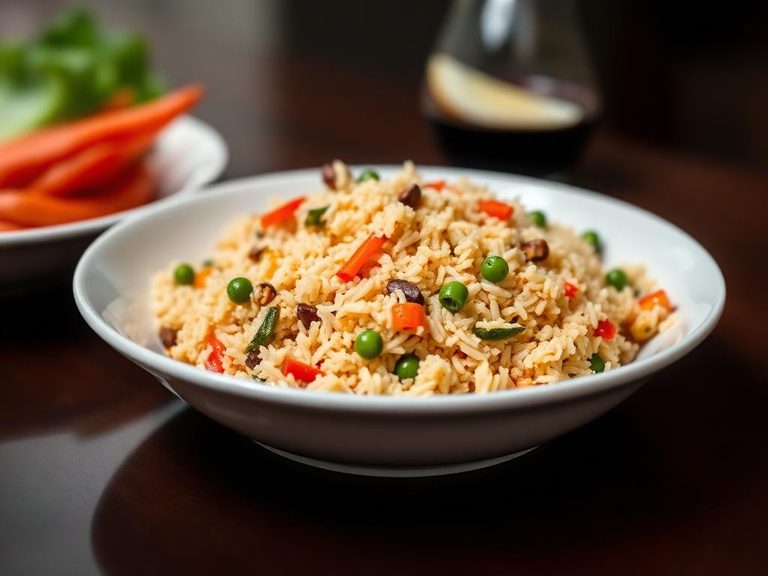
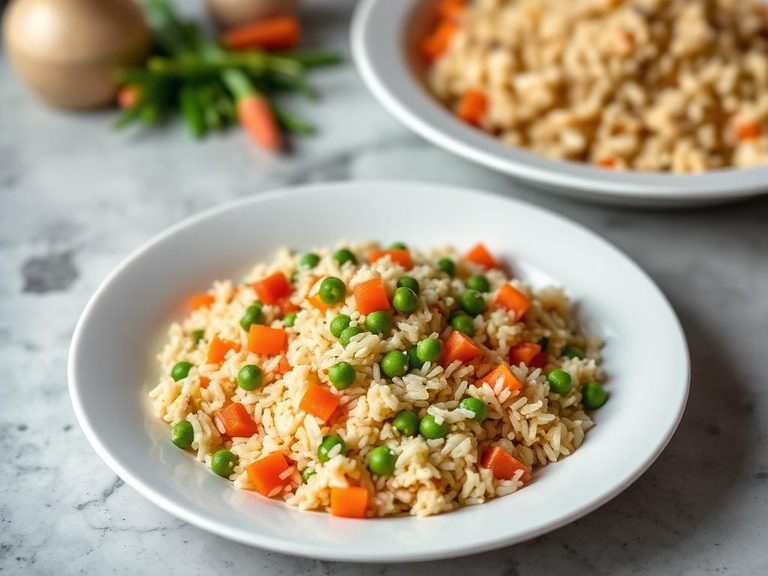
A comforting, colorful staple of tender white rice studded with sweet peas and earthy carrots, lightly glistening with added fat for a richer mouthfeel. Each 100-gram serving provides a modest 128 kcal, with a balanced 23.25g of carbohydrates for energy and a touch of protein (2.69g). Its mild, savory flavor and soft, fluffy texture make it a universally appealing side dish.
Calorie split: 9% protein · 74% carbs · 18% fat
↓ Full nutrition💚 Why it's loved
People love it for its effortless comfort and nostalgic appeal—it's a staple side that pairs with almost anything, from grilled chicken to stews. The natural sweetness of the peas and carrots complements the neutral rice, creating a harmonious, satisfying bite without complexity.
⚠️ Watch-outs & how to enjoy it better
The white rice base has a high glycemic index, which can cause blood-sugar spikes, making it less ideal for those managing diabetes. To counteract this, pair it with a source of protein (like beans or meat) and healthy fats, or mix in more non-starchy vegetables to increase fiber and slow digestion.
Key benefits
- Provides quick-release energy from carbohydrates.
- Offers a small but meaningful protein boost from rice and vegetables.
- Contains dietary fiber (1.2g) from peas and carrots for digestive health.
- Delivers beta-carotene (from carrots) and plant compounds from peas.
- A versatile, low-fat (2.45g) base for adding other proteins.
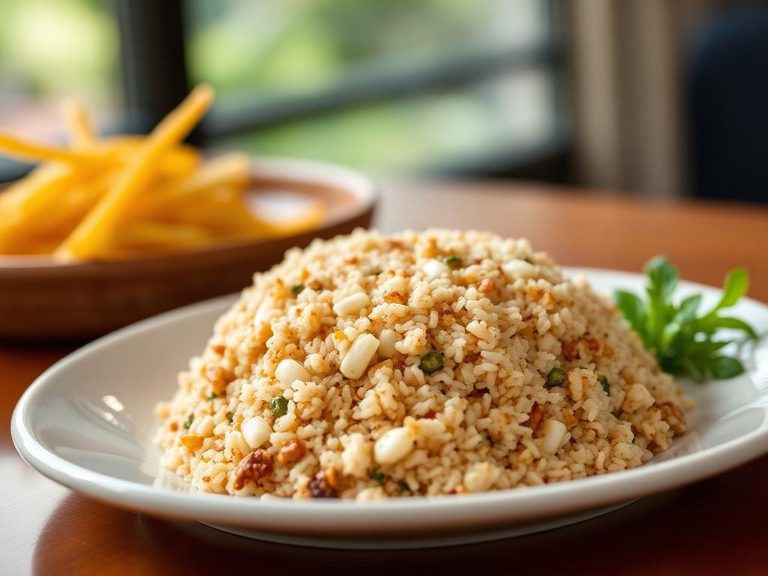
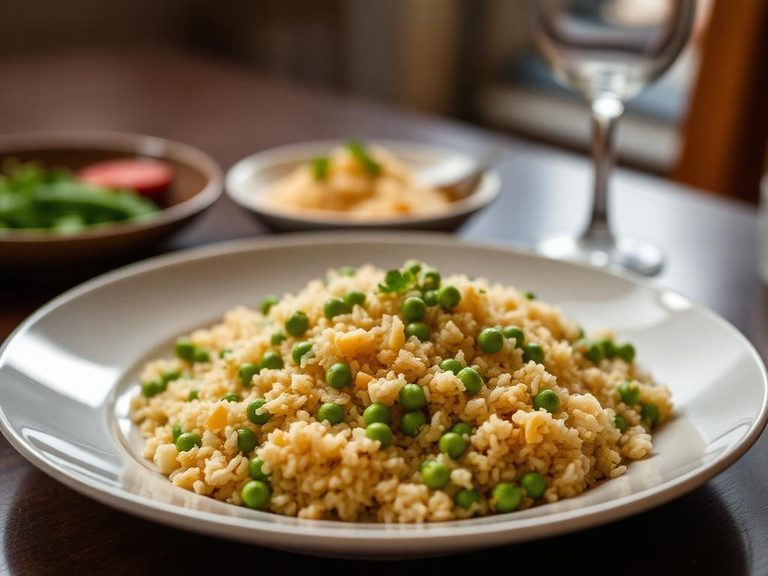
🍽️ Popular dishes
🌍 Where it's eaten
💡 Did you know?
The practice of adding colorful vegetables like peas and carrots to rice is a classic culinary technique called 'confetti rice' or 'jeweled rice,' used across cultures to add visual appeal, nutrition, and subtle flavor to a simple grain.
Full nutrition (USDA data · scales with serving)
| Water | 70.6 g |
| Energy | 128 kcal |
| Protein | 2.7 g |
| Total lipid (fat) | 2.5 g |
| Carbohydrate, by difference | 23.3 g |
| Fiber, total dietary | 1.2 g |
| Total Sugars | 1.1 g |
| Calcium, Ca | 15.0 mg |
| Iron, Fe | 1.1 mg |
| Magnesium, Mg | 13.0 mg |
| Phosphorus, P | 45.0 mg |
| Potassium, K | 65.0 mg |
| Sodium, Na | 225 mg |
| Zinc, Zn | 0.47 mg |
| Copper, Cu | 0.07 mg |
| Selenium, Se | 5.7 ug |
| Vitamin C, total ascorbic acid | 1.5 mg |
| Thiamin | 0.16 mg |
| Riboflavin | 0.03 mg |
| Niacin | 1.3 mg |
| Vitamin B-6 | 0.09 mg |
| Folate, total | 50.0 ug |
| Folic acid | 40.0 ug |
| Folate, food | 10.0 ug |
| Folate, DFE | 79.0 ug |
| Choline, total | 5.9 mg |
| Vitamin B-12 | 0.00 ug |
| Vitamin B-12, added | 0.00 ug |
| Vitamin A, RAE | 116 ug |
| Retinol | 0.00 ug |
| Carotene, beta | 1152 ug |
| Carotene, alpha | 456 ug |
| Cryptoxanthin, beta | 0.00 ug |
| Lycopene | 0.00 ug |
| Lutein + zeaxanthin | 375 ug |
| Vitamin E (alpha-tocopherol) | 0.53 mg |
| Vitamin E, added | 0.00 mg |
| Vitamin D (D2 + D3) | 0.00 ug |
| Vitamin K (phylloquinone) | 6.9 ug |
| Alcohol, ethyl | 0.00 g |
| Caffeine | 0.00 mg |
| Theobromine | 0.00 mg |
Fat & fatty acid profile (per 100g)
| Fatty acids, total saturated | 0.35 g |
| SFA 4:0 | 0.00 g |
| SFA 6:0 | 0.00 g |
| SFA 8:0 | 0.00 g |
| SFA 10:0 | 0.00 g |
| SFA 12:0 | 0.00 g |
| SFA 14:0 | 0.00 g |
| SFA 16:0 | 0.26 g |
| SFA 18:0 | 0.07 g |
| Fatty acids, total monounsaturated | 0.98 g |
| MUFA 16:1 | 0.01 g |
| MUFA 18:1 | 0.96 g |
| MUFA 20:1 | 0.01 g |
| MUFA 22:1 | 0.00 g |
| Fatty acids, total polyunsaturated | 0.92 g |
| PUFA 18:2 | 0.81 g |
| PUFA 18:3 | 0.11 g |
| PUFA 18:4 | 0.00 g |
| PUFA 20:4 | 0.00 g |
| PUFA 20:5 n-3 (EPA) | 0.00 g |
| PUFA 22:5 n-3 (DPA) | 0.00 g |
| PUFA 22:6 n-3 (DHA) | 0.00 g |
| Cholesterol | 0.00 mg |
Amino acid profile (per 100g)
Estimated from Snacks, rice cakes, brown rice, sesame seed — USDA does not publish this profile for Rice.
| Tryptophan | 0.10 g |
| Threonine | 0.28 g |
| Isoleucine | 0.32 g |
| Leucine | 0.63 g |
| Lysine | 0.29 g |
| Methionine | 0.17 g |
| Cystine | 0.09 g |
| Phenylalanine | 0.39 g |
| Tyrosine | 0.29 g |
| Valine | 0.44 g |
| Arginine | 0.59 g |
| Histidine | 0.19 g |
| Alanine | 0.44 g |
| Aspartic acid | 0.71 g |
| Glutamic acid | 1.6 g |
| Glycine | 0.38 g |
| Proline | 0.35 g |
| Serine | 0.39 g |
FAQ
Is this the same as 'pilaf' or 'pulao'?
It's very similar and often used interchangeably. Pilaf/pulao are cooking methods where rice is sautéed in fat before simmering, which this dish likely is, given the 'fat added' note. The terms often imply a flavorful, vegetable-studded rice.
Can I make this healthier?
Absolutely. Use brown rice or a cauliflower-rice blend to increase fiber and lower the glycemic load. Reduce added fat by using a non-stick pan or broth for moisture, and boost the vegetable ratio even higher.
Why is fat added to plain rice?
Fat (like butter, oil, or ghee) is added to prevent grains from clumping, enhance mouthfeel, and carry the flavors of the vegetables and any seasonings. It also helps with the absorption of fat-soluble vitamins from the carrots.
Nutrient density (calculated · NRF9.3)
Nutrient Rich Foods index: beneficial nutrients (protein, fiber, vitamins, minerals) minus saturated fat, added sugar & sodium, per 100 kcal.
NRF9.3 index — Fulgoni, Keast & Drewnowski, 2009. Computed from USDA nutrients.
Weight-loss friendliness (composite index)
Energy density 1.28 kcal/g · 8% calories from protein · 1.2 g fiber · 1.1 g sugar per 100 g.
Composite of energy density (Rolls et al., 1999), protein & fiber satiety, minus sugar. A calculated heuristic — ranks satiety-per-calorie, not a clinical measure.
Dietary load (calculated from USDA values)
Potential renal acid load. Positive = acid-forming, negative = alkaline-forming.
Sodium-to-potassium ratio: 3.46 (lower is better — aim for ≤ 1)
Sodium:potassium per WHO potassium guidance. Computed from USDA nutrients.