

Rice, brown, with peas and carrots, no added fat
Common food

Photo: Wikipedia
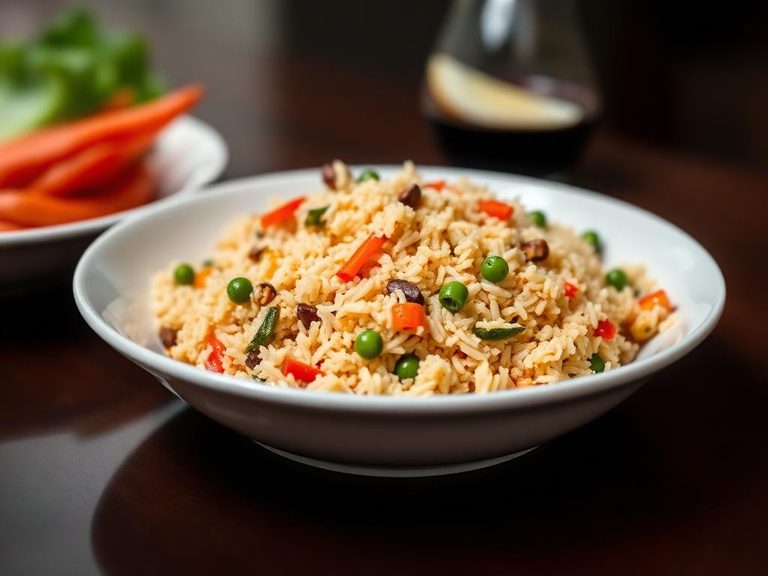
This is a simple, wholesome side dish of fluffy brown rice studded with sweet green peas and tender carrots. The texture is pleasantly chewy with a mild, earthy sweetness from the vegetables, and it's a nutritionally balanced base with a good fiber boost.
Calorie split: 10% protein · 83% carbs · 7% fat
↓ Full nutrition💚 Why it's loved
People appreciate its comforting, familiar taste and the convenience of a complete, nutritious side that pairs with almost any main dish. It's a staple in many home kitchens for its ability to add color, texture, and subtle sweetness to a meal.
⚠️ Watch-outs & how to enjoy it better
The chewy texture of brown rice can be less appealing to some, and the dish's mild flavor might be seen as bland without proper seasoning. For those monitoring blood sugar, the carbohydrate content is notable; pairing it with a protein source like chicken or tofu can help moderate the glycemic response.
Key benefits
- High in dietary fiber from whole grain brown rice and vegetables.
- Low in fat, making it heart-healthy.
- Provides plant-based protein from the rice and peas.
- A good source of complex carbohydrates for sustained energy.
- Contains vitamins A and C from the carrots and peas.
🍽️ Popular dishes
🌍 Where it's eaten
💡 Did you know?
Brown rice is a 'whole grain' because it retains its bran and germ layers, which are removed to make white rice, giving it a nuttier flavor and significantly more fiber.
Full nutrition (USDA data · scales with serving)
| Water | 73.0 g |
| Energy | 109 kcal |
| Protein | 2.8 g |
| Total lipid (fat) | 0.84 g |
| Carbohydrate, by difference | 22.4 g |
| Fiber, total dietary | 2.1 g |
| Total Sugars | 1.1 g |
| Calcium, Ca | 9.0 mg |
| Iron, Fe | 0.64 mg |
| Magnesium, Mg | 34.0 mg |
| Phosphorus, P | 92.0 mg |
| Potassium, K | 101 mg |
| Sodium, Na | 198 mg |
| Zinc, Zn | 0.66 mg |
| Copper, Cu | 0.10 mg |
| Selenium, Se | 4.7 ug |
| Vitamin C, total ascorbic acid | 1.3 mg |
| Thiamin | 0.17 mg |
| Riboflavin | 0.07 mg |
| Niacin | 2.2 mg |
| Vitamin B-6 | 0.12 mg |
| Folate, total | 14.0 ug |
| Folic acid | 0.00 ug |
| Folate, food | 14.0 ug |
| Folate, DFE | 14.0 ug |
| Choline, total | 11.0 mg |
| Vitamin B-12 | 0.00 ug |
| Vitamin B-12, added | 0.00 ug |
| Vitamin A, RAE | 101 ug |
| Retinol | 0.00 ug |
| Carotene, beta | 1003 ug |
| Carotene, alpha | 396 ug |
| Cryptoxanthin, beta | 0.00 ug |
| Lycopene | 0.00 ug |
| Lutein + zeaxanthin | 326 ug |
| Vitamin E (alpha-tocopherol) | 0.21 mg |
| Vitamin E, added | 0.00 mg |
| Vitamin D (D2 + D3) | 0.00 ug |
| Vitamin K (phylloquinone) | 4.3 ug |
| Alcohol, ethyl | 0.00 g |
| Caffeine | 0.00 mg |
| Theobromine | 0.00 mg |
Fat & fatty acid profile (per 100g)
| Fatty acids, total saturated | 0.21 g |
| SFA 4:0 | 0.00 g |
| SFA 6:0 | 0.00 g |
| SFA 8:0 | 0.00 g |
| SFA 10:0 | 0.01 g |
| SFA 12:0 | 0.00 g |
| SFA 14:0 | 0.01 g |
| SFA 16:0 | 0.16 g |
| SFA 18:0 | 0.02 g |
| Fatty acids, total monounsaturated | 0.29 g |
| MUFA 16:1 | 0.00 g |
| MUFA 18:1 | 0.29 g |
| MUFA 20:1 | 0.00 g |
| MUFA 22:1 | 0.00 g |
| Fatty acids, total polyunsaturated | 0.32 g |
| PUFA 18:2 | 0.31 g |
| PUFA 18:3 | 0.01 g |
| PUFA 18:4 | 0.00 g |
| PUFA 20:4 | 0.00 g |
| PUFA 20:5 n-3 (EPA) | 0.00 g |
| PUFA 22:5 n-3 (DPA) | 0.00 g |
| PUFA 22:6 n-3 (DHA) | 0.00 g |
| Cholesterol | 0.00 mg |
Amino acid profile (per 100g)
Estimated from Snacks, rice cakes, brown rice, sesame seed — USDA does not publish this profile for Rice.
| Tryptophan | 0.10 g |
| Threonine | 0.28 g |
| Isoleucine | 0.32 g |
| Leucine | 0.63 g |
| Lysine | 0.29 g |
| Methionine | 0.17 g |
| Cystine | 0.09 g |
| Phenylalanine | 0.39 g |
| Tyrosine | 0.29 g |
| Valine | 0.44 g |
| Arginine | 0.59 g |
| Histidine | 0.19 g |
| Alanine | 0.44 g |
| Aspartic acid | 0.71 g |
| Glutamic acid | 1.6 g |
| Glycine | 0.38 g |
| Proline | 0.35 g |
| Serine | 0.39 g |
FAQ
Is this dish gluten-free?
Yes, this specific combination of brown rice, peas, and carrots is naturally gluten-free, assuming no cross-contamination or added sauces containing gluten.
How can I add more flavor without adding fat?
Sauté the vegetables in a splash of low-sodium broth or water before adding the rice. Use herbs like thyme or parsley, spices like cumin or paprika, or a squeeze of lemon juice at the end.
Can I use frozen vegetables?
Absolutely. Frozen peas and carrots are a convenient, nutritious, and often more affordable alternative to fresh, and they require no chopping.
Nutrient density (calculated · NRF9.3)
Nutrient Rich Foods index: beneficial nutrients (protein, fiber, vitamins, minerals) minus saturated fat, added sugar & sodium, per 100 kcal.
NRF9.3 index — Fulgoni, Keast & Drewnowski, 2009. Computed from USDA nutrients.
Weight-loss friendliness (composite index)
Energy density 1.09 kcal/g · 10% calories from protein · 2.1 g fiber · 1.1 g sugar per 100 g.
Composite of energy density (Rolls et al., 1999), protein & fiber satiety, minus sugar. A calculated heuristic — ranks satiety-per-calorie, not a clinical measure.
Dietary load (calculated from USDA values)
Potential renal acid load. Positive = acid-forming, negative = alkaline-forming.
Sodium-to-potassium ratio: 1.96 (lower is better — aim for ≤ 1)
Sodium:potassium per WHO potassium guidance. Computed from USDA nutrients.