

Rice, white, with corn, fat added
Common food
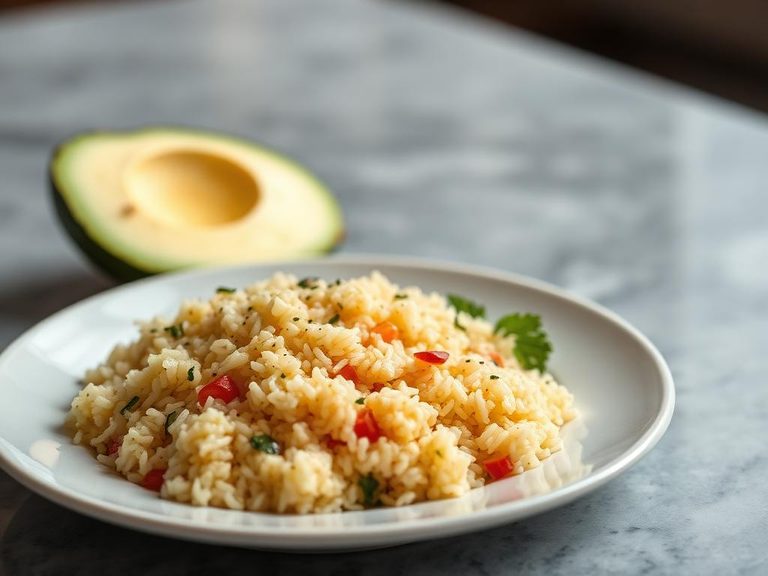
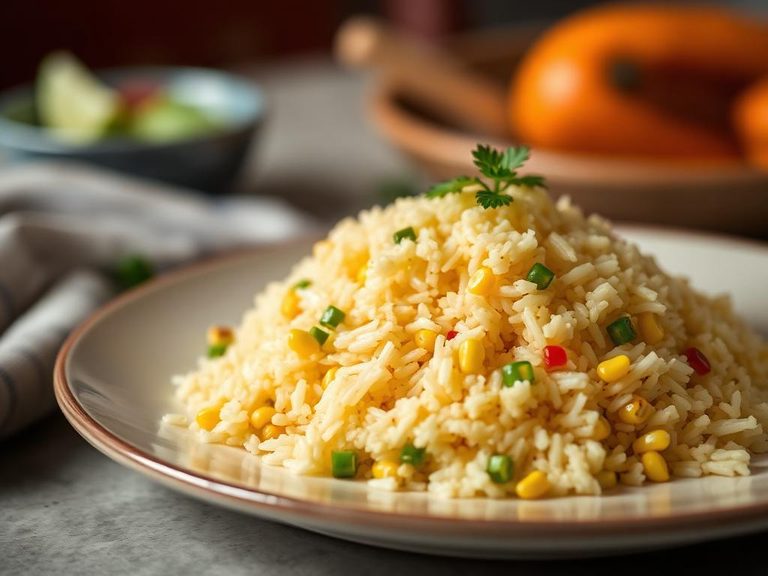
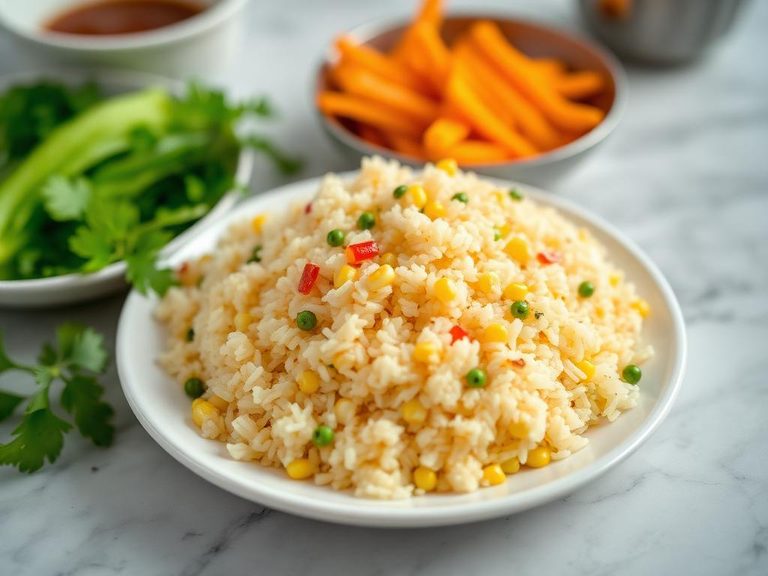
This is a comforting staple of fluffy white rice studded with sweet, golden corn kernels and enriched with a subtle richness from added fat. The texture is a delightful contrast between the soft, yielding rice and the occasional pop of juicy corn. Nutritionally, it's a quick-energy carbohydrate source with a modest protein content.
Calorie split: 8% protein · 75% carbs · 17% fat
↓ Full nutrition💚 Why it's loved
People love it for its simple, comforting sweetness and the satisfying textural contrast between the soft rice and plump corn. It's a versatile side that pairs beautifully with everything from savory stews to grilled proteins.
⚠️ Watch-outs & how to enjoy it better
The combination of refined white rice and corn can cause a rapid rise in blood sugar, making it a consideration for those managing diabetes or insulin resistance. To counteract this, pair it with a source of protein (like beans or chicken) and a non-starchy vegetable to slow digestion and create a more balanced meal.
Key benefits
- Provides quick-release energy from carbohydrates
- Contains some dietary fiber from the corn
- Offers a small amount of plant-based protein
- Can be a palatable way to increase calorie intake
- The added fat can enhance the absorption of fat-soluble vitamins
🍽️ Popular dishes
🌍 Where it's eaten
💡 Did you know?
In many Caribbean and Latin American kitchens, this dish is a classic 'one-pot' meal where the rice is often cooked in the same broth or sofrito as a stewed meat, allowing the grains to absorb all the savory flavors.
Full nutrition (USDA data · scales with serving)
| Water | 68.8 g |
| Energy | 134 kcal |
| Protein | 2.6 g |
| Total lipid (fat) | 2.5 g |
| Carbohydrate, by difference | 25.2 g |
| Fiber, total dietary | 0.90 g |
| Total Sugars | 0.81 g |
| Calcium, Ca | 8.0 mg |
| Iron, Fe | 0.99 mg |
| Magnesium, Mg | 16.0 mg |
| Phosphorus, P | 51.0 mg |
| Potassium, K | 84.0 mg |
| Sodium, Na | 178 mg |
| Zinc, Zn | 0.51 mg |
| Copper, Cu | 0.06 mg |
| Selenium, Se | 5.6 ug |
| Vitamin C, total ascorbic acid | 0.90 mg |
| Thiamin | 0.13 mg |
| Riboflavin | 0.03 mg |
| Niacin | 1.4 mg |
| Vitamin B-6 | 0.09 mg |
| Folate, total | 51.0 ug |
| Folic acid | 40.0 ug |
| Folate, food | 11.0 ug |
| Folate, DFE | 79.0 ug |
| Choline, total | 7.1 mg |
| Vitamin B-12 | 0.00 ug |
| Vitamin B-12, added | 0.00 ug |
| Vitamin A, RAE | 3.0 ug |
| Retinol | 0.00 ug |
| Carotene, beta | 13.0 ug |
| Carotene, alpha | 4.0 ug |
| Cryptoxanthin, beta | 31.0 ug |
| Lycopene | 0.00 ug |
| Lutein + zeaxanthin | 172 ug |
| Vitamin E (alpha-tocopherol) | 0.45 mg |
| Vitamin E, added | 0.00 mg |
| Vitamin D (D2 + D3) | 0.00 ug |
| Vitamin K (phylloquinone) | 2.2 ug |
| Alcohol, ethyl | 0.00 g |
| Caffeine | 0.00 mg |
| Theobromine | 0.00 mg |
Fat & fatty acid profile (per 100g)
| Fatty acids, total saturated | 0.37 g |
| SFA 4:0 | 0.00 g |
| SFA 6:0 | 0.00 g |
| SFA 8:0 | 0.00 g |
| SFA 10:0 | 0.00 g |
| SFA 12:0 | 0.00 g |
| SFA 14:0 | 0.00 g |
| SFA 16:0 | 0.28 g |
| SFA 18:0 | 0.07 g |
| Fatty acids, total monounsaturated | 1.0 g |
| MUFA 16:1 | 0.01 g |
| MUFA 18:1 | 0.99 g |
| MUFA 20:1 | 0.01 g |
| MUFA 22:1 | 0.00 g |
| Fatty acids, total polyunsaturated | 0.95 g |
| PUFA 18:2 | 0.85 g |
| PUFA 18:3 | 0.10 g |
| PUFA 18:4 | 0.00 g |
| PUFA 20:4 | 0.00 g |
| PUFA 20:5 n-3 (EPA) | 0.00 g |
| PUFA 22:5 n-3 (DPA) | 0.00 g |
| PUFA 22:6 n-3 (DHA) | 0.00 g |
| Cholesterol | 0.00 mg |
Amino acid profile (per 100g)
Estimated from Snacks, rice cakes, brown rice, sesame seed — USDA does not publish this profile for Rice.
| Tryptophan | 0.10 g |
| Threonine | 0.28 g |
| Isoleucine | 0.32 g |
| Leucine | 0.63 g |
| Lysine | 0.29 g |
| Methionine | 0.17 g |
| Cystine | 0.09 g |
| Phenylalanine | 0.39 g |
| Tyrosine | 0.29 g |
| Valine | 0.44 g |
| Arginine | 0.59 g |
| Histidine | 0.19 g |
| Alanine | 0.44 g |
| Aspartic acid | 0.71 g |
| Glutamic acid | 1.6 g |
| Glycine | 0.38 g |
| Proline | 0.35 g |
| Serine | 0.39 g |
FAQ
Is this the same as 'corn rice'?
Yes, 'corn rice' is a common name for this dish, especially in the Southern United States. It refers to white rice cooked with whole kernel corn.
What kind of fat is typically added?
Traditionally, butter, lard, or bacon drippings are used for flavor. Modern recipes might use vegetable oil or olive oil.
Is it gluten-free?
Naturally, yes. Both rice and corn are gluten-free grains. However, always check for cross-contamination if you have celiac disease.
Nutrient density (calculated · NRF9.3)
Nutrient Rich Foods index: beneficial nutrients (protein, fiber, vitamins, minerals) minus saturated fat, added sugar & sodium, per 100 kcal.
NRF9.3 index — Fulgoni, Keast & Drewnowski, 2009. Computed from USDA nutrients.
Weight-loss friendliness (composite index)
Energy density 1.34 kcal/g · 8% calories from protein · 0.9 g fiber · 0.8 g sugar per 100 g.
Composite of energy density (Rolls et al., 1999), protein & fiber satiety, minus sugar. A calculated heuristic — ranks satiety-per-calorie, not a clinical measure.
Dietary load (calculated from USDA values)
Potential renal acid load. Positive = acid-forming, negative = alkaline-forming.
Sodium-to-potassium ratio: 2.12 (lower is better — aim for ≤ 1)
Sodium:potassium per WHO potassium guidance. Computed from USDA nutrients.