

Raw vegetable, NFS
Common food

Photo: Wikipedia
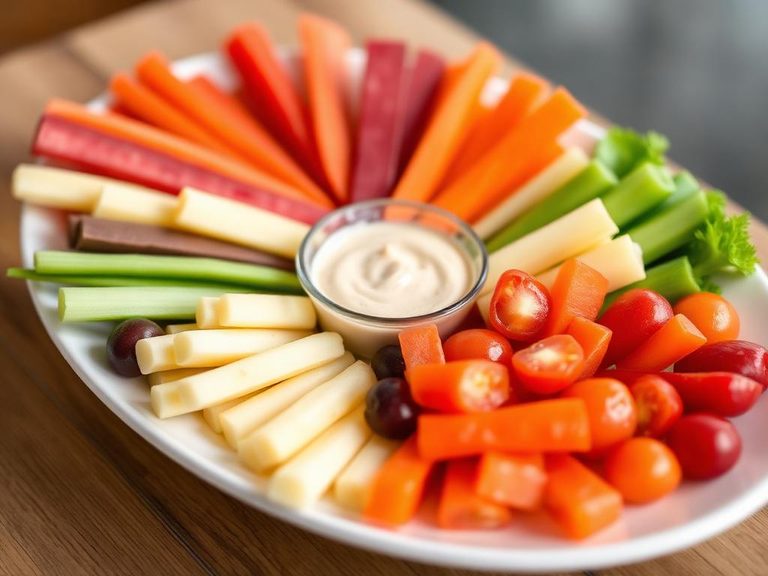
A crisp, refreshing medley of uncooked vegetables—think crunchy carrots, juicy cucumbers, and snappy bell peppers—offering a satisfying snap with every bite. This low-calorie powerhouse delivers a burst of natural sweetness from its 2.53g of sugar per 100g, balanced by a clean, earthy flavor profile. With 2g of fiber and virtually no fat, it's a nutrient-dense snack that keeps you feeling light and energized.
Calorie split: 16% protein · 77% carbs · 8% fat
↓ Full nutrition💚 Why it's loved
People love raw vegetables for their satisfying crunch and versatility—they can be tossed into salads, dipped in hummus, or eaten plain as a guilt-free snack. Their natural, clean flavors pair beautifully with a wide range of dips and seasonings, making them a staple in health-conscious and cultural cuisines worldwide.
⚠️ Watch-outs & how to enjoy it better
Some raw vegetables, like spinach or beets, can contain oxalates that may interfere with mineral absorption in sensitive individuals. To counteract this, pair them with calcium-rich foods or lightly cook them to reduce oxalate levels. Additionally, those with irritable bowel conditions may find the high fiber content irritating—start with small portions and gradually increase intake.
Key benefits
- Extremely low in calories (30 kcal per 100g) for weight management
- Good source of dietary fiber (2g) to support digestion and satiety
- Provides natural sugars for quick energy without heavy fats
- Rich in vitamins and antioxidants that vary by vegetable type
- Hydrating due to high water content in most raw vegetables
🍽️ Popular dishes


🌍 Where it's eaten
💡 Did you know?
Raw vegetables can retain up to 50% more vitamin C than their cooked counterparts, as heat breaks down this heat-sensitive nutrient.
Full nutrition (USDA data · scales with serving)
| Water | 92.0 g |
| Energy | 30.0 kcal |
| Protein | 1.2 g |
| Total lipid (fat) | 0.26 g |
| Carbohydrate, by difference | 5.8 g |
| Fiber, total dietary | 2.0 g |
| Total Sugars | 2.5 g |
| Calcium, Ca | 35.0 mg |
| Iron, Fe | 0.26 mg |
| Magnesium, Mg | 13.0 mg |
| Phosphorus, P | 37.0 mg |
| Potassium, K | 263 mg |
| Sodium, Na | 53.0 mg |
| Zinc, Zn | 0.21 mg |
| Copper, Cu | 0.04 mg |
| Selenium, Se | 0.40 ug |
| Vitamin C, total ascorbic acid | 28.7 mg |
| Thiamin | 0.05 mg |
| Riboflavin | 0.07 mg |
| Niacin | 0.66 mg |
| Vitamin B-6 | 0.11 mg |
| Folate, total | 39.0 ug |
| Folic acid | 0.00 ug |
| Folate, food | 39.0 ug |
| Folate, DFE | 39.0 ug |
| Choline, total | 10.0 mg |
| Vitamin B-12 | 0.00 ug |
| Vitamin B-12, added | 0.00 ug |
| Vitamin A, RAE | 206 ug |
| Retinol | 0.00 ug |
| Carotene, beta | 2025 ug |
| Carotene, alpha | 921 ug |
| Cryptoxanthin, beta | 1.0 ug |
| Lycopene | 703 ug |
| Lutein + zeaxanthin | 359 ug |
| Vitamin E (alpha-tocopherol) | 0.42 mg |
| Vitamin E, added | 0.00 mg |
| Vitamin D (D2 + D3) | 0.00 ug |
| Vitamin K (phylloquinone) | 37.5 ug |
| Alcohol, ethyl | 0.00 g |
| Caffeine | 0.00 mg |
| Theobromine | 0.00 mg |
Fat & fatty acid profile (per 100g)
| Fatty acids, total saturated | 0.03 g |
| SFA 4:0 | 0.00 g |
| SFA 6:0 | 0.00 g |
| SFA 8:0 | 0.00 g |
| SFA 10:0 | 0.00 g |
| SFA 12:0 | 0.00 g |
| SFA 14:0 | 0.00 g |
| SFA 16:0 | 0.03 g |
| SFA 18:0 | 0.01 g |
| Fatty acids, total monounsaturated | 0.02 g |
| MUFA 16:1 | 0.00 g |
| MUFA 18:1 | 0.02 g |
| MUFA 20:1 | 0.00 g |
| MUFA 22:1 | 0.00 g |
| Fatty acids, total polyunsaturated | 0.07 g |
| PUFA 18:2 | 0.07 g |
| PUFA 18:3 | 0.01 g |
| PUFA 18:4 | 0.00 g |
| PUFA 20:4 | 0.00 g |
| PUFA 20:5 n-3 (EPA) | 0.00 g |
| PUFA 22:5 n-3 (DPA) | 0.00 g |
| PUFA 22:6 n-3 (DHA) | 0.00 g |
| Cholesterol | 0.00 mg |
Amino acid profile (per 100g)
Estimated from Babyfood, vegetables, mix vegetables junior — USDA does not publish this profile for Raw vegetable.
| Tryptophan | 0.01 g |
| Threonine | 0.04 g |
| Isoleucine | 0.06 g |
| Leucine | 0.09 g |
| Lysine | 0.05 g |
| Methionine | 0.02 g |
| Cystine | 0.03 g |
| Phenylalanine | 0.06 g |
| Tyrosine | 0.05 g |
| Valine | 0.07 g |
| Arginine | 0.09 g |
| Histidine | 0.03 g |
| Alanine | 0.06 g |
| Aspartic acid | 0.17 g |
| Glutamic acid | 0.37 g |
| Glycine | 0.05 g |
| Proline | 0.11 g |
| Serine | 0.05 g |
FAQ
Are raw vegetables healthier than cooked ones?
Raw vegetables preserve more heat-sensitive vitamins like vitamin C, but cooking can enhance the availability of other nutrients like lycopene and beta-carotene. The best approach is to include both raw and cooked vegetables in your diet.
Can raw vegetables cause digestive issues?
Yes, some people may experience bloating or gas from raw vegetables due to their fiber content and compounds like raffinose. To reduce this, try chopping them finely, soaking them, or gradually increasing your intake.
How should I store raw vegetables to keep them fresh?
Store most raw vegetables in the refrigerator's crisper drawer in a breathable container or plastic bag with holes. For leafy greens, wrap them in a damp paper towel to prevent wilting. Avoid washing until ready to eat to prevent moisture-related spoilage.
Nutrient density (calculated · NRF9.3)
Nutrient Rich Foods index: beneficial nutrients (protein, fiber, vitamins, minerals) minus saturated fat, added sugar & sodium, per 100 kcal.
NRF9.3 index — Fulgoni, Keast & Drewnowski, 2009. Computed from USDA nutrients.
Weight-loss friendliness (composite index)
Energy density 0.30 kcal/g · 16% calories from protein · 2.0 g fiber · 2.5 g sugar per 100 g.
Composite of energy density (Rolls et al., 1999), protein & fiber satiety, minus sugar. A calculated heuristic — ranks satiety-per-calorie, not a clinical measure.
Dietary load (calculated from USDA values)
Potential renal acid load. Positive = acid-forming, negative = alkaline-forming.
Sodium-to-potassium ratio: 0.20 (lower is better — aim for ≤ 1)
Sodium:potassium per WHO potassium guidance. Computed from USDA nutrients.