

Pork skin rinds
Common food

Photo: Wikipedia
Pork skin rinds, or chicharrones, are dehydrated and fried pork skin that puffs into a light, airy, and intensely crunchy snack. They have a savory, salty, and deeply porky flavor with a texture that shatters on the bite. Nutritionally, they are a zero-carb, high-protein and high-fat food, making them a staple in ketogenic and carnivore diets.
Calorie split: 47% protein · 0% carbs · 53% fat
↓ Full nutrition💚 Why it's loved
People love pork rinds for their unbeatable crunch and intense savory flavor, which delivers a satisfying alternative to potato chips. They are also cherished for their versatility, used as a snack, a salad topper, or a low-carb breading.
⚠️ Watch-outs & how to enjoy it better
The high fat and sodium content can be a concern for those monitoring heart health or blood pressure. To counteract, choose low-sodium brands, practice strict portion control, and pair them with fresh vegetables or a vinegar-based dip to balance the meal.
Key benefits
- Zero carbohydrates, suitable for strict keto and carnivore diets.
- Very high in protein, providing over 60g per 100g serving.
- A crunchy, satisfying snack that can curb cravings for chips.
- Source of collagen, which may support skin and joint health.
- Long shelf life without refrigeration when packaged.
🍽️ Popular dishes

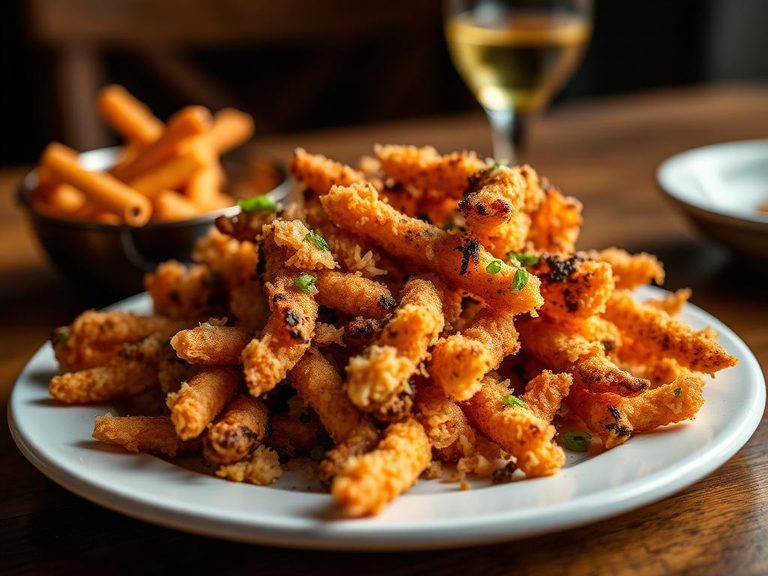
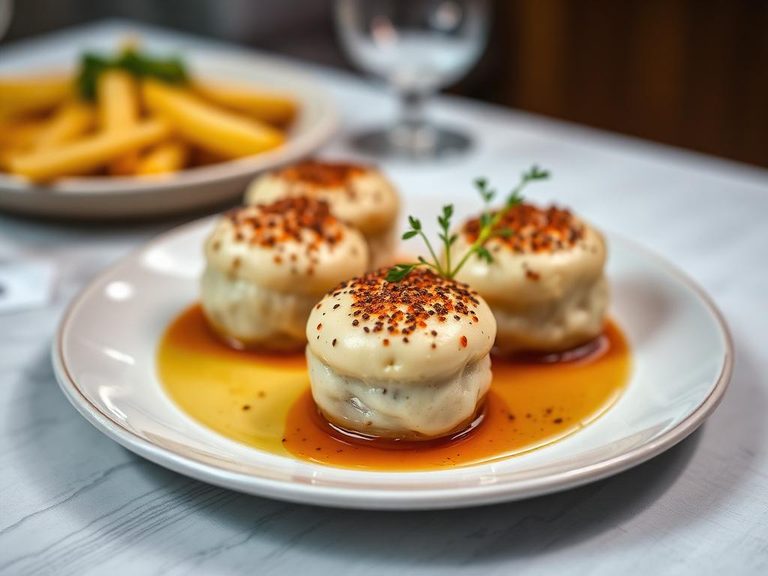
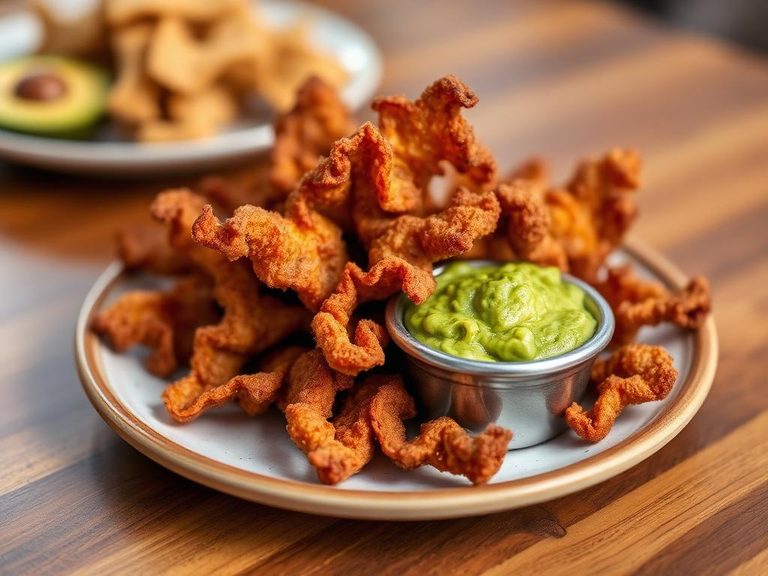

🌍 Where it's eaten
💡 Did you know?
The perfect puff of a pork rind is created by first boiling the skin to render fat, then thoroughly drying it so that when it hits hot oil, the remaining moisture instantly vaporizes, inflating the collagen structure like a balloon.
Full nutrition (USDA data · scales with serving)
| Water | 1.8 g |
| Energy | 544 kcal |
| Protein | 61.3 g |
| Total lipid (fat) | 31.3 g |
| Carbohydrate, by difference | 0.00 g |
| Fiber, total dietary | 0.00 g |
| Total Sugars | 0.00 g |
| Calcium, Ca | 30.0 mg |
| Iron, Fe | 0.88 mg |
| Magnesium, Mg | 11.0 mg |
| Phosphorus, P | 85.0 mg |
| Potassium, K | 127 mg |
| Sodium, Na | 1818 mg |
| Zinc, Zn | 0.56 mg |
| Copper, Cu | 0.09 mg |
| Selenium, Se | 41.0 ug |
| Vitamin C, total ascorbic acid | 0.50 mg |
| Thiamin | 0.10 mg |
| Riboflavin | 0.28 mg |
| Niacin | 1.5 mg |
| Vitamin B-6 | 0.02 mg |
| Folate, total | 0.00 ug |
| Folic acid | 0.00 ug |
| Folate, food | 0.00 ug |
| Folate, DFE | 0.00 ug |
| Choline, total | 165 mg |
| Vitamin B-12 | 0.64 ug |
| Vitamin B-12, added | 0.00 ug |
| Vitamin A, RAE | 12.0 ug |
| Retinol | 12.0 ug |
| Carotene, beta | 0.00 ug |
| Carotene, alpha | 0.00 ug |
| Cryptoxanthin, beta | 0.00 ug |
| Lycopene | 0.00 ug |
| Lutein + zeaxanthin | 0.00 ug |
| Vitamin E (alpha-tocopherol) | 0.53 mg |
| Vitamin E, added | 0.00 mg |
| Vitamin D (D2 + D3) | 0.00 ug |
| Vitamin K (phylloquinone) | 0.00 ug |
| Alcohol, ethyl | 0.00 g |
| Caffeine | 0.00 mg |
| Theobromine | 0.00 mg |
Fat & fatty acid profile (per 100g)
| Fatty acids, total saturated | 11.4 g |
| SFA 4:0 | 0.00 g |
| SFA 6:0 | 0.00 g |
| SFA 8:0 | 0.00 g |
| SFA 10:0 | 0.02 g |
| SFA 12:0 | 0.07 g |
| SFA 14:0 | 0.39 g |
| SFA 16:0 | 6.8 g |
| SFA 18:0 | 4.0 g |
| Fatty acids, total monounsaturated | 14.8 g |
| MUFA 16:1 | 0.97 g |
| MUFA 18:1 | 13.6 g |
| MUFA 20:1 | 0.25 g |
| MUFA 22:1 | 0.00 g |
| Fatty acids, total polyunsaturated | 3.6 g |
| PUFA 18:2 | 3.4 g |
| PUFA 18:3 | 0.26 g |
| PUFA 18:4 | 0.00 g |
| PUFA 20:4 | 0.03 g |
| PUFA 20:5 n-3 (EPA) | 0.00 g |
| PUFA 22:5 n-3 (DPA) | 0.00 g |
| PUFA 22:6 n-3 (DHA) | 0.00 g |
| Cholesterol | 95.0 mg |
Amino acid profile (per 100g)
Estimated from Snacks, pork skins, plain — USDA does not publish this profile for Pork skin rinds.
| Tryptophan | 0.12 g |
| Threonine | 1.8 g |
| Isoleucine | 1.4 g |
| Leucine | 3.3 g |
| Lysine | 2.8 g |
| Methionine | 0.48 g |
| Cystine | 0.53 g |
| Phenylalanine | 1.9 g |
| Tyrosine | 1.2 g |
| Valine | 2.4 g |
| Arginine | 4.8 g |
| Histidine | 0.72 g |
| Alanine | 5.8 g |
| Aspartic acid | 4.5 g |
| Glutamic acid | 7.6 g |
| Glycine | 11.9 g |
| Proline | 7.3 g |
| Serine | 2.6 g |
FAQ
Are pork rinds just fat?
No, while they are high in fat (about 31g per 100g), they are also very high in protein (over 61g per 100g), making them a protein-dense snack.
Can I eat pork rinds on a diet?
They can fit into low-carb or keto diets due to zero carbs, but their high calorie density means portion control is essential for weight loss.
What's the difference between pork rinds and cracklings?
Pork rinds are made from just the skin, while cracklings (or grattons) include some attached fat and meat, making them denser and chewier.
Nutrient density (calculated · NRF9.3)
Nutrient Rich Foods index: beneficial nutrients (protein, fiber, vitamins, minerals) minus saturated fat, added sugar & sodium, per 100 kcal.
NRF9.3 index — Fulgoni, Keast & Drewnowski, 2009. Computed from USDA nutrients.
Weight-loss friendliness (composite index)
Energy density 5.44 kcal/g · 45% calories from protein · 0.0 g fiber · 0.0 g sugar per 100 g.
Composite of energy density (Rolls et al., 1999), protein & fiber satiety, minus sugar. A calculated heuristic — ranks satiety-per-calorie, not a clinical measure.
Dietary load (calculated from USDA values)
Potential renal acid load. Positive = acid-forming, negative = alkaline-forming.
Sodium-to-potassium ratio: 14.31 (lower is better — aim for ≤ 1)
Sodium:potassium per WHO potassium guidance. Computed from USDA nutrients.