

Pork, roast
Common food

Photo: Wikipedia
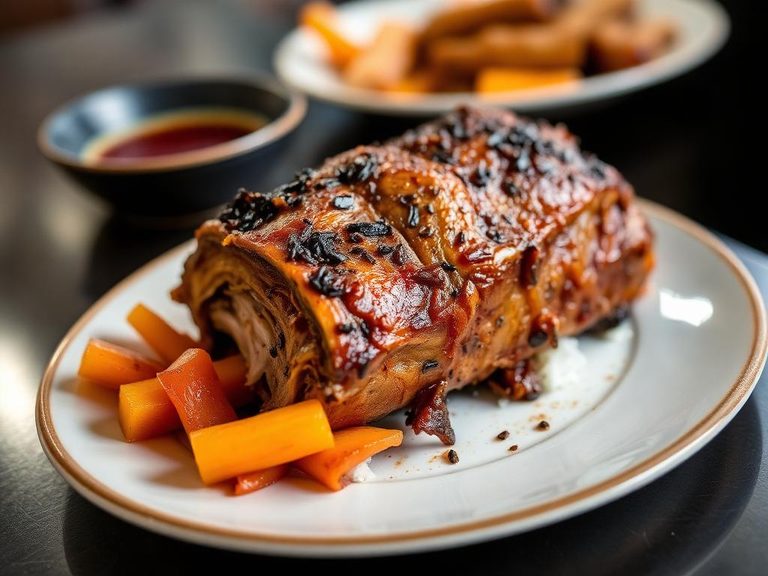
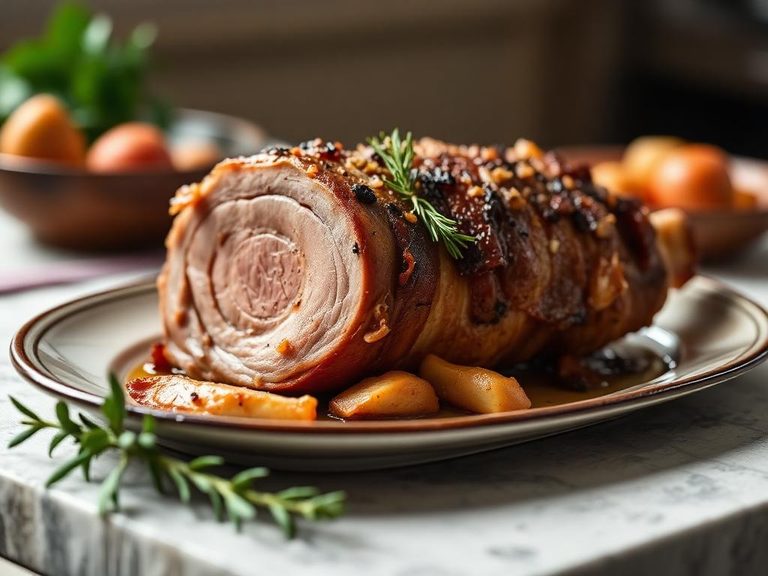
Roast pork is a savory, succulent cut of meat, typically from the shoulder or loin, that develops a rich, caramelized crust and tender, juicy interior when cooked low and slow. Its flavor is deep and meaty, with a satisfying chew that varies from melt-in-your-mouth tender to pleasantly firm depending on the cut. Nutritionally, it's a powerhouse of high-quality protein with minimal carbohydrates and a moderate amount of fat.
Calorie split: 61% protein · 0% carbs · 39% fat
↓ Full nutrition💚 Why it's loved
People adore roast pork for its incredible versatility—it can be seasoned with a simple herb rub, a sweet glaze, or a complex spice blend to suit any palate. It's a centerpiece of comfort food and celebratory feasts across countless cultures, from Sunday family dinners to holiday traditions.
⚠️ Watch-outs & how to enjoy it better
Some cuts, like pork shoulder, can be high in saturated fat, which should be considered for heart-health diets. To counteract this, trim visible fat before cooking, opt for leaner loin cuts, and practice portion control. Additionally, processed roast pork products (like deli slices) can be high in sodium; choosing freshly roasted and unseasoned meat allows you to control salt intake.
Key benefits
- Excellent source of complete protein for muscle maintenance.
- Provides essential minerals like zinc and selenium.
- Naturally zero in carbohydrates and sugars.
- Rich in B vitamins, particularly thiamine (B1).
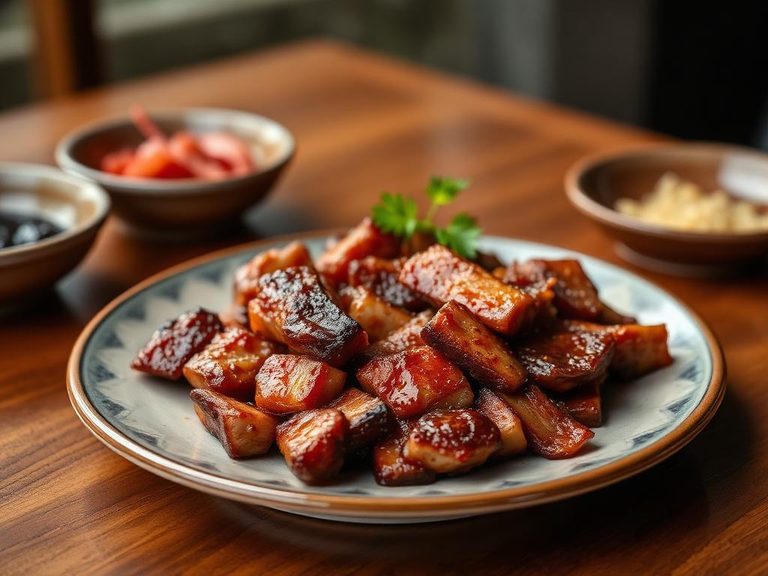
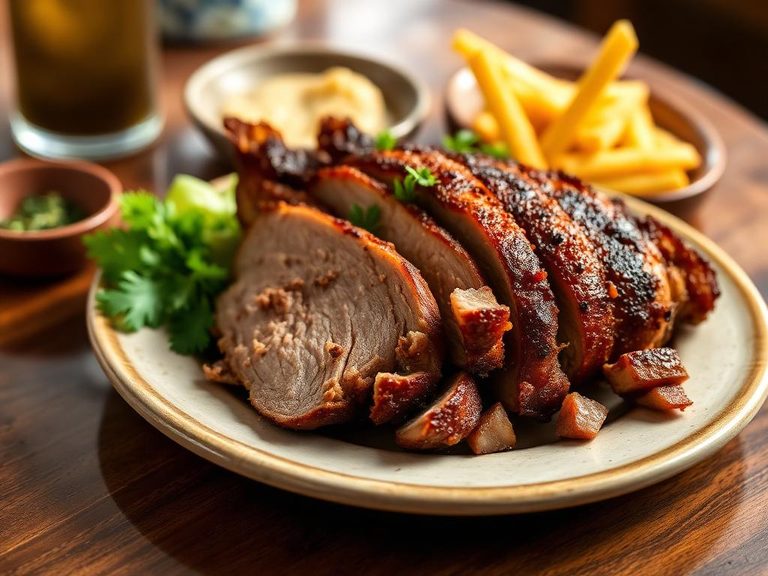
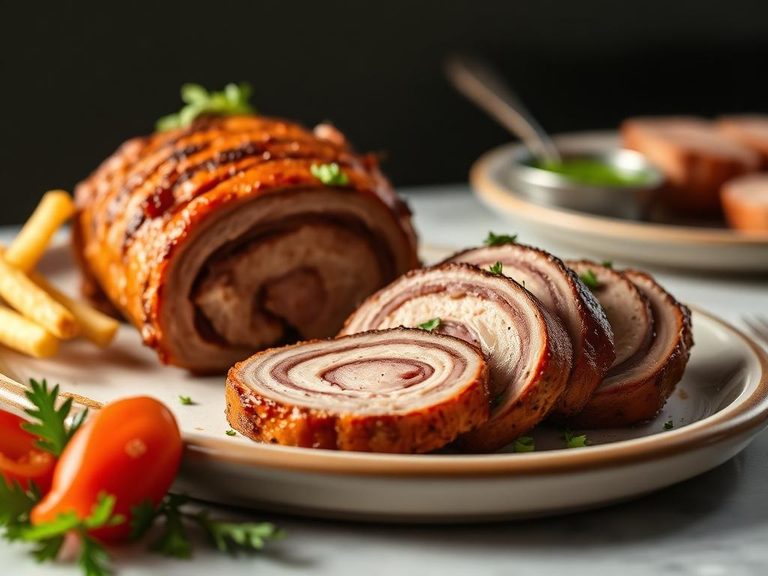
🍽️ Popular dishes
🌍 Where it's eaten
💡 Did you know?
The prized crispy skin on a roast pork, known as 'crackling,' is achieved by scoring the skin, rubbing it with salt, and cooking it at a high temperature to render the fat and puff the skin into a crunchy, golden layer.
Full nutrition (USDA data · scales with serving)
| Water | 64.2 g |
| Energy | 181 kcal |
| Protein | 26.6 g |
| Total lipid (fat) | 7.5 g |
| Carbohydrate, by difference | 0.00 g |
| Fiber, total dietary | 0.00 g |
| Total Sugars | 0.00 g |
| Calcium, Ca | 7.0 mg |
| Iron, Fe | 0.64 mg |
| Magnesium, Mg | 25.0 mg |
| Phosphorus, P | 223 mg |
| Potassium, K | 350 mg |
| Sodium, Na | 353 mg |
| Zinc, Zn | 2.1 mg |
| Copper, Cu | 0.08 mg |
| Selenium, Se | 35.1 ug |
| Vitamin C, total ascorbic acid | 0.00 mg |
| Thiamin | 0.55 mg |
| Riboflavin | 0.23 mg |
| Niacin | 7.1 mg |
| Vitamin B-6 | 0.70 mg |
| Folate, total | 0.00 ug |
| Folic acid | 0.00 ug |
| Folate, food | 0.00 ug |
| Folate, DFE | 0.00 ug |
| Choline, total | 75.8 mg |
| Vitamin B-12 | 0.56 ug |
| Vitamin B-12, added | 0.00 ug |
| Vitamin A, RAE | 0.00 ug |
| Retinol | 0.00 ug |
| Carotene, beta | 0.00 ug |
| Carotene, alpha | 0.00 ug |
| Cryptoxanthin, beta | 0.00 ug |
| Lycopene | 0.00 ug |
| Lutein + zeaxanthin | 0.00 ug |
| Vitamin E (alpha-tocopherol) | 0.10 mg |
| Vitamin E, added | 0.00 mg |
| Vitamin D (D2 + D3) | 0.40 ug |
| Vitamin K (phylloquinone) | 0.00 ug |
| Alcohol, ethyl | 0.00 g |
| Caffeine | 0.00 mg |
| Theobromine | 0.00 mg |
Fat & fatty acid profile (per 100g)
| Fatty acids, total saturated | 2.4 g |
| SFA 4:0 | 0.00 g |
| SFA 6:0 | 0.00 g |
| SFA 8:0 | 0.00 g |
| SFA 10:0 | 0.00 g |
| SFA 12:0 | 0.00 g |
| SFA 14:0 | 0.08 g |
| SFA 16:0 | 1.5 g |
| SFA 18:0 | 0.78 g |
| Fatty acids, total monounsaturated | 3.0 g |
| MUFA 16:1 | 0.17 g |
| MUFA 18:1 | 2.7 g |
| MUFA 20:1 | 0.05 g |
| MUFA 22:1 | 0.00 g |
| Fatty acids, total polyunsaturated | 0.81 g |
| PUFA 18:2 | 0.70 g |
| PUFA 18:3 | 0.03 g |
| PUFA 18:4 | 0.00 g |
| PUFA 20:4 | 0.05 g |
| PUFA 20:5 n-3 (EPA) | 0.00 g |
| PUFA 22:5 n-3 (DPA) | 0.00 g |
| PUFA 22:6 n-3 (DHA) | 0.00 g |
| Cholesterol | 79.0 mg |
Amino acid profile (per 100g)
Estimated from Pork, cured, salt pork, raw — USDA does not publish this profile for Pork.
| Tryptophan | 0.02 g |
| Threonine | 0.17 g |
| Isoleucine | 0.13 g |
| Leucine | 0.35 g |
| Lysine | 0.42 g |
| Methionine | 0.07 g |
| Cystine | 0.04 g |
| Phenylalanine | 0.19 g |
| Tyrosine | 0.08 g |
| Valine | 0.24 g |
| Arginine | 0.52 g |
| Histidine | 0.06 g |
| Alanine | 0.28 g |
| Aspartic acid | 0.42 g |
| Glutamic acid | 0.69 g |
| Glycine | 0.36 g |
| Proline | 0.27 g |
| Serine | 0.19 g |
FAQ
What's the best cut for roast pork?
It depends on your goal. For lean, tender slices, choose the loin. For rich, fall-apart meat perfect for shredding, the shoulder (or 'butt') is ideal. For a show-stopping centerpiece with crispy skin, a pork belly or leg with skin-on is excellent.
How do I prevent roast pork from drying out?
Use a meat thermometer to cook to the correct internal temperature (145°F/63°C for medium with a rest time). For shoulder, cook longer to break down connective tissue. Basting or using a roasting pan with liquid can also add moisture.
Is roast pork healthy?
As a lean protein source, it can be part of a healthy diet. The loin cut is particularly lean. The healthiness depends on the cut, cooking method, and portion size. Pairing it with vegetables and whole grains creates a balanced meal.
Nutrient density (calculated · NRF9.3)
Nutrient Rich Foods index: beneficial nutrients (protein, fiber, vitamins, minerals) minus saturated fat, added sugar & sodium, per 100 kcal.
NRF9.3 index — Fulgoni, Keast & Drewnowski, 2009. Computed from USDA nutrients.
Weight-loss friendliness (composite index)
Energy density 1.81 kcal/g · 59% calories from protein · 0.0 g fiber · 0.0 g sugar per 100 g.
Composite of energy density (Rolls et al., 1999), protein & fiber satiety, minus sugar. A calculated heuristic — ranks satiety-per-calorie, not a clinical measure.
Dietary load (calculated from USDA values)
Potential renal acid load. Positive = acid-forming, negative = alkaline-forming.
Sodium-to-potassium ratio: 1.01 (lower is better — aim for ≤ 1)
Sodium:potassium per WHO potassium guidance. Computed from USDA nutrients.