

Pizza with meat other than pepperoni, from frozen, thick crust
Common food
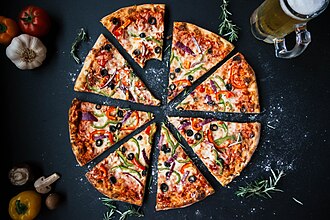
Photo: Wikipedia
A hearty, thick-crust frozen pizza topped with savory meats like sausage, ham, or bacon, offering a satisfyingly chewy base and a rich, savory flavor profile. Each 100g serving provides a balanced mix of protein and carbohydrates, with a notable fat content that contributes to its indulgent texture and taste. It's a convenient, comforting meal that combines the convenience of frozen food with the classic appeal of a meat-loaded pizza.
Calorie split: 16% protein · 41% carbs · 43% fat
↓ Full nutrition💚 Why it's loved
People love this pizza for its comforting, hearty nature—the thick crust offers a satisfying chew, while the variety of meats adds a rich, savory depth that feels indulgent. It's a versatile crowd-pleaser, perfect for casual dinners, game nights, or as a nostalgic comfort food that brings people together.
⚠️ Watch-outs & how to enjoy it better
The high fat and sodium content, typical of frozen meats and processed crusts, can be a concern for those monitoring heart health or blood pressure. Additionally, the refined carbohydrates in the thick crust may cause blood sugar spikes, especially for individuals with insulin sensitivity. To counteract these, pair it with a side of leafy greens or a simple salad to add fiber and slow digestion, and practice portion control by sticking to a single serving (around 118g) to manage intake.
Key benefits
- Provides a good source of protein (10.75g per 100g) for muscle maintenance and satiety.
- Offers a substantial amount of carbohydrates (27.68g per 100g) for quick energy, ideal for active individuals.
- Contains dietary fiber (2.1g per 100g) which can aid in digestion and promote a feeling of fullness.
- Serves as a convenient, quick-to-prepare meal option for busy lifestyles or casual gatherings.
- The thick crust provides a satisfying, doughy texture that many find comforting and filling.
🍽️ Popular dishes


🌍 Where it's eaten
💡 Did you know?
The thick-crust style, often associated with Chicago deep-dish pizza, was invented in 1943 at Pizzeria Uno, where the crust was designed to hold layers of cheese and toppings like a savory pie.
Full nutrition (USDA data · scales with serving)
| Water | 46.5 g |
| Energy | 270 kcal |
| Protein | 10.8 g |
| Total lipid (fat) | 13.0 g |
| Carbohydrate, by difference | 27.7 g |
| Fiber, total dietary | 2.1 g |
| Total Sugars | 3.5 g |
| Calcium, Ca | 171 mg |
| Iron, Fe | 2.2 mg |
| Magnesium, Mg | 23.0 mg |
| Phosphorus, P | 177 mg |
| Potassium, K | 160 mg |
| Sodium, Na | 463 mg |
| Zinc, Zn | 1.4 mg |
| Copper, Cu | 0.22 mg |
| Selenium, Se | 21.4 ug |
| Vitamin C, total ascorbic acid | 1.1 mg |
| Thiamin | 0.21 mg |
| Riboflavin | 0.26 mg |
| Niacin | 2.4 mg |
| Vitamin B-6 | 0.10 mg |
| Folate, total | 36.0 ug |
| Folic acid | 36.0 ug |
| Folate, food | 0.00 ug |
| Folate, DFE | 62.0 ug |
| Choline, total | 16.9 mg |
| Vitamin B-12 | 0.79 ug |
| Vitamin B-12, added | 0.00 ug |
| Vitamin A, RAE | 64.0 ug |
| Retinol | 56.0 ug |
| Carotene, beta | 84.0 ug |
| Carotene, alpha | 0.00 ug |
| Cryptoxanthin, beta | 0.00 ug |
| Lycopene | 1738 ug |
| Lutein + zeaxanthin | 32.0 ug |
| Vitamin E (alpha-tocopherol) | 1.0 mg |
| Vitamin E, added | 0.00 mg |
| Vitamin D (D2 + D3) | 0.00 ug |
| Vitamin K (phylloquinone) | 6.3 ug |
| Alcohol, ethyl | 0.00 g |
| Caffeine | 0.00 mg |
| Theobromine | 0.00 mg |
Fat & fatty acid profile (per 100g)
| Fatty acids, total saturated | 4.5 g |
| SFA 4:0 | 0.26 g |
| SFA 6:0 | 0.05 g |
| SFA 8:0 | 0.08 g |
| SFA 10:0 | 0.11 g |
| SFA 12:0 | 0.14 g |
| SFA 14:0 | 0.45 g |
| SFA 16:0 | 2.2 g |
| SFA 18:0 | 1.2 g |
| Fatty acids, total monounsaturated | 4.6 g |
| MUFA 16:1 | 0.15 g |
| MUFA 18:1 | 4.4 g |
| MUFA 20:1 | 0.04 g |
| MUFA 22:1 | 0.00 g |
| Fatty acids, total polyunsaturated | 2.1 g |
| PUFA 18:2 | 1.8 g |
| PUFA 18:3 | 0.17 g |
| PUFA 18:4 | 0.04 g |
| PUFA 20:4 | 0.02 g |
| PUFA 20:5 n-3 (EPA) | 0.00 g |
| PUFA 22:5 n-3 (DPA) | 0.00 g |
| PUFA 22:6 n-3 (DHA) | 0.00 g |
| Cholesterol | 17.0 mg |
Amino acid profile (per 100g)
Estimated from Fast Food, Pizza Chain, 14" pizza, meat and vegetable topping, regular crust — USDA does not publish this profile for Pizza with meat other than pepperoni.
| Tryptophan | 0.11 g |
| Threonine | 0.40 g |
| Isoleucine | 0.48 g |
| Leucine | 0.92 g |
| Lysine | 0.61 g |
| Methionine | 0.22 g |
| Cystine | 0.18 g |
| Phenylalanine | 0.55 g |
| Tyrosine | 0.39 g |
| Valine | 0.58 g |
| Arginine | 0.51 g |
| Histidine | 0.33 g |
| Alanine | 0.45 g |
| Aspartic acid | 0.86 g |
| Glutamic acid | 2.9 g |
| Glycine | 0.42 g |
| Proline | 1.1 g |
| Serine | 0.60 g |
| Hydroxyproline | 0.01 g |
FAQ
Is this pizza suitable for a high-protein diet?
While it provides a decent amount of protein (10.75g per 100g), it's also high in fat and carbohydrates, so it may not be ideal for strict high-protein diets unless portion-controlled and paired with additional protein sources.
How can I reduce the sodium content when eating this pizza?
To lower sodium intake, opt for a smaller portion, pair it with low-sodium sides like fresh vegetables, and avoid adding extra salty toppings or dipping sauces.
Can this pizza be part of a balanced meal?
Yes, by balancing it with a side of fiber-rich vegetables or a salad, and ensuring the rest of your daily meals are lower in sodium and saturated fat, you can incorporate it into a balanced diet.
Nutrient density (calculated · NRF9.3)
Nutrient Rich Foods index: beneficial nutrients (protein, fiber, vitamins, minerals) minus saturated fat, added sugar & sodium, per 100 kcal.
NRF9.3 index — Fulgoni, Keast & Drewnowski, 2009. Computed from USDA nutrients.
Weight-loss friendliness (composite index)
Energy density 2.70 kcal/g · 16% calories from protein · 2.1 g fiber · 3.5 g sugar per 100 g.
Composite of energy density (Rolls et al., 1999), protein & fiber satiety, minus sugar. A calculated heuristic — ranks satiety-per-calorie, not a clinical measure.
Dietary load (calculated from USDA values)
Potential renal acid load. Positive = acid-forming, negative = alkaline-forming.
Sodium-to-potassium ratio: 2.89 (lower is better — aim for ≤ 1)
Sodium:potassium per WHO potassium guidance. Computed from USDA nutrients.