

Pizza, with meat other than pepperoni, from school lunch, thick crust
Common food

Photo: Wikipedia
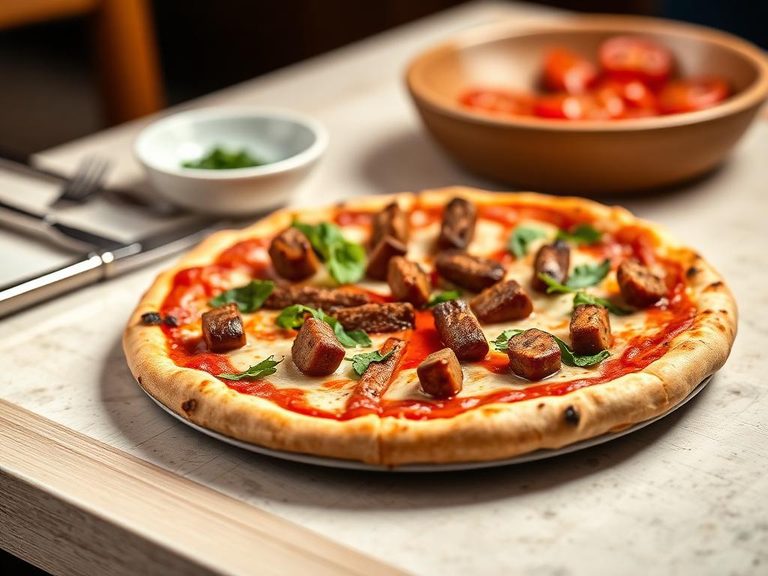
This is a hearty, thick-crust school lunch pizza slice topped with a savory blend of meats like sausage, ham, or ground beef. It offers a satisfying chew from the bready base and a rich, salty-savory flavor from the protein-packed topping. With a solid 13.26g of protein per 100g, it's a more substantial meal than many might expect from a school cafeteria staple.
Calorie split: 21% protein · 48% carbs · 32% fat
↓ Full nutrition💚 Why it's loved
People love it for the comforting, nostalgic combination of warm, chewy bread, melted cheese, and savory meat toppings. It's a versatile canvas that satisfies hearty appetites and is often a highlight of the school lunch menu.
⚠️ Watch-outs & how to enjoy it better
The thick crust and processed meats can lead to a significant blood-sugar spike and are often high in sodium. To counteract this, pair a smaller portion with a side salad or vegetable to add fiber and slow digestion. Choosing a slice with less cheese and meat, or blotting excess grease, can also reduce saturated fat and sodium intake.
Key benefits
- Provides a good source of protein for muscle maintenance and satiety.
- Offers a convenient, calorie-dense energy source for active individuals.
- Contains dietary fiber, especially if the crust includes whole grains.
- Serves as a familiar, comforting food that can encourage eating in school settings.
🍽️ Popular dishes


🌍 Where it's eaten
💡 Did you know?
The U.S. Department of Agriculture has specific guidelines for school lunch pizza, requiring it to contain a minimum amount of tomato paste and often mandating that the crust be made with enriched flour.
Full nutrition (USDA data · scales with serving)
| Water | 45.3 g |
| Energy | 257 kcal |
| Protein | 13.3 g |
| Total lipid (fat) | 9.1 g |
| Carbohydrate, by difference | 30.6 g |
| Fiber, total dietary | 4.0 g |
| Total Sugars | 3.7 g |
| Calcium, Ca | 168 mg |
| Iron, Fe | 2.2 mg |
| Magnesium, Mg | 23.0 mg |
| Phosphorus, P | 279 mg |
| Potassium, K | 282 mg |
| Sodium, Na | 433 mg |
| Zinc, Zn | 1.6 mg |
| Copper, Cu | 0.12 mg |
| Selenium, Se | 25.0 ug |
| Vitamin C, total ascorbic acid | 0.40 mg |
| Thiamin | 0.33 mg |
| Riboflavin | 0.31 mg |
| Niacin | 4.1 mg |
| Vitamin B-6 | 0.12 mg |
| Folate, total | 81.0 ug |
| Folic acid | 56.0 ug |
| Folate, food | 25.0 ug |
| Folate, DFE | 120 ug |
| Choline, total | 29.1 mg |
| Vitamin B-12 | 0.34 ug |
| Vitamin B-12, added | 0.00 ug |
| Vitamin A, RAE | 60.0 ug |
| Retinol | 54.0 ug |
| Carotene, beta | 78.0 ug |
| Carotene, alpha | 0.00 ug |
| Cryptoxanthin, beta | 0.00 ug |
| Lycopene | 1944 ug |
| Lutein + zeaxanthin | 23.0 ug |
| Vitamin E (alpha-tocopherol) | 0.75 mg |
| Vitamin E, added | 0.00 mg |
| Vitamin D (D2 + D3) | 0.00 ug |
| Vitamin K (phylloquinone) | 3.3 ug |
| Alcohol, ethyl | 0.00 g |
| Caffeine | 0.00 mg |
| Theobromine | 0.00 mg |
Fat & fatty acid profile (per 100g)
| Fatty acids, total saturated | 4.2 g |
| SFA 4:0 | 0.11 g |
| SFA 6:0 | 0.09 g |
| SFA 8:0 | 0.06 g |
| SFA 10:0 | 0.14 g |
| SFA 12:0 | 0.16 g |
| SFA 14:0 | 0.54 g |
| SFA 16:0 | 2.1 g |
| SFA 18:0 | 0.78 g |
| Fatty acids, total monounsaturated | 2.9 g |
| MUFA 16:1 | 0.29 g |
| MUFA 18:1 | 2.5 g |
| MUFA 20:1 | 0.01 g |
| MUFA 22:1 | 0.00 g |
| Fatty acids, total polyunsaturated | 1.2 g |
| PUFA 18:2 | 1.1 g |
| PUFA 18:3 | 0.09 g |
| PUFA 18:4 | 0.00 g |
| PUFA 20:4 | 0.03 g |
| PUFA 20:5 n-3 (EPA) | 0.00 g |
| PUFA 22:5 n-3 (DPA) | 0.01 g |
| PUFA 22:6 n-3 (DHA) | 0.01 g |
| Cholesterol | 26.0 mg |
Amino acid profile (per 100g)
Estimated from Fast Food, Pizza Chain, 14" pizza, cheese topping, stuffed crust — USDA does not publish this profile for Pizza.
| Tryptophan | 0.12 g |
| Threonine | 0.39 g |
| Isoleucine | 0.57 g |
| Leucine | 1.1 g |
| Lysine | 0.59 g |
| Methionine | 0.27 g |
| Phenylalanine | 0.64 g |
| Tyrosine | 0.40 g |
| Valine | 0.71 g |
| Arginine | 0.44 g |
| Histidine | 0.32 g |
| Alanine | 0.38 g |
| Aspartic acid | 0.81 g |
| Glutamic acid | 3.4 g |
| Glycine | 0.31 g |
| Proline | 1.7 g |
| Serine | 0.58 g |
| Hydroxyproline | 0.00 g |
FAQ
How does this differ from a standard pepperoni pizza?
The primary difference is the topping. This uses a blend of other meats like sausage, ham, or ground beef, which can alter the flavor profile, fat content, and texture compared to the uniform spiciness of pepperoni.
Is the thick crust healthier than thin crust?
Not necessarily. A thick crust typically means more calories and carbohydrates per slice. However, it may provide more fiber if made with whole grains, and its density can make the slice more filling.
Why is school lunch pizza often a rectangle?
Rectangular or square slices are easier to produce in large, sheet-pan batches for institutional cafeterias. This shape, often called 'sheet pizza' or 'Sicilian-style,' maximizes efficiency and ensures uniform portioning.
Nutrient density (calculated · NRF9.3)
Nutrient Rich Foods index: beneficial nutrients (protein, fiber, vitamins, minerals) minus saturated fat, added sugar & sodium, per 100 kcal.
NRF9.3 index — Fulgoni, Keast & Drewnowski, 2009. Computed from USDA nutrients.
Weight-loss friendliness (composite index)
Energy density 2.57 kcal/g · 21% calories from protein · 4.0 g fiber · 3.7 g sugar per 100 g.
Composite of energy density (Rolls et al., 1999), protein & fiber satiety, minus sugar. A calculated heuristic — ranks satiety-per-calorie, not a clinical measure.
Dietary load (calculated from USDA values)
Potential renal acid load. Positive = acid-forming, negative = alkaline-forming.
Sodium-to-potassium ratio: 1.54 (lower is better — aim for ≤ 1)
Sodium:potassium per WHO potassium guidance. Computed from USDA nutrients.