

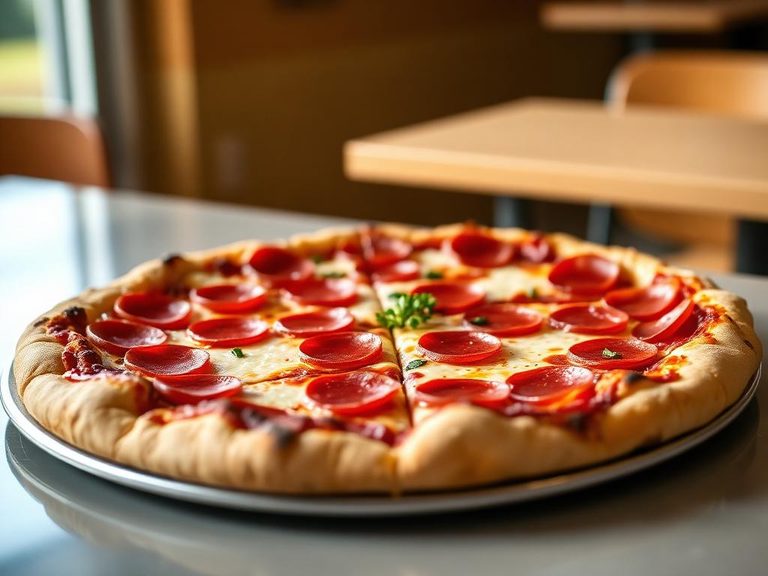
Pizza with pepperoni, from school lunch, thick crust
Common food
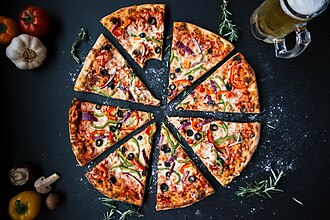
Photo: Wikipedia
This is a hearty, thick-crust pepperoni pizza slice, typically served in school cafeterias, offering a satisfyingly chewy base topped with savory, slightly spicy pepperoni and melted cheese. Its dense, bready texture provides a comforting mouthfeel, while the pepperoni adds a salty, umami punch. Nutritionally, it delivers a solid protein boost (14.35g per 100g) and significant fiber (4.3g per 100g), making it more substantial than a thin-crust alternative.
Calorie split: 22% protein · 44% carbs · 34% fat
↓ Full nutrition💚 Why it's loved
People love it for its comforting, familiar flavors—the combination of salty pepperoni, tangy tomato sauce, and melted cheese on a thick, chewy crust is a classic comfort food. It's also incredibly versatile, easily customizable with different toppings, and holds a special place in school lunch culture as a highly anticipated meal.
⚠️ Watch-outs & how to enjoy it better
The thick crust and high-fat pepperoni can lead to blood sugar spikes and a heavy, sluggish feeling if overeaten, and the sodium content is often high. To counteract this, pair it with a side salad or vegetables to add volume and fiber, practice portion control by limiting to one slice, and choose a water or unsweetened drink instead of soda.
Key benefits
- High protein content supports muscle maintenance and satiety.
- Good source of dietary fiber, aiding digestion and fullness.
- Provides a quick energy boost from carbohydrates.
- Contains calcium from cheese for bone health.
- Offers a balanced mix of macronutrients for a meal.
🍽️ Popular dishes
🌍 Where it's eaten
💡 Did you know?
The thick crust of school lunch pizza is often made with a dough that includes added sugar and oil, which helps it stay soft and chewy even after being reheated in a cafeteria oven.
Full nutrition (USDA data · scales with serving)
| Water | 45.3 g |
| Energy | 259 kcal |
| Protein | 14.3 g |
| Total lipid (fat) | 9.8 g |
| Carbohydrate, by difference | 28.3 g |
| Fiber, total dietary | 4.3 g |
| Total Sugars | 4.0 g |
| Calcium, Ca | 155 mg |
| Iron, Fe | 2.5 mg |
| Magnesium, Mg | 41.0 mg |
| Phosphorus, P | 305 mg |
| Potassium, K | 308 mg |
| Sodium, Na | 474 mg |
| Zinc, Zn | 1.9 mg |
| Copper, Cu | 0.08 mg |
| Selenium, Se | 22.0 ug |
| Vitamin C, total ascorbic acid | 0.20 mg |
| Thiamin | 0.21 mg |
| Riboflavin | 0.28 mg |
| Niacin | 2.5 mg |
| Vitamin B-6 | 0.14 mg |
| Folate, total | 59.0 ug |
| Folic acid | 39.0 ug |
| Folate, food | 20.0 ug |
| Folate, DFE | 87.0 ug |
| Choline, total | 23.2 mg |
| Vitamin B-12 | 1.2 ug |
| Vitamin B-12, added | 0.00 ug |
| Vitamin A, RAE | 43.0 ug |
| Retinol | 36.0 ug |
| Carotene, beta | 83.0 ug |
| Carotene, alpha | 0.00 ug |
| Cryptoxanthin, beta | 0.00 ug |
| Lycopene | 1839 ug |
| Lutein + zeaxanthin | 21.0 ug |
| Vitamin E (alpha-tocopherol) | 0.81 mg |
| Vitamin E, added | 0.00 mg |
| Vitamin D (D2 + D3) | 0.00 ug |
| Vitamin K (phylloquinone) | 10.8 ug |
| Alcohol, ethyl | 0.00 g |
| Caffeine | 0.00 mg |
| Theobromine | 0.00 mg |
Fat & fatty acid profile (per 100g)
| Fatty acids, total saturated | 4.2 g |
| SFA 4:0 | 0.12 g |
| SFA 6:0 | 0.10 g |
| SFA 8:0 | 0.06 g |
| SFA 10:0 | 0.15 g |
| SFA 12:0 | 0.17 g |
| SFA 14:0 | 0.60 g |
| SFA 16:0 | 2.1 g |
| SFA 18:0 | 0.89 g |
| Fatty acids, total monounsaturated | 2.9 g |
| MUFA 16:1 | 0.15 g |
| MUFA 18:1 | 2.3 g |
| MUFA 20:1 | 0.02 g |
| MUFA 22:1 | 0.00 g |
| Fatty acids, total polyunsaturated | 1.2 g |
| PUFA 18:2 | 0.70 g |
| PUFA 18:3 | 0.06 g |
| PUFA 18:4 | 0.00 g |
| PUFA 20:4 | 0.01 g |
| PUFA 20:5 n-3 (EPA) | 0.00 g |
| PUFA 22:5 n-3 (DPA) | 0.00 g |
| PUFA 22:6 n-3 (DHA) | 0.00 g |
| Cholesterol | 24.0 mg |
Amino acid profile (per 100g)
Estimated from PIZZA HUT 12" Pepperoni Pizza, Hand-Tossed Crust — USDA does not publish this profile for Pizza with pepperoni.
| Tryptophan | 0.12 g |
| Threonine | 0.42 g |
| Isoleucine | 0.54 g |
| Leucine | 1.1 g |
| Lysine | 0.76 g |
| Methionine | 0.27 g |
| Cystine | 0.18 g |
| Phenylalanine | 0.63 g |
| Tyrosine | 0.48 g |
| Valine | 0.67 g |
| Arginine | 0.54 g |
| Histidine | 0.36 g |
| Alanine | 0.49 g |
| Aspartic acid | 0.85 g |
| Glutamic acid | 3.3 g |
| Glycine | 0.45 g |
| Proline | 1.2 g |
| Serine | 0.66 g |
FAQ
Is thick-crust pepperoni pizza healthy?
It can be part of a balanced diet if eaten in moderation. It provides protein and fiber, but is also high in sodium and fat. Pairing it with vegetables and watching portion sizes helps balance it out.
How does thick-crust pizza differ nutritionally from thin-crust?
Thick-crust pizza generally has more calories and carbohydrates per slice due to the extra dough, but it also provides more fiber and can be more filling. Thin-crust versions are lighter but may leave you less satisfied.
Can I make a healthier version at home?
Yes! Use whole-wheat or cauliflower crust, load up on vegetable toppings, use lean turkey pepperoni, and opt for part-skim mozzarella to reduce fat and increase fiber.
Nutrient density (calculated · NRF9.3)
Nutrient Rich Foods index: beneficial nutrients (protein, fiber, vitamins, minerals) minus saturated fat, added sugar & sodium, per 100 kcal.
NRF9.3 index — Fulgoni, Keast & Drewnowski, 2009. Computed from USDA nutrients.
Weight-loss friendliness (composite index)
Energy density 2.59 kcal/g · 22% calories from protein · 4.3 g fiber · 4.0 g sugar per 100 g.
Composite of energy density (Rolls et al., 1999), protein & fiber satiety, minus sugar. A calculated heuristic — ranks satiety-per-calorie, not a clinical measure.
Dietary load (calculated from USDA values)
Potential renal acid load. Positive = acid-forming, negative = alkaline-forming.
Sodium-to-potassium ratio: 1.54 (lower is better — aim for ≤ 1)
Sodium:potassium per WHO potassium guidance. Computed from USDA nutrients.