

School Lunch, pizza, pepperoni topping, thick crust, whole grain, frozen, cooked
Whole food · Fast Foods
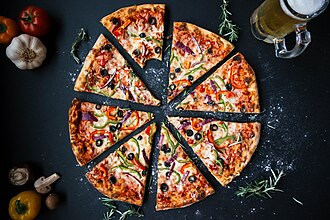
Photo: Wikipedia
This is a hearty, school-lunch staple: a thick, whole-grain crust topped with savory pepperoni and melted cheese, baked to a satisfying chew. The whole-grain base adds a nutty depth and a boost of fiber, while the pepperoni delivers a salty, spicy kick. It's a comforting, energy-dense meal that balances protein and carbs for sustained fuel.
Calorie split: 22% protein · 44% carbs · 34% fat
↓ Full nutrition💚 Why it's loved
People adore it for the classic, crave-worthy combination of salty pepperoni, gooey cheese, and a chewy, bready crust. It's a nostalgic comfort food that's both filling and easy to eat, making it a universal favorite in cafeterias and homes.
⚠️ Watch-outs & how to enjoy it better
The processed pepperoni and cheese can be high in sodium and saturated fat, which may concern those monitoring heart health or blood pressure. To counteract, pair a slice with a side salad or vegetables to add volume and nutrients without extra sodium, and practice portion control by enjoying one slice as part of a balanced meal.
Key benefits
- Whole-grain crust provides dietary fiber for digestive health.
- Good source of protein from cheese and pepperoni for muscle maintenance.
- Convenient, pre-portioned meal for quick preparation.
- Balanced macronutrients for a satisfying, energy-sustaining lunch.
🍽️ Popular dishes
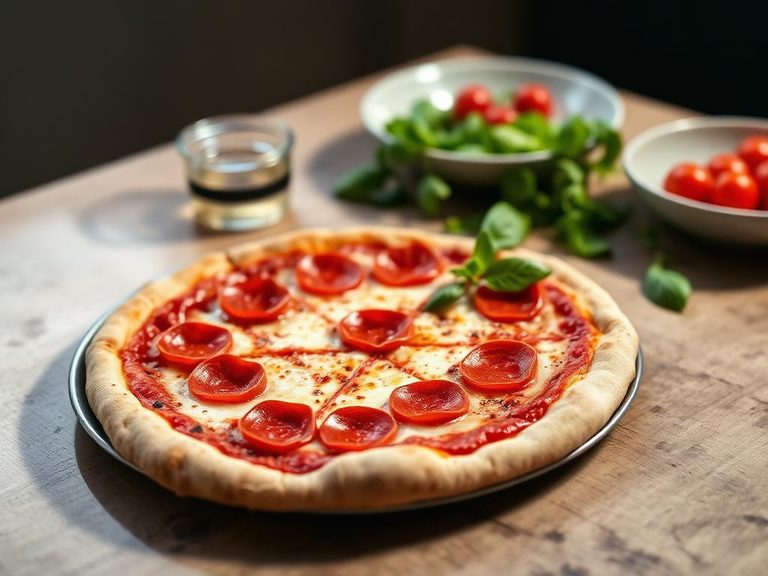



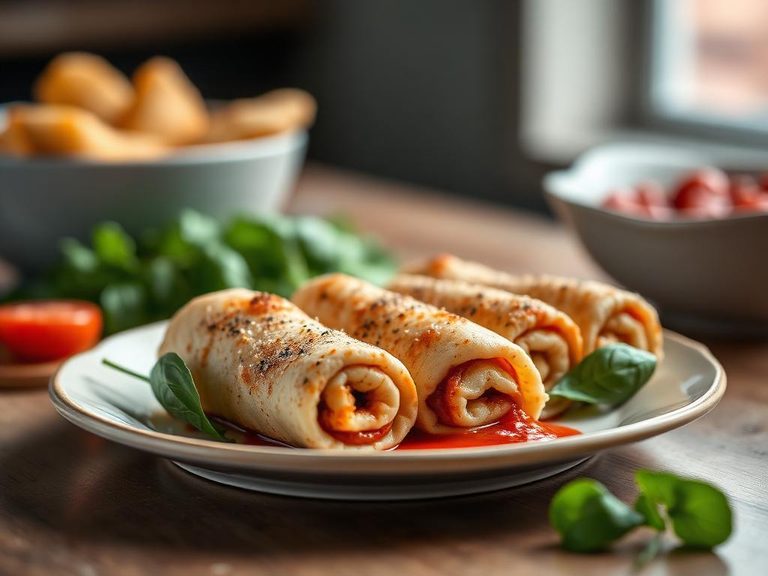
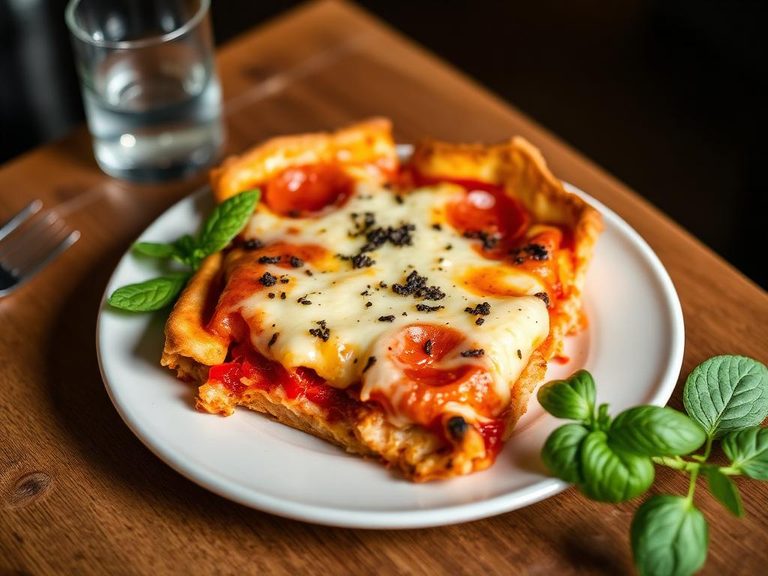
🌍 Where it's eaten
💡 Did you know?
Pepperoni is actually an Italian-American creation, not found in traditional Italian cuisine, and its name comes from the Italian word for 'bell pepper'.
Full nutrition (USDA data · scales with serving)
| Water | 45.3 g |
| Energy | 259 kcal |
| Energy | 1083 kj |
| Protein | 14.3 g |
| Total lipid (fat) | 9.8 g |
| Ash | 2.2 g |
| Carbohydrate, by difference | 28.3 g |
| Fiber, total dietary | 4.3 g |
| Total Sugars | 4.0 g |
| Calcium, Ca | 155 mg |
| Iron, Fe | 2.5 mg |
| Magnesium, Mg | 41.0 mg |
| Phosphorus, P | 305 mg |
| Potassium, K | 308 mg |
| Sodium, Na | 474 mg |
| Zinc, Zn | 1.9 mg |
| Copper, Cu | 0.08 mg |
| Manganese, Mn | 0.45 mg |
| Selenium, Se | 22.0 ug |
| Vitamin C, total ascorbic acid | 0.20 mg |
| Thiamin | 0.21 mg |
| Riboflavin | 0.28 mg |
| Niacin | 2.5 mg |
| Vitamin B-6 | 0.14 mg |
| Folate, total | 59.0 ug |
| Folic acid | 39.0 ug |
| Folate, food | 20.0 ug |
| Folate, DFE | 87.0 ug |
| Choline, total | 23.2 mg |
| Vitamin B-12 | 1.2 ug |
| Vitamin B-12, added | 0.00 ug |
| Vitamin A, RAE | 43.0 ug |
| Retinol | 36.0 ug |
| Carotene, beta | 83.0 ug |
| Carotene, alpha | 0.00 ug |
| Cryptoxanthin, beta | 0.00 ug |
| Vitamin A, IU | 257 iu |
| Lycopene | 1839 ug |
| Lutein + zeaxanthin | 21.0 ug |
| Vitamin E (alpha-tocopherol) | 0.81 mg |
| Vitamin E, added | 0.00 mg |
| Vitamin D (D2 + D3), International Units | 0.00 iu |
| Vitamin D (D2 + D3) | 0.00 ug |
| Vitamin K (phylloquinone) | 10.8 ug |
| Alcohol, ethyl | 0.00 g |
| Caffeine | 0.00 mg |
| Theobromine | 0.00 mg |
Fat & fatty acid profile (per 100g)
| Fatty acids, total saturated | 4.2 g |
| SFA 4:0 | 0.12 g |
| SFA 6:0 | 0.10 g |
| SFA 8:0 | 0.06 g |
| SFA 10:0 | 0.15 g |
| SFA 12:0 | 0.17 g |
| SFA 14:0 | 0.60 g |
| SFA 16:0 | 2.1 g |
| SFA 18:0 | 0.89 g |
| Fatty acids, total monounsaturated | 2.9 g |
| MUFA 16:1 | 0.15 g |
| MUFA 18:1 | 2.3 g |
| MUFA 20:1 | 0.02 g |
| MUFA 22:1 | 0.00 g |
| Fatty acids, total polyunsaturated | 1.2 g |
| PUFA 18:2 | 0.70 g |
| PUFA 18:3 | 0.06 g |
| PUFA 18:4 | 0.00 g |
| PUFA 20:4 | 0.01 g |
| PUFA 20:5 n-3 (EPA) | 0.00 g |
| PUFA 22:5 n-3 (DPA) | 0.00 g |
| PUFA 22:6 n-3 (DHA) | 0.00 g |
| Cholesterol | 24.0 mg |
FAQ
Is whole-grain pizza crust healthier than regular crust?
Yes, whole-grain crust retains the bran and germ, offering more fiber, vitamins, and minerals compared to refined white flour crust, which can help with digestion and blood sugar regulation.
How does frozen pizza compare nutritionally to fresh?
Frozen pizza can be comparable if made with quality ingredients, but it often contains more sodium and preservatives for shelf stability. Checking labels for sodium and added sugars is key.
Can this be part of a balanced diet?
Absolutely. When enjoyed in moderation alongside vegetables or a salad, it provides a good mix of carbs, protein, and fats. Opting for whole-grain versions adds nutritional value.
Nutrient density (calculated · NRF9.3)
Nutrient Rich Foods index: beneficial nutrients (protein, fiber, vitamins, minerals) minus saturated fat, added sugar & sodium, per 100 kcal.
NRF9.3 index — Fulgoni, Keast & Drewnowski, 2009. Computed from USDA nutrients.
Weight-loss friendliness (composite index)
Energy density 2.59 kcal/g · 22% calories from protein · 4.3 g fiber · 4.0 g sugar per 100 g.
Composite of energy density (Rolls et al., 1999), protein & fiber satiety, minus sugar. A calculated heuristic — ranks satiety-per-calorie, not a clinical measure.
Dietary load (calculated from USDA values)
Potential renal acid load. Positive = acid-forming, negative = alkaline-forming.
Sodium-to-potassium ratio: 1.54 (lower is better — aim for ≤ 1)
Sodium:potassium per WHO potassium guidance. Computed from USDA nutrients.