

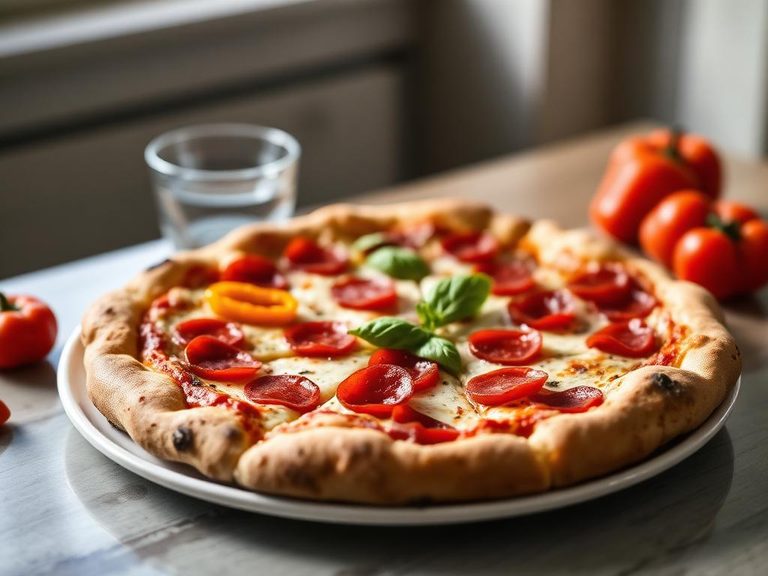
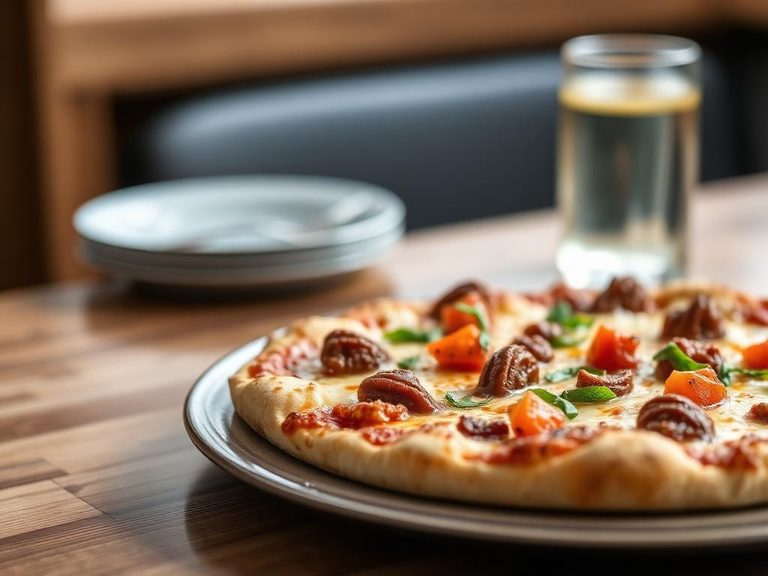
Pizza with extra meat and extra vegetables, thin crust
Common food

Photo: Wikipedia
This is a lean, protein-packed pizza with a satisfyingly crisp, cracker-like thin crust. It's loaded with savory meats and fresh vegetables, creating a complex texture and a robust, umami-rich flavor profile. At just 222 kcal per 100g, it offers a balanced macro split with a notable 11.43g of protein.
Calorie split: 21% protein · 42% carbs · 37% fat
↓ Full nutrition💚 Why it's loved
People adore the textural contrast between the shattering-crisp crust and the juicy, flavorful toppings. It's the ultimate customizable canvas, satisfying cravings for both hearty protein and fresh, garden vegetables in one iconic, shareable package.
⚠️ Watch-outs & how to enjoy it better
The combination of processed meats and cheese can be high in sodium, potentially causing water retention. The refined flour crust can still cause blood-sugar spikes for some. Counteract this by pairing a slice with a large, leafy green salad dressed in olive oil, which adds fiber and healthy fat to slow digestion.
Key benefits
- High protein content supports satiety and muscle maintenance.
- Thin crust reduces overall carbohydrate load versus traditional pizza.
- Vegetable toppings add dietary fiber, vitamins, and minerals.
- Balanced fat content from meats and cheese provides flavor and energy.
- Lower calorie density per serving allows for a more generous portion.
🍽️ Popular dishes

🌍 Where it's eaten
💡 Did you know?
The term 'pizza' first appeared in a Latin text from the town of Gaeta in 997 AD, though the dish we recognize today was invented in 18th-century Naples.
Full nutrition (USDA data · scales with serving)
| Water | 53.7 g |
| Energy | 222 kcal |
| Protein | 11.4 g |
| Total lipid (fat) | 9.2 g |
| Carbohydrate, by difference | 23.7 g |
| Fiber, total dietary | 1.9 g |
| Total Sugars | 2.9 g |
| Calcium, Ca | 134 mg |
| Iron, Fe | 2.2 mg |
| Magnesium, Mg | 21.0 mg |
| Phosphorus, P | 182 mg |
| Potassium, K | 201 mg |
| Sodium, Na | 452 mg |
| Zinc, Zn | 1.4 mg |
| Copper, Cu | 0.12 mg |
| Selenium, Se | 17.6 ug |
| Vitamin C, total ascorbic acid | 5.7 mg |
| Thiamin | 0.29 mg |
| Riboflavin | 0.19 mg |
| Niacin | 3.8 mg |
| Vitamin B-6 | 0.12 mg |
| Folate, total | 67.0 ug |
| Folic acid | 35.0 ug |
| Folate, food | 31.0 ug |
| Folate, DFE | 91.0 ug |
| Choline, total | 22.1 mg |
| Vitamin B-12 | 0.47 ug |
| Vitamin B-12, added | 0.00 ug |
| Vitamin A, RAE | 49.0 ug |
| Retinol | 42.0 ug |
| Carotene, beta | 81.0 ug |
| Carotene, alpha | 1.0 ug |
| Cryptoxanthin, beta | 0.00 ug |
| Lycopene | 1280 ug |
| Lutein + zeaxanthin | 80.0 ug |
| Vitamin E (alpha-tocopherol) | 0.71 mg |
| Vitamin E, added | 0.00 mg |
| Vitamin D (D2 + D3) | 0.00 ug |
| Vitamin K (phylloquinone) | 5.0 ug |
| Alcohol, ethyl | 0.00 g |
| Caffeine | 0.00 mg |
| Theobromine | 0.00 mg |
Fat & fatty acid profile (per 100g)
| Fatty acids, total saturated | 3.9 g |
| SFA 4:0 | 0.07 g |
| SFA 6:0 | 0.05 g |
| SFA 8:0 | 0.04 g |
| SFA 10:0 | 0.10 g |
| SFA 12:0 | 0.12 g |
| SFA 14:0 | 0.44 g |
| SFA 16:0 | 2.1 g |
| SFA 18:0 | 0.83 g |
| Fatty acids, total monounsaturated | 3.0 g |
| MUFA 16:1 | 0.15 g |
| MUFA 18:1 | 2.8 g |
| MUFA 20:1 | 0.04 g |
| MUFA 22:1 | 0.00 g |
| Fatty acids, total polyunsaturated | 1.4 g |
| PUFA 18:2 | 1.3 g |
| PUFA 18:3 | 0.13 g |
| PUFA 18:4 | 0.00 g |
| PUFA 20:4 | 0.02 g |
| PUFA 20:5 n-3 (EPA) | 0.00 g |
| PUFA 22:5 n-3 (DPA) | 0.00 g |
| PUFA 22:6 n-3 (DHA) | 0.00 g |
| Cholesterol | 23.0 mg |
Amino acid profile (per 100g)
Estimated from DOMINO'S 14" EXTRAVAGANZZA FEAST Pizza, Classic Hand-Tossed Crust — USDA does not publish this profile for Pizza with extra meat and extra vegetables.
| Tryptophan | 0.08 g |
| Threonine | 0.32 g |
| Isoleucine | 0.43 g |
| Leucine | 0.86 g |
| Lysine | 0.53 g |
| Methionine | 0.23 g |
| Cystine | 0.14 g |
| Phenylalanine | 0.52 g |
| Tyrosine | 0.34 g |
| Valine | 0.53 g |
| Arginine | 0.46 g |
| Histidine | 0.39 g |
| Alanine | 0.38 g |
| Aspartic acid | 0.75 g |
| Glutamic acid | 2.8 g |
| Glycine | 0.39 g |
| Proline | 1.5 g |
| Serine | 0.58 g |
FAQ
Is thin crust pizza healthier than regular crust?
Generally, yes. A thin crust uses less dough, resulting in fewer carbohydrates and calories per slice compared to a thicker, pan-style or deep-dish crust of the same diameter.
How can I make this pizza even more nutritious at home?
Use a whole-wheat or cauliflower-based thin crust, load up on non-starchy vegetables like spinach and broccoli, choose lean proteins like grilled chicken or turkey pepperoni, and go light on the cheese.
Why is the calorie count so specific (222 kcal)?
This reflects a precise nutritional analysis of a standardized recipe. Calorie counts can vary significantly based on exact ingredients, portion sizes, and preparation methods.
Nutrient density (calculated · NRF9.3)
Nutrient Rich Foods index: beneficial nutrients (protein, fiber, vitamins, minerals) minus saturated fat, added sugar & sodium, per 100 kcal.
NRF9.3 index — Fulgoni, Keast & Drewnowski, 2009. Computed from USDA nutrients.
Weight-loss friendliness (composite index)
Energy density 2.22 kcal/g · 21% calories from protein · 1.9 g fiber · 2.9 g sugar per 100 g.
Composite of energy density (Rolls et al., 1999), protein & fiber satiety, minus sugar. A calculated heuristic — ranks satiety-per-calorie, not a clinical measure.
Dietary load (calculated from USDA values)
Potential renal acid load. Positive = acid-forming, negative = alkaline-forming.
Sodium-to-potassium ratio: 2.25 (lower is better — aim for ≤ 1)
Sodium:potassium per WHO potassium guidance. Computed from USDA nutrients.