

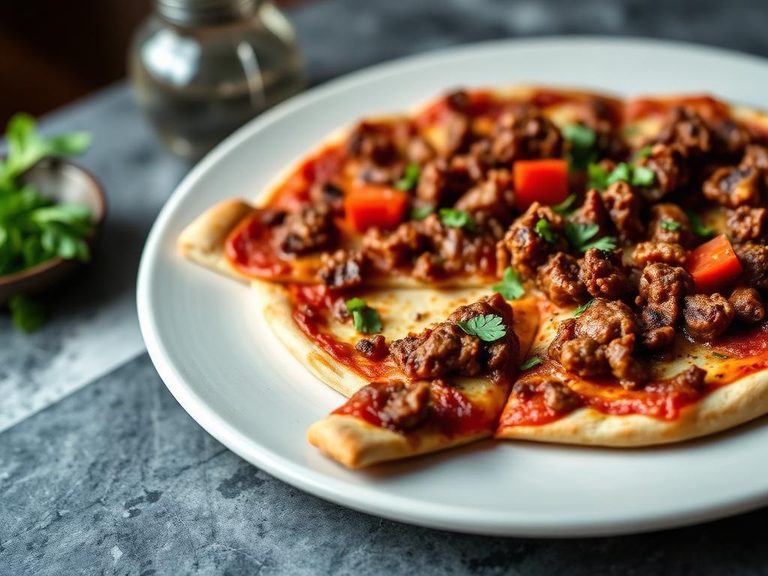
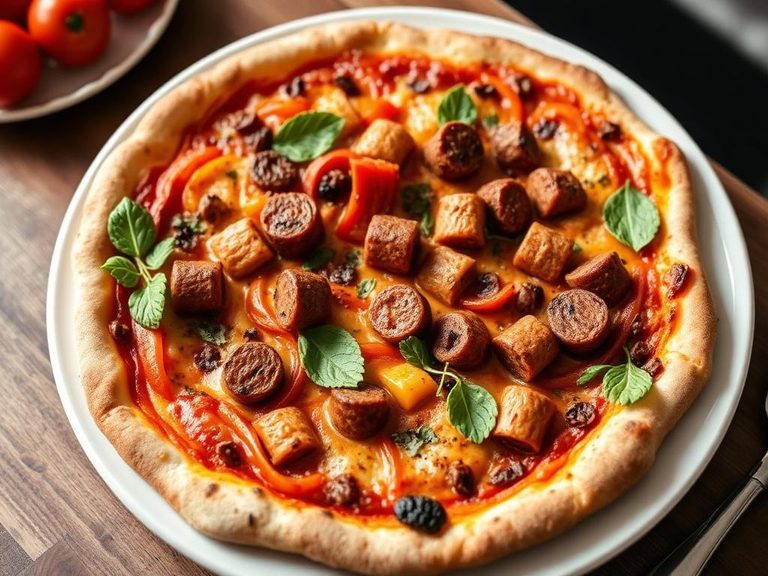
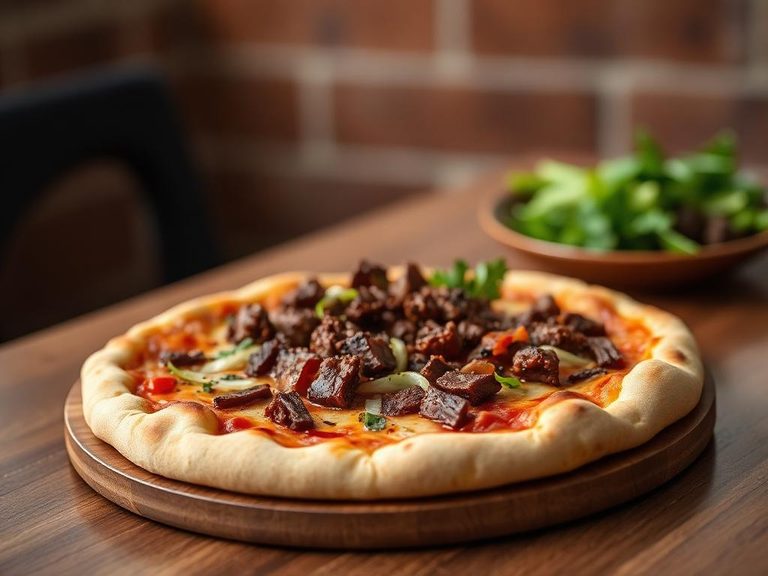
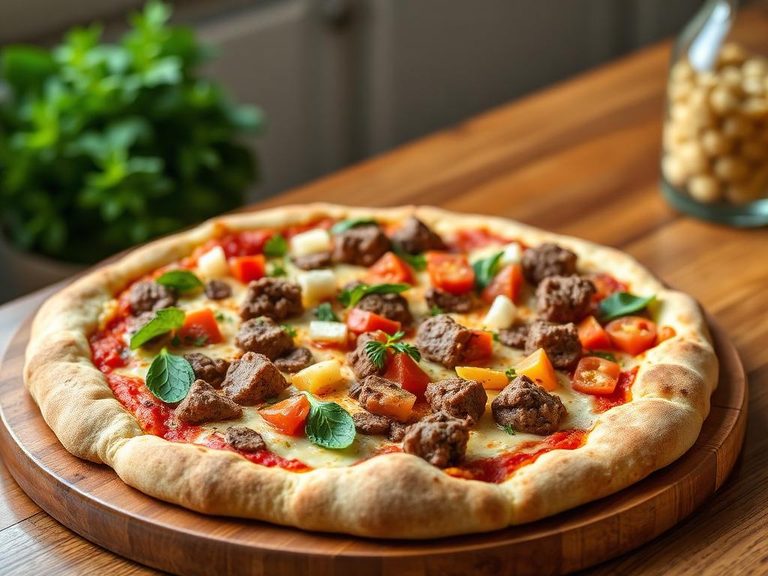
Pizza with extra meat and extra vegetables, thick crust
Common food

Photo: Wikipedia
A hearty, thick-crust pizza piled high with savory meats and crisp vegetables, offering a satisfying crunch and a rich, savory flavor profile. Its substantial base provides a chewy, bread-like foundation that balances the juicy toppings. Nutritionally, it delivers a solid protein punch from the meats, though it's more calorie-dense due to the generous toppings and thick dough.
Calorie split: 18% protein · 44% carbs · 37% fat
↓ Full nutrition💚 Why it's loved
People adore it for the customizable, indulgent experience—where every bite offers a perfect mix of chewy crust, savory meat, and fresh vegetables. It's a social food, deeply tied to gatherings, celebrations, and casual comfort.
⚠️ Watch-outs & how to enjoy it better
The thick crust and extra toppings can lead to a high calorie and sodium load, which may cause blood-sugar spikes or water retention. To counteract, pair a smaller slice with a large side salad to boost fiber and volume, and opt for a thin-crust version if watching intake. Be mindful of portion size, as the dense, flavorful nature can easily lead to overeating.
Key benefits
- High in protein for muscle maintenance and satiety.
- Provides quick energy from carbohydrate-rich crust.
- Vegetable toppings add essential vitamins and fiber.
- Offers a balanced meal with carbs, protein, and fats.
- Satisfying and filling, reducing the need for snacking.
🍽️ Popular dishes

🌍 Where it's eaten
💡 Did you know?
The world record for the largest pizza ever made, which used a thick-crust style, was created in Rome in 2012 and measured over 1261 square meters—roughly the size of two basketball courts.
Full nutrition (USDA data · scales with serving)
| Water | 50.5 g |
| Energy | 239 kcal |
| Protein | 11.0 g |
| Total lipid (fat) | 10.0 g |
| Carbohydrate, by difference | 26.4 g |
| Fiber, total dietary | 1.9 g |
| Total Sugars | 2.9 g |
| Calcium, Ca | 143 mg |
| Iron, Fe | 2.3 mg |
| Magnesium, Mg | 21.0 mg |
| Phosphorus, P | 187 mg |
| Potassium, K | 190 mg |
| Sodium, Na | 478 mg |
| Zinc, Zn | 1.3 mg |
| Copper, Cu | 0.11 mg |
| Selenium, Se | 16.9 ug |
| Vitamin C, total ascorbic acid | 4.3 mg |
| Thiamin | 0.30 mg |
| Riboflavin | 0.19 mg |
| Niacin | 3.6 mg |
| Vitamin B-6 | 0.10 mg |
| Folate, total | 85.0 ug |
| Folic acid | 51.0 ug |
| Folate, food | 34.0 ug |
| Folate, DFE | 120 ug |
| Choline, total | 20.6 mg |
| Vitamin B-12 | 0.40 ug |
| Vitamin B-12, added | 0.00 ug |
| Vitamin A, RAE | 55.0 ug |
| Retinol | 48.0 ug |
| Carotene, beta | 85.0 ug |
| Carotene, alpha | 1.0 ug |
| Cryptoxanthin, beta | 0.00 ug |
| Lycopene | 1478 ug |
| Lutein + zeaxanthin | 46.0 ug |
| Vitamin E (alpha-tocopherol) | 0.74 mg |
| Vitamin E, added | 0.00 mg |
| Vitamin D (D2 + D3) | 0.00 ug |
| Vitamin K (phylloquinone) | 8.1 ug |
| Alcohol, ethyl | 0.00 g |
| Caffeine | 0.00 mg |
| Theobromine | 0.00 mg |
Fat & fatty acid profile (per 100g)
| Fatty acids, total saturated | 3.9 g |
| SFA 4:0 | 0.08 g |
| SFA 6:0 | 0.06 g |
| SFA 8:0 | 0.04 g |
| SFA 10:0 | 0.11 g |
| SFA 12:0 | 0.13 g |
| SFA 14:0 | 0.47 g |
| SFA 16:0 | 2.0 g |
| SFA 18:0 | 0.83 g |
| Fatty acids, total monounsaturated | 2.9 g |
| MUFA 16:1 | 0.14 g |
| MUFA 18:1 | 2.7 g |
| MUFA 20:1 | 0.04 g |
| MUFA 22:1 | 0.00 g |
| Fatty acids, total polyunsaturated | 2.3 g |
| PUFA 18:2 | 2.0 g |
| PUFA 18:3 | 0.24 g |
| PUFA 18:4 | 0.00 g |
| PUFA 20:4 | 0.01 g |
| PUFA 20:5 n-3 (EPA) | 0.00 g |
| PUFA 22:5 n-3 (DPA) | 0.00 g |
| PUFA 22:6 n-3 (DHA) | 0.00 g |
| Cholesterol | 22.0 mg |
Amino acid profile (per 100g)
Estimated from DOMINO'S 14" EXTRAVAGANZZA FEAST Pizza, Classic Hand-Tossed Crust — USDA does not publish this profile for Pizza with extra meat and extra vegetables.
| Tryptophan | 0.08 g |
| Threonine | 0.32 g |
| Isoleucine | 0.43 g |
| Leucine | 0.86 g |
| Lysine | 0.53 g |
| Methionine | 0.23 g |
| Cystine | 0.14 g |
| Phenylalanine | 0.52 g |
| Tyrosine | 0.34 g |
| Valine | 0.53 g |
| Arginine | 0.46 g |
| Histidine | 0.39 g |
| Alanine | 0.38 g |
| Aspartic acid | 0.75 g |
| Glutamic acid | 2.8 g |
| Glycine | 0.39 g |
| Proline | 1.5 g |
| Serine | 0.58 g |
FAQ
Is this pizza a good source of protein?
Yes, with 10.97g of protein per 100g, largely from the extra meat toppings, it contributes meaningfully to daily protein needs, especially for active individuals.
How does the thick crust affect its nutrition compared to thin crust?
The thick crust significantly increases the carbohydrate and calorie content per slice, providing more energy but also requiring more mindful portion control.
Can this be part of a balanced diet?
Absolutely, when enjoyed in moderation. Balance it with a side of leafy greens or vegetables, and consider it as an occasional treat rather than a daily staple.
Nutrient density (calculated · NRF9.3)
Nutrient Rich Foods index: beneficial nutrients (protein, fiber, vitamins, minerals) minus saturated fat, added sugar & sodium, per 100 kcal.
NRF9.3 index — Fulgoni, Keast & Drewnowski, 2009. Computed from USDA nutrients.
Weight-loss friendliness (composite index)
Energy density 2.39 kcal/g · 18% calories from protein · 1.9 g fiber · 2.9 g sugar per 100 g.
Composite of energy density (Rolls et al., 1999), protein & fiber satiety, minus sugar. A calculated heuristic — ranks satiety-per-calorie, not a clinical measure.
Dietary load (calculated from USDA values)
Potential renal acid load. Positive = acid-forming, negative = alkaline-forming.
Sodium-to-potassium ratio: 2.52 (lower is better — aim for ≤ 1)
Sodium:potassium per WHO potassium guidance. Computed from USDA nutrients.