

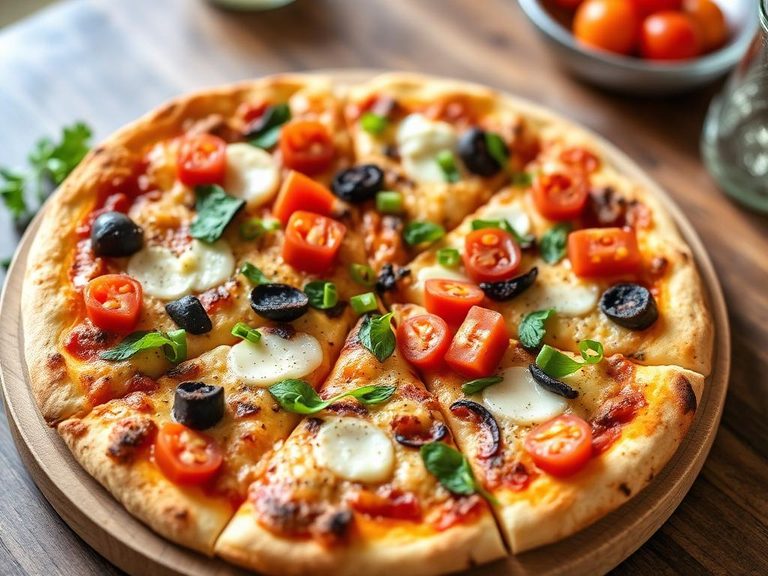
Pizza with cheese and extra vegetables, thick crust
Common food
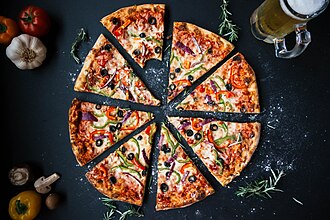
Photo: Wikipedia
A hearty, thick-crust pizza slice loaded with melted cheese and a colorful medley of vegetables like bell peppers, onions, and mushrooms. The crust offers a satisfying, bready chew, while the toppings provide a savory, umami-rich flavor with fresh, slightly crisp vegetable notes. Nutritionally, it's a balanced meal-in-one, offering a good source of protein from the cheese and complex carbs from the crust.
Calorie split: 16% protein · 49% carbs · 35% fat
↓ Full nutrition💚 Why it's loved
People love it for its comforting, familiar combination of gooey cheese, savory sauce, and customizable toppings that cater to nearly every taste. It's a social food, deeply embedded in casual dining culture, perfect for sharing at gatherings, parties, or a simple family night in.
⚠️ Watch-outs & how to enjoy it better
The thick crust can be calorie-dense and may cause blood-sugar spikes due to its refined carbohydrate content. To counteract this, pair a smaller portion with a side salad dressed in olive oil to add fiber and healthy fats that slow digestion. Be mindful of sodium from cheese and processed meats, and choose vegetable toppings to boost the nutrient profile.
Key benefits
- Provides a balanced mix of protein, carbs, and fats in one dish
- Vegetable toppings add dietary fiber, vitamins, and antioxidants
- Cheese is a good source of calcium and phosphorus for bone health
- Thick crust offers sustained energy from complex carbohydrates
- Highly customizable to include a wide variety of nutrient-dense vegetables
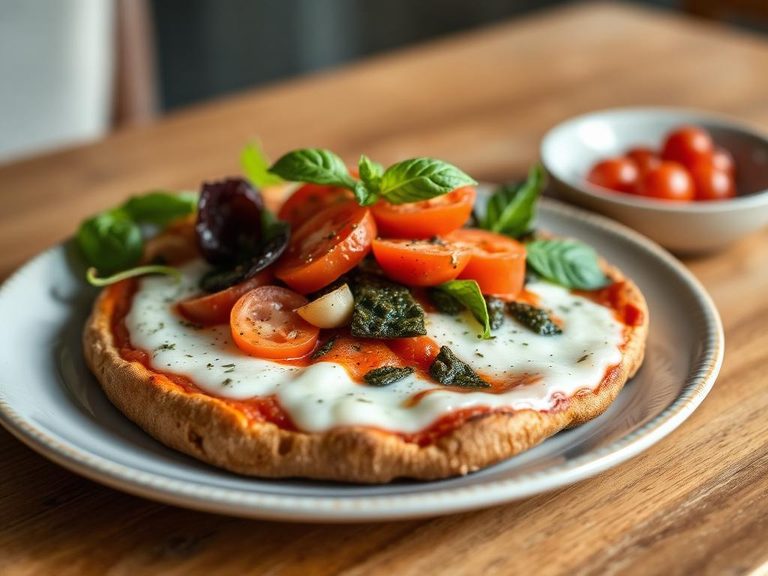
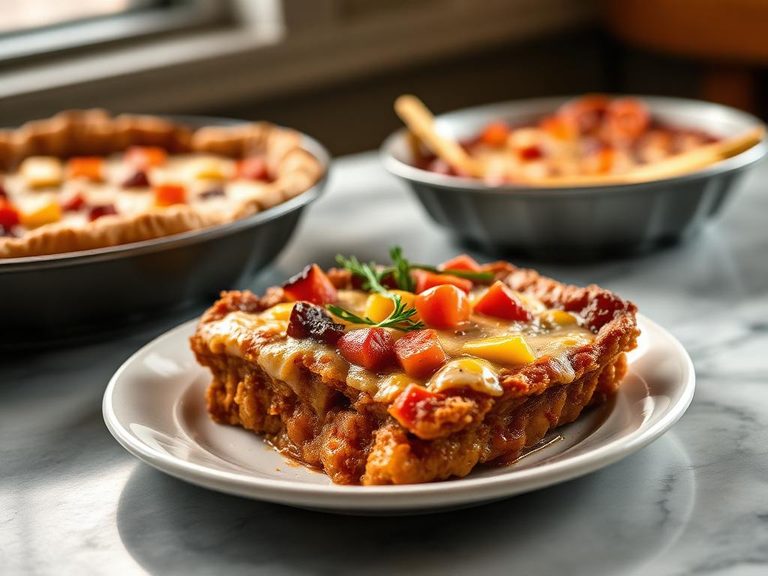
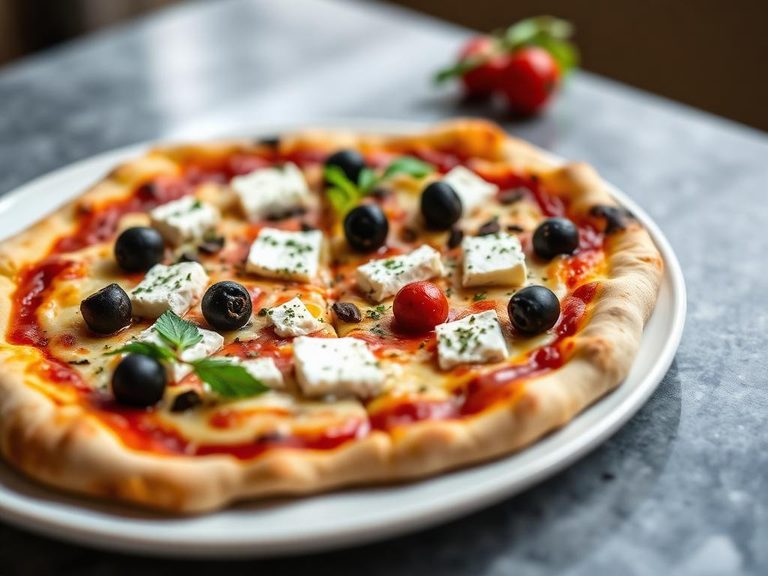
🍽️ Popular dishes

🌍 Where it's eaten
💡 Did you know?
The world's largest pizza, made in Rome in 2012, measured over 13,000 square feet—roughly the size of two basketball courts—and was made with a gluten-free dough.
Full nutrition (USDA data · scales with serving)
| Water | 49.4 g |
| Energy | 240 kcal |
| Protein | 9.5 g |
| Total lipid (fat) | 9.5 g |
| Carbohydrate, by difference | 29.4 g |
| Fiber, total dietary | 2.1 g |
| Total Sugars | 3.2 g |
| Calcium, Ca | 158 mg |
| Iron, Fe | 2.4 mg |
| Magnesium, Mg | 21.0 mg |
| Phosphorus, P | 185 mg |
| Potassium, K | 174 mg |
| Sodium, Na | 490 mg |
| Zinc, Zn | 1.1 mg |
| Copper, Cu | 0.12 mg |
| Selenium, Se | 16.4 ug |
| Vitamin C, total ascorbic acid | 3.5 mg |
| Thiamin | 0.32 mg |
| Riboflavin | 0.19 mg |
| Niacin | 3.2 mg |
| Vitamin B-6 | 0.07 mg |
| Folate, total | 93.0 ug |
| Folic acid | 57.0 ug |
| Folate, food | 36.0 ug |
| Folate, DFE | 132 ug |
| Choline, total | 15.9 mg |
| Vitamin B-12 | 0.30 ug |
| Vitamin B-12, added | 0.00 ug |
| Vitamin A, RAE | 61.0 ug |
| Retinol | 52.0 ug |
| Carotene, beta | 96.0 ug |
| Carotene, alpha | 1.0 ug |
| Cryptoxanthin, beta | 0.00 ug |
| Lycopene | 1653 ug |
| Lutein + zeaxanthin | 52.0 ug |
| Vitamin E (alpha-tocopherol) | 0.78 mg |
| Vitamin E, added | 0.00 mg |
| Vitamin D (D2 + D3) | 0.00 ug |
| Vitamin K (phylloquinone) | 9.0 ug |
| Alcohol, ethyl | 0.00 g |
| Caffeine | 0.00 mg |
| Theobromine | 0.00 mg |
Fat & fatty acid profile (per 100g)
| Fatty acids, total saturated | 3.7 g |
| SFA 4:0 | 0.09 g |
| SFA 6:0 | 0.07 g |
| SFA 8:0 | 0.05 g |
| SFA 10:0 | 0.12 g |
| SFA 12:0 | 0.14 g |
| SFA 14:0 | 0.49 g |
| SFA 16:0 | 1.9 g |
| SFA 18:0 | 0.74 g |
| Fatty acids, total monounsaturated | 2.5 g |
| MUFA 16:1 | 0.10 g |
| MUFA 18:1 | 2.3 g |
| MUFA 20:1 | 0.04 g |
| MUFA 22:1 | 0.00 g |
| Fatty acids, total polyunsaturated | 2.4 g |
| PUFA 18:2 | 2.1 g |
| PUFA 18:3 | 0.27 g |
| PUFA 18:4 | 0.00 g |
| PUFA 20:4 | 0.01 g |
| PUFA 20:5 n-3 (EPA) | 0.00 g |
| PUFA 22:5 n-3 (DPA) | 0.00 g |
| PUFA 22:6 n-3 (DHA) | 0.00 g |
| Cholesterol | 15.0 mg |
Amino acid profile (per 100g)
Estimated from Fast Food, Pizza Chain, 14" pizza, cheese topping, regular crust — USDA does not publish this profile for Pizza with cheese and extra vegetables.
| Threonine | 0.41 g |
| Isoleucine | 0.56 g |
| Leucine | 1.1 g |
| Lysine | 0.77 g |
| Methionine | 0.26 g |
| Cystine | 0.16 g |
| Phenylalanine | 0.66 g |
| Tyrosine | 0.52 g |
| Valine | 0.72 g |
| Arginine | 0.49 g |
| Histidine | 0.35 g |
| Alanine | 0.42 g |
| Aspartic acid | 0.84 g |
| Glutamic acid | 3.5 g |
| Glycine | 0.34 g |
| Proline | 1.4 g |
| Serine | 0.70 g |
| Hydroxyproline | 0.00 g |
FAQ
Is thick-crust pizza less healthy than thin-crust?
Generally, yes. The thicker crust means more refined carbohydrates and calories per slice compared to a thin-crust version with similar toppings. However, it can be part of a balanced diet when eaten in moderation.
How can I make this pizza more nutritious?
Load it with a variety of colorful vegetables like spinach, broccoli, and tomatoes. Choose a whole-wheat crust for added fiber, use part-skim mozzarella to reduce saturated fat, and add lean protein like grilled chicken.
What's the best way to reheat leftover thick-crust pizza?
For the crispiest crust, reheat slices in a skillet over medium heat for 2-3 minutes, then cover to melt the cheese. Alternatively, use an oven or toaster oven at 375°F (190°C) for about 10 minutes.
Nutrient density (calculated · NRF9.3)
Nutrient Rich Foods index: beneficial nutrients (protein, fiber, vitamins, minerals) minus saturated fat, added sugar & sodium, per 100 kcal.
NRF9.3 index — Fulgoni, Keast & Drewnowski, 2009. Computed from USDA nutrients.
Weight-loss friendliness (composite index)
Energy density 2.40 kcal/g · 16% calories from protein · 2.1 g fiber · 3.2 g sugar per 100 g.
Composite of energy density (Rolls et al., 1999), protein & fiber satiety, minus sugar. A calculated heuristic — ranks satiety-per-calorie, not a clinical measure.
Dietary load (calculated from USDA values)
Potential renal acid load. Positive = acid-forming, negative = alkaline-forming.
Sodium-to-potassium ratio: 2.82 (lower is better — aim for ≤ 1)
Sodium:potassium per WHO potassium guidance. Computed from USDA nutrients.