

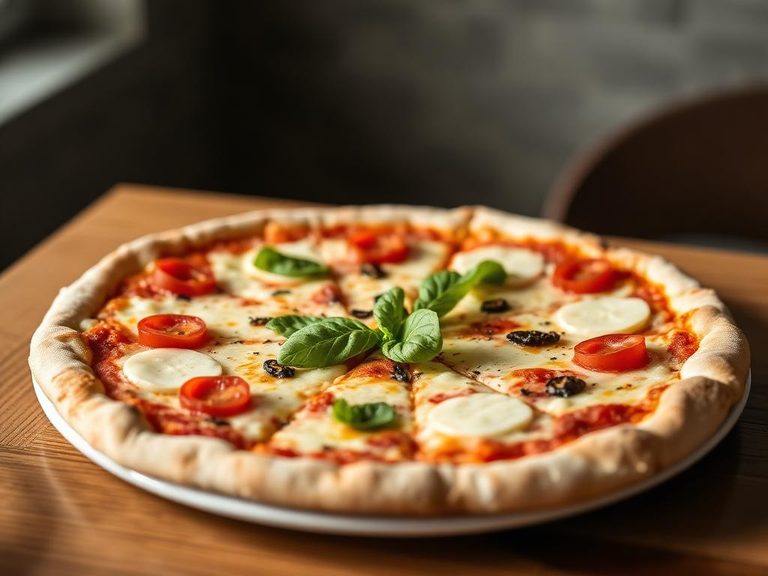
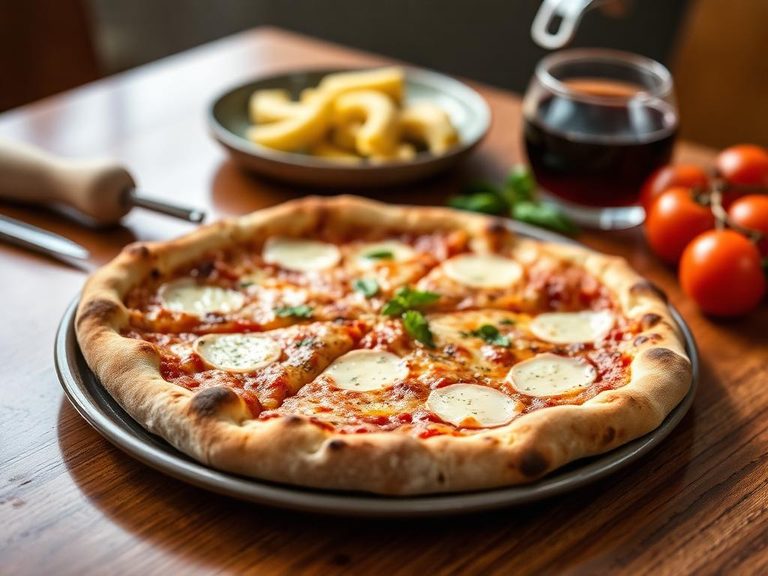
Pizza, extra cheese, thin crust
Common food
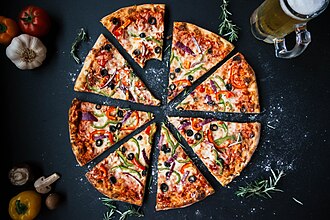
Photo: Wikipedia
A classic thin-crust pizza with an extra layer of melted cheese, offering a satisfying crunch from the base and a rich, gooey topping. The thin crust provides a lighter, crisper texture compared to deep-dish styles, while the extra cheese delivers a savory, umami-packed bite. Per 100g, it offers a balanced energy source with 268 kcal, moderate protein from the cheese, and carbs from the crust.
Calorie split: 18% protein · 47% carbs · 35% fat
↓ Full nutrition💚 Why it's loved
People adore the irresistible contrast between the crispy, thin base and the stretchy, melted cheese, creating a perfect textural harmony. It's a globally beloved comfort food, celebrated for its versatility and role in social gatherings and casual dining.
⚠️ Watch-outs & how to enjoy it better
The extra cheese and refined carbs can contribute to high saturated fat and calorie intake, potentially causing blood-sugar spikes. Those watching sodium or dairy intake should be cautious. To counteract, pair a slice with a large side salad, opt for whole-grain crust if available, and practice portion control by limiting yourself to one or two slices.
Key benefits
- Good source of protein for muscle maintenance
- Provides calcium from the cheese for bone health
- Contains dietary fiber from the crust and any vegetable toppings
- Offers quick energy from carbohydrates
- Can be a vehicle for vegetable toppings to increase nutrient intake
🍽️ Popular dishes
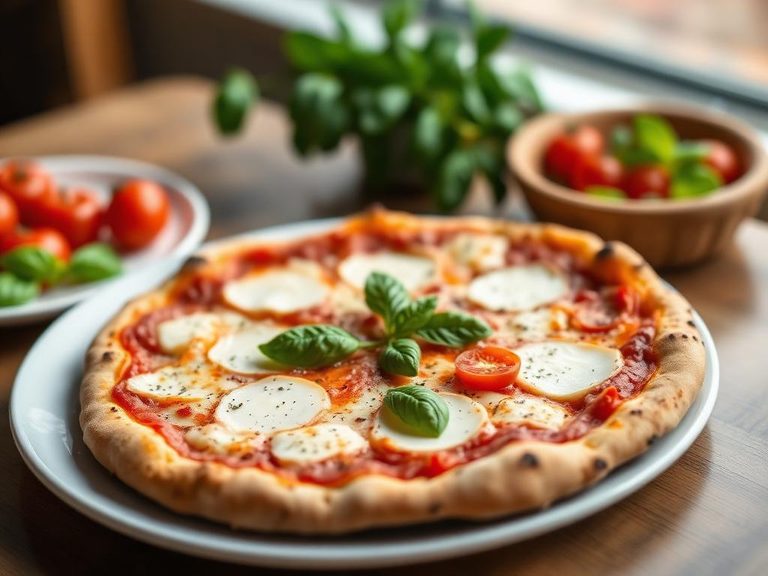
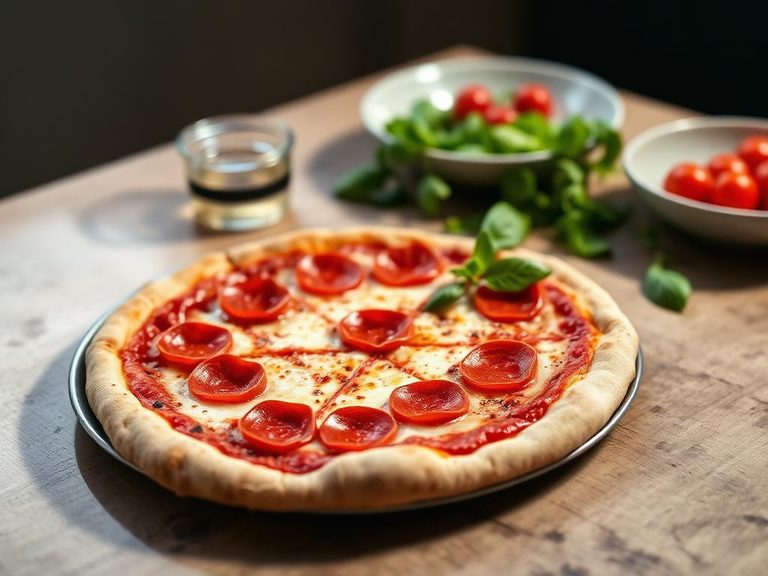
🌍 Where it's eaten
💡 Did you know?
The world's largest pizza ever made was baked in Rome in 2012, measuring over 13,000 square feet—roughly the size of a football field.
Full nutrition (USDA data · scales with serving)
| Water | 43.4 g |
| Energy | 268 kcal |
| Protein | 12.1 g |
| Total lipid (fat) | 10.3 g |
| Carbohydrate, by difference | 31.7 g |
| Fiber, total dietary | 2.2 g |
| Total Sugars | 3.5 g |
| Calcium, Ca | 216 mg |
| Iron, Fe | 2.4 mg |
| Magnesium, Mg | 24.0 mg |
| Phosphorus, P | 234 mg |
| Potassium, K | 169 mg |
| Sodium, Na | 549 mg |
| Zinc, Zn | 1.5 mg |
| Copper, Cu | 0.10 mg |
| Selenium, Se | 20.3 ug |
| Vitamin C, total ascorbic acid | 1.3 mg |
| Thiamin | 0.37 mg |
| Riboflavin | 0.20 mg |
| Niacin | 3.6 mg |
| Vitamin B-6 | 0.08 mg |
| Folate, total | 89.0 ug |
| Folic acid | 49.0 ug |
| Folate, food | 39.0 ug |
| Folate, DFE | 123 ug |
| Choline, total | 16.0 mg |
| Vitamin B-12 | 0.45 ug |
| Vitamin B-12, added | 0.00 ug |
| Vitamin A, RAE | 77.0 ug |
| Retinol | 69.0 ug |
| Carotene, beta | 87.0 ug |
| Carotene, alpha | 0.00 ug |
| Cryptoxanthin, beta | 0.00 ug |
| Lycopene | 1808 ug |
| Lutein + zeaxanthin | 55.0 ug |
| Vitamin E (alpha-tocopherol) | 0.81 mg |
| Vitamin E, added | 0.00 mg |
| Vitamin D (D2 + D3) | 0.00 ug |
| Vitamin K (phylloquinone) | 6.4 ug |
| Alcohol, ethyl | 0.00 g |
| Caffeine | 0.00 mg |
| Theobromine | 0.00 mg |
Fat & fatty acid profile (per 100g)
| Fatty acids, total saturated | 4.9 g |
| SFA 4:0 | 0.12 g |
| SFA 6:0 | 0.09 g |
| SFA 8:0 | 0.06 g |
| SFA 10:0 | 0.16 g |
| SFA 12:0 | 0.20 g |
| SFA 14:0 | 0.67 g |
| SFA 16:0 | 2.5 g |
| SFA 18:0 | 0.92 g |
| Fatty acids, total monounsaturated | 2.7 g |
| MUFA 16:1 | 0.13 g |
| MUFA 18:1 | 2.5 g |
| MUFA 20:1 | 0.04 g |
| MUFA 22:1 | 0.00 g |
| Fatty acids, total polyunsaturated | 1.6 g |
| PUFA 18:2 | 1.4 g |
| PUFA 18:3 | 0.17 g |
| PUFA 18:4 | 0.00 g |
| PUFA 20:4 | 0.01 g |
| PUFA 20:5 n-3 (EPA) | 0.00 g |
| PUFA 22:5 n-3 (DPA) | 0.00 g |
| PUFA 22:6 n-3 (DHA) | 0.00 g |
| Cholesterol | 20.0 mg |
Amino acid profile (per 100g)
Estimated from Fast Food, Pizza Chain, 14" pizza, cheese topping, stuffed crust — USDA does not publish this profile for Pizza.
| Tryptophan | 0.12 g |
| Threonine | 0.39 g |
| Isoleucine | 0.57 g |
| Leucine | 1.1 g |
| Lysine | 0.59 g |
| Methionine | 0.27 g |
| Phenylalanine | 0.64 g |
| Tyrosine | 0.40 g |
| Valine | 0.71 g |
| Arginine | 0.44 g |
| Histidine | 0.32 g |
| Alanine | 0.38 g |
| Aspartic acid | 0.81 g |
| Glutamic acid | 3.4 g |
| Glycine | 0.31 g |
| Proline | 1.7 g |
| Serine | 0.58 g |
| Hydroxyproline | 0.00 g |
FAQ
Is thin-crust pizza healthier than thick-crust?
Generally, yes. A thin crust typically has fewer calories and carbohydrates per slice than a deep-dish or stuffed crust, making it a lighter option, especially if you're mindful of the cheese and toppings.
How can I make this pizza more nutritious at home?
Use a whole-wheat or cauliflower crust for added fiber, load up on vegetable toppings like bell peppers, spinach, and mushrooms, and consider part-skim mozzarella to reduce saturated fat while keeping the cheesy flavor.
What's the best way to store leftover pizza?
Place slices in an airtight container in the refrigerator for up to 4 days. For longer storage, wrap slices tightly in foil and freeze for up to 2 months. Reheat in a skillet or oven to restore crispness.
Nutrient density (calculated · NRF9.3)
Nutrient Rich Foods index: beneficial nutrients (protein, fiber, vitamins, minerals) minus saturated fat, added sugar & sodium, per 100 kcal.
NRF9.3 index — Fulgoni, Keast & Drewnowski, 2009. Computed from USDA nutrients.
Weight-loss friendliness (composite index)
Energy density 2.68 kcal/g · 18% calories from protein · 2.2 g fiber · 3.5 g sugar per 100 g.
Composite of energy density (Rolls et al., 1999), protein & fiber satiety, minus sugar. A calculated heuristic — ranks satiety-per-calorie, not a clinical measure.
Dietary load (calculated from USDA values)
Potential renal acid load. Positive = acid-forming, negative = alkaline-forming.
Sodium-to-potassium ratio: 3.25 (lower is better — aim for ≤ 1)
Sodium:potassium per WHO potassium guidance. Computed from USDA nutrients.