

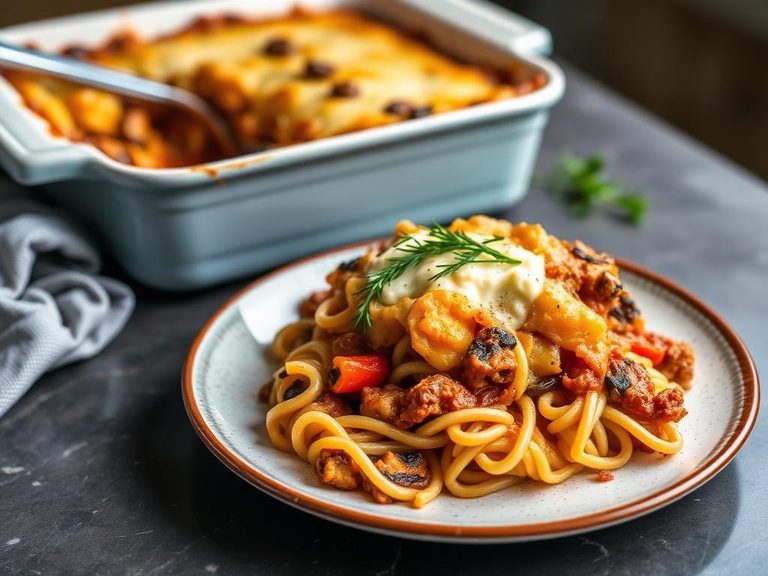
Pasta, whole grain, with tomato-based sauce, meat, and added vegetables, home recipe
Common food

Photo: Wikipedia
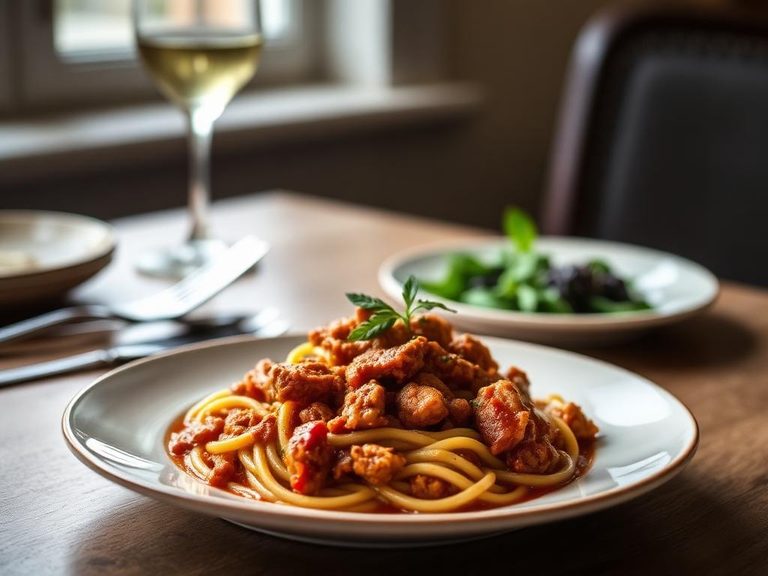
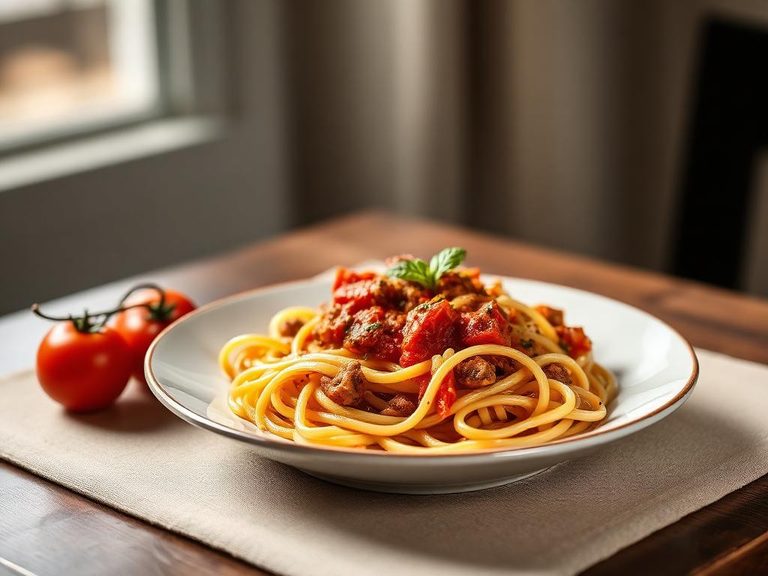
This is a hearty, home-cooked bowl of whole grain pasta tossed in a rich tomato sauce with savory meat and a medley of tender vegetables. It offers a satisfying, chewy texture from the whole wheat pasta, complemented by the umami depth of the meat and the fresh, sweet notes of the vegetables. A nutritionally balanced meal, it provides a solid source of protein and fiber while remaining relatively low in fat and calories.
Calorie split: 19% protein · 60% carbs · 21% fat
↓ Full nutrition💚 Why it's loved
People adore this dish for its comforting, familiar flavors and incredible versatility—it's a perfect canvas for seasonal vegetables and different meats. It's a staple of home cooking, offering a satisfying, complete meal that feels both nourishing and indulgent.
⚠️ Watch-outs & how to enjoy it better
The whole grain pasta and tomato sauce can be high in sodium and may cause digestive discomfort for some due to fiber or FODMAPs. To counteract, choose low-sodium sauce, rinse canned tomatoes, and ensure vegetables are well-cooked. The tomatoes are also high in oxalates; pairing with a calcium-rich food like Parmesan cheese can help mitigate this.
Key benefits
- Good source of plant-based and animal protein for muscle maintenance.
- High in dietary fiber from whole grain pasta and vegetables, aiding digestion.
- Provides complex carbohydrates for sustained energy release.
- Contains vitamins and antioxidants from the tomato sauce and vegetables.
- A balanced, all-in-one meal combining carbs, protein, and fiber.
🍽️ Popular dishes
🌍 Where it's eaten
💡 Did you know?
The combination of tomatoes, meat, and pasta in Italy is a relatively modern invention, as tomatoes were only widely adopted in Italian cuisine in the 18th and 19th centuries.
Full nutrition (USDA data · scales with serving)
| Water | 71.7 g |
| Energy | 119 kcal |
| Protein | 6.0 g |
| Total lipid (fat) | 2.9 g |
| Carbohydrate, by difference | 18.5 g |
| Fiber, total dietary | 2.7 g |
| Total Sugars | 2.3 g |
| Calcium, Ca | 18.0 mg |
| Iron, Fe | 1.4 mg |
| Magnesium, Mg | 37.0 mg |
| Phosphorus, P | 99.0 mg |
| Potassium, K | 201 mg |
| Sodium, Na | 162 mg |
| Zinc, Zn | 1.4 mg |
| Copper, Cu | 0.17 mg |
| Selenium, Se | 21.9 ug |
| Vitamin C, total ascorbic acid | 4.7 mg |
| Thiamin | 0.10 mg |
| Riboflavin | 0.11 mg |
| Niacin | 3.4 mg |
| Vitamin B-6 | 0.15 mg |
| Folate, total | 18.0 ug |
| Folic acid | 0.00 ug |
| Folate, food | 18.0 ug |
| Folate, DFE | 18.0 ug |
| Choline, total | 15.8 mg |
| Vitamin B-12 | 0.25 ug |
| Vitamin B-12, added | 0.00 ug |
| Vitamin A, RAE | 13.0 ug |
| Retinol | 0.00 ug |
| Carotene, beta | 154 ug |
| Carotene, alpha | 1.0 ug |
| Cryptoxanthin, beta | 9.0 ug |
| Lycopene | 3799 ug |
| Lutein + zeaxanthin | 153 ug |
| Vitamin E (alpha-tocopherol) | 0.89 mg |
| Vitamin E, added | 0.00 mg |
| Vitamin D (D2 + D3) | 0.00 ug |
| Vitamin K (phylloquinone) | 5.0 ug |
| Alcohol, ethyl | 0.00 g |
| Caffeine | 0.00 mg |
| Theobromine | 0.00 mg |
Fat & fatty acid profile (per 100g)
| Fatty acids, total saturated | 0.77 g |
| SFA 4:0 | 0.00 g |
| SFA 6:0 | 0.00 g |
| SFA 8:0 | 0.00 g |
| SFA 10:0 | 0.00 g |
| SFA 12:0 | 0.00 g |
| SFA 14:0 | 0.05 g |
| SFA 16:0 | 0.47 g |
| SFA 18:0 | 0.20 g |
| Fatty acids, total monounsaturated | 0.88 g |
| MUFA 16:1 | 0.06 g |
| MUFA 18:1 | 0.78 g |
| MUFA 20:1 | 0.01 g |
| MUFA 22:1 | 0.00 g |
| Fatty acids, total polyunsaturated | 0.51 g |
| PUFA 18:2 | 0.45 g |
| PUFA 18:3 | 0.05 g |
| PUFA 18:4 | 0.00 g |
| PUFA 20:4 | 0.00 g |
| PUFA 20:5 n-3 (EPA) | 0.00 g |
| PUFA 22:5 n-3 (DPA) | 0.00 g |
| PUFA 22:6 n-3 (DHA) | 0.00 g |
| Cholesterol | 8.0 mg |
Amino acid profile (per 100g)
Estimated from Restaurant, Italian, chicken parmesan without pasta — USDA does not publish this profile for Pasta.
| Tryptophan | 0.20 g |
| Threonine | 0.66 g |
| Isoleucine | 0.72 g |
| Leucine | 1.3 g |
| Lysine | 1.3 g |
| Methionine | 0.41 g |
| Cystine | 0.20 g |
| Phenylalanine | 1.1 g |
| Tyrosine | 0.53 g |
| Valine | 0.81 g |
| Arginine | 0.93 g |
| Histidine | 0.50 g |
| Alanine | 0.79 g |
| Aspartic acid | 1.4 g |
| Glutamic acid | 2.8 g |
| Glycine | 0.61 g |
| Proline | 1.3 g |
| Serine | 0.70 g |
| Hydroxyproline | 0.04 g |
FAQ
Is this dish healthy?
Yes, it can be a very healthy, balanced meal. The whole grain pasta provides fiber, the meat offers protein, and the vegetables add vitamins. The overall healthiness depends on the specific sauce recipe, particularly the amount of added salt, sugar, and fat.
Can I make this vegetarian?
Absolutely. Simply omit the meat or replace it with plant-based alternatives like lentils, mushrooms, or textured vegetable protein (TVP) for a similar hearty texture and protein boost.
How can I reduce the glycemic impact?
Using whole grain pasta already helps. You can further lower the glycemic load by ensuring the pasta is cooked al dente (firm to the bite), increasing the proportion of vegetables and protein relative to the pasta, and eating the meal with a side salad or healthy fat like olive oil.
Nutrient density (calculated · NRF9.3)
Nutrient Rich Foods index: beneficial nutrients (protein, fiber, vitamins, minerals) minus saturated fat, added sugar & sodium, per 100 kcal.
NRF9.3 index — Fulgoni, Keast & Drewnowski, 2009. Computed from USDA nutrients.
Weight-loss friendliness (composite index)
Energy density 1.19 kcal/g · 20% calories from protein · 2.7 g fiber · 2.3 g sugar per 100 g.
Composite of energy density (Rolls et al., 1999), protein & fiber satiety, minus sugar. A calculated heuristic — ranks satiety-per-calorie, not a clinical measure.
Dietary load (calculated from USDA values)
Potential renal acid load. Positive = acid-forming, negative = alkaline-forming.
Sodium-to-potassium ratio: 0.81 (lower is better — aim for ≤ 1)
Sodium:potassium per WHO potassium guidance. Computed from USDA nutrients.