

Nuts, cashew butter, plain, with salt added
Whole food · Nut and Seed Products

Photo: Wikipedia
Cashew butter is a luxuriously smooth, creamy spread made from ground roasted cashews, often with a touch of salt to enhance its naturally sweet, buttery flavor. Its texture is velvety and rich, lacking the graininess of some other nut butters. Nutritionally, it's a dense source of healthy monounsaturated fats and provides a solid 12g of protein per 100g, making it a satisfying energy booster.
Calorie split: 7% protein · 19% carbs · 74% fat
↓ Full nutrition💚 Why it's loved
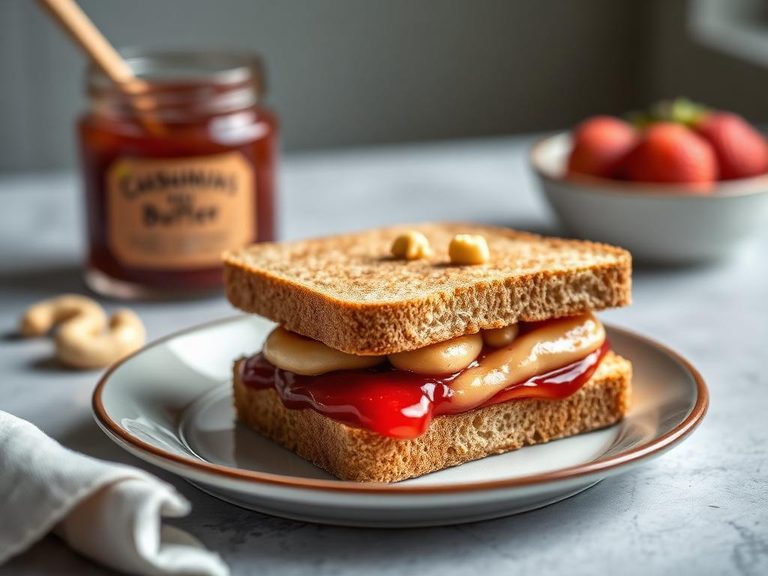
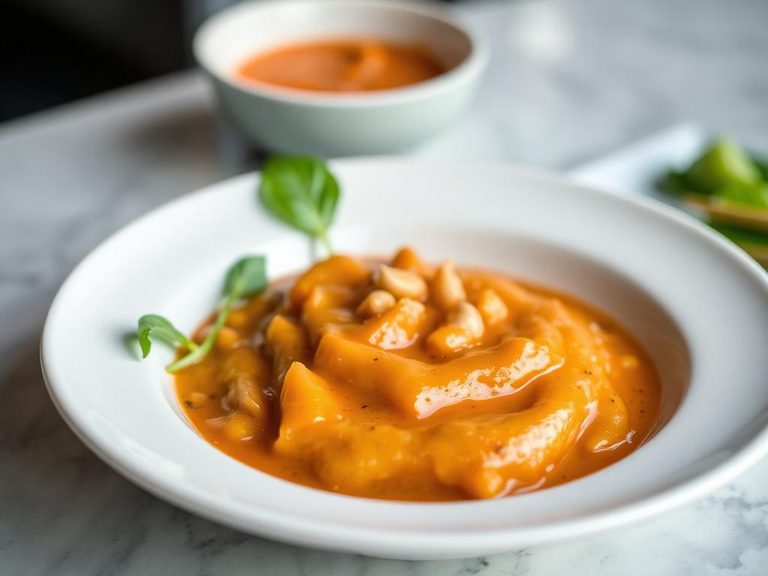
People adore cashew butter for its uniquely sweet, buttery taste and ultra-smooth, non-gritty texture that melts on the tongue. Its versatility makes it a favorite for everything from spreading on toast to blending into smoothies or using as a base for savory sauces.
⚠️ Watch-outs & how to enjoy it better
Its high fat and calorie density (over 500 kcal per 100g) means portion control is key to avoid unintended weight gain. It is a common tree nut allergen and can cause blood sugar spikes if consumed in large amounts due to its sugar content. To counteract, pair it with high-fiber foods like apple slices or whole-grain crackers, and stick to a measured tablespoon serving.
Key benefits
- Rich in heart-healthy monounsaturated fats.
- Good source of plant-based protein (12g per 100g).
- Contains essential minerals like magnesium and phosphorus.
- Provides quick, sustained energy from its fat and carb content.
- Naturally sweet flavor can reduce need for added sugars.
🍽️ Popular dishes
🌍 Where it's eaten
💡 Did you know?
Cashews are not true nuts but are seeds that grow at the bottom of a cashew apple, and the shell contains a caustic oil (urushiol) that must be carefully removed before processing.
Full nutrition (USDA data · scales with serving)
| Water | 2.3 g |
| Energy | 609 kcal |
| Energy | 2549 kj |
| Protein | 12.1 g |
| Total lipid (fat) | 53.0 g |
| Ash | 2.5 g |
| Carbohydrate, by difference | 30.3 g |
| Fiber, total dietary | 3.0 g |
| Total Sugars | 9.1 g |
| Calcium, Ca | 61.0 mg |
| Iron, Fe | 4.9 mg |
| Magnesium, Mg | 206 mg |
| Phosphorus, P | 388 mg |
| Potassium, K | 447 mg |
| Sodium, Na | 295 mg |
| Zinc, Zn | 4.4 mg |
| Copper, Cu | 1.8 mg |
| Selenium, Se | 9.3 ug |
| Vitamin C, total ascorbic acid | 0.00 mg |
| Thiamin | 0.16 mg |
| Riboflavin | 0.16 mg |
| Niacin | 1.1 mg |
| Vitamin B-6 | 0.20 mg |
| Folate, total | 55.0 ug |
| Folic acid | 0.00 ug |
| Folate, food | 55.0 ug |
| Folate, DFE | 55.0 ug |
| Choline, total | 48.3 mg |
| Vitamin B-12 | 0.00 ug |
| Vitamin B-12, added | 0.00 ug |
| Vitamin A, RAE | 0.00 ug |
| Retinol | 0.00 ug |
| Carotene, beta | 0.00 ug |
| Carotene, alpha | 0.00 ug |
| Cryptoxanthin, beta | 0.00 ug |
| Vitamin A, IU | 0.00 iu |
| Lycopene | 0.00 ug |
| Lutein + zeaxanthin | 18.0 ug |
| Vitamin E (alpha-tocopherol) | 5.1 mg |
| Vitamin E, added | 0.00 mg |
| Vitamin D (D2 + D3), International Units | 0.00 iu |
| Vitamin D (D2 + D3) | 0.00 ug |
| Vitamin K (phylloquinone) | 30.3 ug |
| Alcohol, ethyl | 0.00 g |
| Caffeine | 0.00 mg |
| Theobromine | 0.00 mg |
Fat & fatty acid profile (per 100g)
| Fatty acids, total saturated | 10.6 g |
| SFA 4:0 | 0.00 g |
| SFA 6:0 | 0.00 g |
| SFA 8:0 | 0.12 g |
| SFA 10:0 | 0.12 g |
| SFA 12:0 | 0.69 g |
| SFA 14:0 | 0.33 g |
| SFA 16:0 | 5.2 g |
| SFA 18:0 | 3.8 g |
| Fatty acids, total monounsaturated | 26.7 g |
| MUFA 16:1 | 0.25 g |
| MUFA 18:1 | 26.3 g |
| MUFA 20:1 | 0.11 g |
| MUFA 22:1 | 0.00 g |
| Fatty acids, total polyunsaturated | 13.4 g |
| PUFA 18:2 | 13.2 g |
| PUFA 18:3 | 0.16 g |
| PUFA 18:4 | 0.00 g |
| PUFA 20:4 | 0.00 g |
| PUFA 20:5 n-3 (EPA) | 0.00 g |
| PUFA 22:5 n-3 (DPA) | 0.00 g |
| PUFA 22:6 n-3 (DHA) | 0.00 g |
| Fatty acids, total trans | 0.00 g |
| Cholesterol | 0.00 mg |
Amino acid profile (per 100g)
| Tryptophan | 0.16 g |
| Threonine | 0.39 g |
| Isoleucine | 0.45 g |
| Leucine | 0.83 g |
| Lysine | 0.52 g |
| Methionine | 0.20 g |
| Cystine | 0.22 g |
| Phenylalanine | 0.54 g |
| Tyrosine | 0.29 g |
| Valine | 0.62 g |
| Arginine | 1.2 g |
| Histidine | 0.26 g |
| Alanine | 0.47 g |
| Aspartic acid | 1.0 g |
| Glutamic acid | 2.5 g |
| Glycine | 0.53 g |
| Proline | 0.46 g |
| Serine | 0.61 g |
FAQ
Is cashew butter healthier than peanut butter?
Both are nutritious, but cashew butter is slightly higher in carbs and sugar, while peanut butter has more protein. Cashew butter is richer in magnesium and iron.
Can I make cashew butter at home?
Yes, simply blend roasted cashews in a food processor for 10-15 minutes until smooth, adding a pinch of salt or oil if desired.
Why is cashew butter more expensive than peanut butter?
Cashews require more labor-intensive processing to remove their toxic shell oil, and the trees take longer to produce a harvest, driving up costs.
Nutrient density (calculated · NRF9.3)
Nutrient Rich Foods index: beneficial nutrients (protein, fiber, vitamins, minerals) minus saturated fat, added sugar & sodium, per 100 kcal.
NRF9.3 index — Fulgoni, Keast & Drewnowski, 2009. Computed from USDA nutrients.
Weight-loss friendliness (composite index)
Energy density 6.09 kcal/g · 8% calories from protein · 3.0 g fiber · 9.1 g sugar per 100 g.
Composite of energy density (Rolls et al., 1999), protein & fiber satiety, minus sugar. A calculated heuristic — ranks satiety-per-calorie, not a clinical measure.
Dietary load (calculated from USDA values)
Potential renal acid load. Positive = acid-forming, negative = alkaline-forming.
Sodium-to-potassium ratio: 0.66 (lower is better — aim for ≤ 1)
Sodium:potassium per WHO potassium guidance. Computed from USDA nutrients.