

Milk, reduced fat, fluid, 2% milkfat, with added nonfat milk solids and vitamin A and vitamin D
Whole food · Dairy and Egg Products
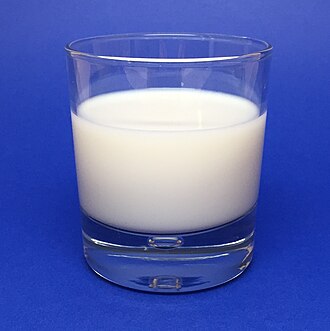
Photo: Wikipedia
This is 2% milk, a staple dairy beverage that strikes a balance between richness and lightness. It has a clean, creamy taste and a smooth, pourable texture, fortified with vitamins A and D for a nutritional boost. With 51 kcal and 3.48g of protein per 100g, it's a nutrient-dense choice for everyday drinking.
Calorie split: 27% protein · 39% carbs · 34% fat
↓ Full nutrition💚 Why it's loved
People love its familiar, comforting flavor that's versatile enough for cereal, coffee, baking, or drinking straight. It's a cultural cornerstone in many diets, symbolizing nourishment and home cooking.
⚠️ Watch-outs & how to enjoy it better
As a dairy product, it's a common allergen for those with lactose intolerance or milk protein allergies, which can cause digestive discomfort. To manage this, consider lactose-free versions, or pair it with high-fiber foods like oats or whole-grain toast to slow sugar absorption and support digestion.
Key benefits
- Excellent source of high-quality protein for muscle maintenance
- Naturally provides calcium for bone health
- Fortified with Vitamin D to aid calcium absorption
- Contains Vitamin A for vision and immune function
- Lower in fat than whole milk while retaining creaminess
🍽️ Popular dishes





🌍 Where it's eaten
💡 Did you know?
The '2%' in the name refers to the milkfat by weight, not that it's 2% of the calories from fat—which is actually closer to 35%.
Full nutrition (USDA data · scales with serving)
| Water | 88.9 g |
| Energy | 51.0 kcal |
| Energy | 213 kj |
| Protein | 3.5 g |
| Total lipid (fat) | 1.9 g |
| Ash | 0.77 g |
| Carbohydrate, by difference | 5.0 g |
| Fiber, total dietary | 0.00 g |
| Calcium, Ca | 128 mg |
| Iron, Fe | 0.05 mg |
| Magnesium, Mg | 14.0 mg |
| Phosphorus, P | 100 mg |
| Potassium, K | 162 mg |
| Sodium, Na | 52.0 mg |
| Zinc, Zn | 0.40 mg |
| Copper, Cu | 0.01 mg |
| Manganese, Mn | 0.00 mg |
| Selenium, Se | 2.3 ug |
| Vitamin C, total ascorbic acid | 1.0 mg |
| Thiamin | 0.04 mg |
| Riboflavin | 0.17 mg |
| Niacin | 0.09 mg |
| Pantothenic acid | 0.34 mg |
| Vitamin B-6 | 0.04 mg |
| Folate, total | 5.0 ug |
| Folic acid | 0.00 ug |
| Folate, food | 5.0 ug |
| Folate, DFE | 5.0 ug |
| Vitamin B-12 | 0.38 ug |
| Vitamin A, RAE | 56.0 ug |
| Retinol | 55.0 ug |
| Vitamin A, IU | 204 iu |
| Vitamin D (D2 + D3), International Units | 40.0 iu |
| Vitamin D (D2 + D3) | 1.0 ug |
| Alcohol, ethyl | 0.00 g |
Fat & fatty acid profile (per 100g)
| Fatty acids, total saturated | 1.2 g |
| SFA 4:0 | 0.06 g |
| SFA 6:0 | 0.04 g |
| SFA 8:0 | 0.02 g |
| SFA 10:0 | 0.05 g |
| SFA 12:0 | 0.05 g |
| SFA 14:0 | 0.19 g |
| SFA 16:0 | 0.51 g |
| SFA 18:0 | 0.23 g |
| Fatty acids, total monounsaturated | 0.56 g |
| MUFA 16:1 | 0.04 g |
| MUFA 18:1 | 0.48 g |
| MUFA 20:1 | 0.00 g |
| MUFA 22:1 | 0.00 g |
| Fatty acids, total polyunsaturated | 0.07 g |
| PUFA 18:2 | 0.04 g |
| PUFA 18:3 | 0.03 g |
| PUFA 18:4 | 0.00 g |
| PUFA 20:4 | 0.00 g |
| PUFA 20:5 n-3 (EPA) | 0.00 g |
| PUFA 22:5 n-3 (DPA) | 0.00 g |
| PUFA 22:6 n-3 (DHA) | 0.00 g |
| Cholesterol | 8.0 mg |
Amino acid profile (per 100g)
| Tryptophan | 0.05 g |
| Threonine | 0.16 g |
| Isoleucine | 0.21 g |
| Leucine | 0.34 g |
| Lysine | 0.28 g |
| Methionine | 0.09 g |
| Cystine | 0.03 g |
| Phenylalanine | 0.17 g |
| Tyrosine | 0.17 g |
| Valine | 0.23 g |
| Arginine | 0.13 g |
| Histidine | 0.09 g |
| Alanine | 0.12 g |
| Aspartic acid | 0.26 g |
| Glutamic acid | 0.73 g |
| Glycine | 0.07 g |
| Proline | 0.34 g |
| Serine | 0.19 g |
FAQ
How does 2% milk differ from whole and skim milk?
2% milk has a moderate fat content, offering more creaminess than skim (fat-free) milk but less richness than whole milk (which is about 3.25% fat). It's a popular middle ground for those seeking flavor with fewer calories and less saturated fat.
Why are vitamins A and D added?
Vitamin D is added to help the body absorb calcium, crucial for bone health. Vitamin A is often added to replace what's lost during the fat-reduction process, supporting vision and immune function.
Is the added nonfat milk solids just powdered milk?
Yes, essentially. Nonfat milk solids (or milk powder) are added to boost protein, calcium, and overall milk solids content after some fat is removed, improving texture and nutritional profile without adding fat.
Nutrient density (calculated · NRF9.3)
Nutrient Rich Foods index: beneficial nutrients (protein, fiber, vitamins, minerals) minus saturated fat, added sugar & sodium, per 100 kcal.
NRF9.3 index — Fulgoni, Keast & Drewnowski, 2009. Computed from USDA nutrients.
Weight-loss friendliness (composite index)
Energy density 0.51 kcal/g · 27% calories from protein · 0.0 g fiber · 0.0 g sugar per 100 g.
Composite of energy density (Rolls et al., 1999), protein & fiber satiety, minus sugar. A calculated heuristic — ranks satiety-per-calorie, not a clinical measure.
Dietary load (calculated from USDA values)
Potential renal acid load. Positive = acid-forming, negative = alkaline-forming.
Sodium-to-potassium ratio: 0.32 (lower is better — aim for ≤ 1)
Sodium:potassium per WHO potassium guidance. Computed from USDA nutrients.