

Marmalade
Common food
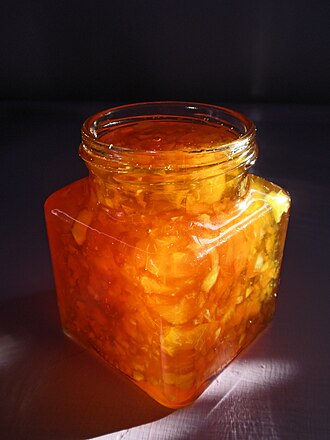
Photo: Wikipedia
Marmalade is a vibrant, citrus-based preserve, typically made from Seville oranges, whose defining characteristic is the suspended slivers of bitter peel. It delivers a complex flavor profile that is simultaneously sweet, tart, and slightly bitter, with a thick, glossy, and spreadable texture. Nutritionally, it is a concentrated source of simple carbohydrates, providing a quick energy boost with virtually no fat or protein.
Calorie split: 0% protein · 100% carbs · 0% fat
↓ Full nutrition💚 Why it's loved
People love marmalade for its distinctive, sophisticated balance of sweet and bitter citrus notes that cut through richness. It's deeply embedded in British and Irish breakfast culture, evoking a sense of tradition and comfort.
⚠️ Watch-outs & how to enjoy it better
Its high sugar content (60g per 100g) can cause rapid blood-sugar spikes, making it a concern for those managing diabetes or insulin resistance. To mitigate this, pair it with a source of protein or fat like yogurt, nuts, or cheese, and practice strict portion control (e.g., a thin scrape on toast rather than a thick layer).
Key benefits
- Provides a quick source of energy from natural sugars.
- Contains vitamin C from citrus peel and juice.
- The peel offers dietary fiber and flavonoids.
- A traditional, long-lasting way to preserve seasonal citrus.
- Adds a complex sweet-tart flavor to both sweet and savory dishes.
🍽️ Popular dishes



🌍 Where it's eaten
💡 Did you know?
The first known recipe for marmalade, dating to 1797, was for a quince preserve; the iconic orange version became popular in Britain after a Portuguese ship carrying Seville oranges was delayed in Dundee, Scotland.
Full nutrition (USDA data · scales with serving)
| Water | 33.2 g |
| Energy | 246 kcal |
| Protein | 0.30 g |
| Total lipid (fat) | 0.00 g |
| Carbohydrate, by difference | 66.3 g |
| Fiber, total dietary | 0.70 g |
| Total Sugars | 60.0 g |
| Calcium, Ca | 38.0 mg |
| Iron, Fe | 0.15 mg |
| Magnesium, Mg | 2.0 mg |
| Phosphorus, P | 4.0 mg |
| Potassium, K | 37.0 mg |
| Sodium, Na | 56.0 mg |
| Zinc, Zn | 0.04 mg |
| Copper, Cu | 0.09 mg |
| Selenium, Se | 0.60 ug |
| Vitamin C, total ascorbic acid | 4.8 mg |
| Thiamin | 0.01 mg |
| Riboflavin | 0.03 mg |
| Niacin | 0.05 mg |
| Vitamin B-6 | 0.02 mg |
| Folate, total | 9.0 ug |
| Folic acid | 0.00 ug |
| Folate, food | 9.0 ug |
| Folate, DFE | 9.0 ug |
| Choline, total | 3.0 mg |
| Vitamin B-12 | 0.00 ug |
| Vitamin B-12, added | 0.00 ug |
| Vitamin A, RAE | 3.0 ug |
| Retinol | 0.00 ug |
| Carotene, beta | 15.0 ug |
| Carotene, alpha | 5.0 ug |
| Cryptoxanthin, beta | 38.0 ug |
| Lycopene | 0.00 ug |
| Lutein + zeaxanthin | 58.0 ug |
| Vitamin E (alpha-tocopherol) | 0.06 mg |
| Vitamin E, added | 0.00 mg |
| Vitamin D (D2 + D3) | 0.00 ug |
| Vitamin K (phylloquinone) | 0.00 ug |
| Alcohol, ethyl | 0.00 g |
| Caffeine | 0.00 mg |
| Theobromine | 0.00 mg |
Fat & fatty acid profile (per 100g)
| Fatty acids, total saturated | 0.00 g |
| SFA 4:0 | 0.00 g |
| SFA 6:0 | 0.00 g |
| SFA 8:0 | 0.00 g |
| SFA 10:0 | 0.00 g |
| SFA 12:0 | 0.00 g |
| SFA 14:0 | 0.00 g |
| SFA 16:0 | 0.00 g |
| SFA 18:0 | 0.00 g |
| Fatty acids, total monounsaturated | 0.00 g |
| MUFA 16:1 | 0.00 g |
| MUFA 18:1 | 0.00 g |
| MUFA 20:1 | 0.00 g |
| MUFA 22:1 | 0.00 g |
| Fatty acids, total polyunsaturated | 0.00 g |
| PUFA 18:2 | 0.00 g |
| PUFA 18:3 | 0.00 g |
| PUFA 18:4 | 0.00 g |
| PUFA 20:4 | 0.00 g |
| PUFA 20:5 n-3 (EPA) | 0.00 g |
| PUFA 22:5 n-3 (DPA) | 0.00 g |
| PUFA 22:6 n-3 (DHA) | 0.00 g |
| Cholesterol | 0.00 mg |
Amino acid profile (per 100g)
Estimated from Marmalade, orange — USDA does not publish this profile for Marmalade.
| Tryptophan | 0.00 g |
| Threonine | 0.01 g |
| Isoleucine | 0.01 g |
| Leucine | 0.01 g |
| Lysine | 0.01 g |
| Methionine | 0.01 g |
| Cystine | 0.00 g |
| Phenylalanine | 0.01 g |
| Tyrosine | 0.01 g |
| Valine | 0.01 g |
| Arginine | 0.02 g |
| Histidine | 0.01 g |
| Alanine | 0.02 g |
| Aspartic acid | 0.04 g |
| Glutamic acid | 0.03 g |
| Glycine | 0.03 g |
| Proline | 0.01 g |
| Serine | 0.01 g |
FAQ
What is the difference between marmalade and jam?
Marmalade is specifically made from citrus fruit (like oranges, lemons, or grapefruit) and includes the peel, which gives it its characteristic bitter flavor and texture. Jam is made from any fruit and typically does not contain peel.
Why is marmalade bitter?
The bitterness comes from the essential oils and compounds (like limonin) in the white pith and peel of the citrus fruit, which are deliberately included in the recipe.
How should I store marmalade?
Once opened, store in a cool, dark place like a pantry and use within a few months. For longer storage, keep it in the refrigerator to prevent fermentation and maintain freshness.
Nutrient density (calculated · NRF9.3)
Nutrient Rich Foods index: beneficial nutrients (protein, fiber, vitamins, minerals) minus saturated fat, added sugar & sodium, per 100 kcal.
NRF9.3 index — Fulgoni, Keast & Drewnowski, 2009. Computed from USDA nutrients.
Weight-loss friendliness (composite index)
Energy density 2.46 kcal/g · 0% calories from protein · 0.7 g fiber · 60.0 g sugar per 100 g.
Composite of energy density (Rolls et al., 1999), protein & fiber satiety, minus sugar. A calculated heuristic — ranks satiety-per-calorie, not a clinical measure.
Dietary load (calculated from USDA values)
Potential renal acid load. Positive = acid-forming, negative = alkaline-forming.
Sodium-to-potassium ratio: 1.51 (lower is better — aim for ≤ 1)
Sodium:potassium per WHO potassium guidance. Computed from USDA nutrients.