

Macaroni and Cheese, canned, microwavable
Whole food · Meals, Entrees, and Side Dishes

Photo: Wikipedia
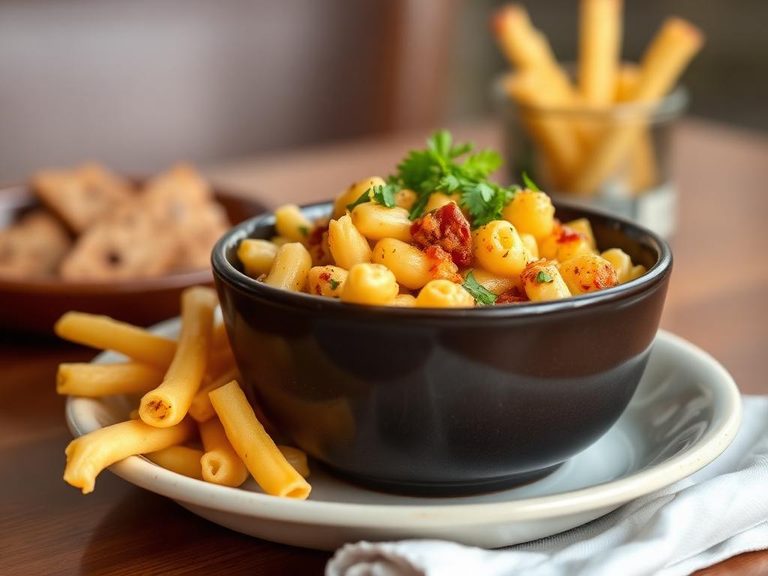
This is the ultimate pantry hero: a single-serving, shelf-stable cup of elbow pasta coated in a smooth, salty, and distinctly processed cheese sauce. The texture is uniformly soft, with the pasta yielding easily and the sauce clinging in a creamy, almost velvety layer. Nutritionally, it's a compact, energy-dense snack, providing a quick hit of carbs and protein for under 150 calories.
Calorie split: 18% protein · 42% carbs · 40% fat
↓ Full nutrition💚 Why it's loved
People adore it for its nostalgic, no-fuss comfort—a warm, salty, cheesy hug in a cup that requires zero culinary skill. Its ultimate versatility lies in being a blank canvas for quick upgrades like hot sauce, leftover proteins, or extra spices.
⚠️ Watch-outs & how to enjoy it better
The primary downsides are its high sodium content and the potential for a blood-sugar spike from the refined carbs and low fiber. To counteract this, pair it with a side of steamed broccoli or a piece of grilled chicken to add fiber and protein, which helps blunt the glycemic response. Always check the label and consider rinsing the pasta lightly if sodium is a major concern.
Key benefits
- Extremely convenient with a long shelf life
- Provides a quick source of energy and protein
- Portion-controlled for single servings
- No refrigeration needed until opened
- Familiar, comforting flavor profile
🍽️ Popular dishes
🌍 Where it's eaten
💡 Did you know?
The cheese sauce in most canned versions isn't made from real melted cheese but from a processed cheese product, which uses emulsifying salts to achieve its famously smooth, non-breaking texture when reheated.
Full nutrition (USDA data · scales with serving)
| Water | 72.9 g |
| Energy | 134 kcal |
| Energy | 559 kj |
| Protein | 6.0 g |
| Total lipid (fat) | 6.0 g |
| Ash | 1.1 g |
| Carbohydrate, by difference | 14.0 g |
| Fiber, total dietary | 0.40 g |
| Total Sugars | 1.4 g |
| Sucrose | 0.00 g |
| Glucose | 0.00 g |
| Fructose | 0.00 g |
| Lactose | 1.2 g |
| Maltose | 0.24 g |
| Galactose | 0.00 g |
| Starch | 11.4 g |
| Calcium, Ca | 57.0 mg |
| Iron, Fe | 0.91 mg |
| Magnesium, Mg | 13.0 mg |
| Phosphorus, P | 97.0 mg |
| Potassium, K | 72.0 mg |
| Sodium, Na | 335 mg |
| Zinc, Zn | 0.55 mg |
| Copper, Cu | 0.26 mg |
| Manganese, Mn | 0.22 mg |
| Selenium, Se | 11.5 ug |
| Vitamin C, total ascorbic acid | 0.00 mg |
| Thiamin | 0.08 mg |
| Riboflavin | 0.19 mg |
| Niacin | 1.0 mg |
| Pantothenic acid | 0.13 mg |
| Vitamin B-6 | 0.04 mg |
| Vitamin B-12 | 0.09 ug |
Fat & fatty acid profile (per 100g)
| Fatty acids, total saturated | 3.7 g |
| SFA 4:0 | 0.00 g |
| SFA 6:0 | 0.00 g |
| SFA 8:0 | 0.00 g |
| SFA 10:0 | 0.14 g |
| SFA 12:0 | 0.19 g |
| SFA 13:0 | 0.00 g |
| SFA 14:0 | 0.62 g |
| SFA 15:0 | 0.00 g |
| SFA 16:0 | 1.8 g |
| SFA 17:0 | 0.00 g |
| SFA 18:0 | 0.88 g |
| SFA 20:0 | 0.00 g |
| SFA 22:0 | 0.00 g |
| SFA 24:0 | 0.00 g |
| Fatty acids, total monounsaturated | 1.8 g |
| MUFA 14:1 | 0.00 g |
| MUFA 16:1 | 0.12 g |
| MUFA 17:1 | 0.00 g |
| MUFA 18:1 | 1.7 g |
| MUFA 20:1 | 0.00 g |
| MUFA 22:1 | 0.00 g |
| Fatty acids, total polyunsaturated | 0.43 g |
| PUFA 18:2 | 0.43 g |
| PUFA 18:3 | 0.00 g |
| PUFA 18:4 | 0.00 g |
| PUFA 20:2 n-6 c,c | 0.00 g |
| PUFA 20:3 | 0.00 g |
| PUFA 20:4 | 0.00 g |
| PUFA 20:5 n-3 (EPA) | 0.00 g |
| PUFA 22:5 n-3 (DPA) | 0.00 g |
| PUFA 22:6 n-3 (DHA) | 0.00 g |
| Cholesterol | 20.0 mg |
Amino acid profile (per 100g)
Estimated from Macaroni and cheese, box mix with cheese sauce, unprepared — USDA does not publish this profile for Macaroni and Cheese.
| Tryptophan | 0.15 g |
| Threonine | 0.40 g |
| Isoleucine | 0.47 g |
| Leucine | 0.86 g |
| Lysine | 0.42 g |
| Methionine | 0.16 g |
| Cystine | 0.17 g |
| Phenylalanine | 0.52 g |
| Tyrosine | 0.29 g |
| Valine | 0.54 g |
| Arginine | 0.38 g |
| Histidine | 0.25 g |
| Alanine | 0.35 g |
| Aspartic acid | 0.59 g |
| Glutamic acid | 3.2 g |
| Glycine | 0.31 g |
| Proline | 1.2 g |
| Serine | 0.52 g |
| Hydroxyproline | 0.00 g |
FAQ
Is the cheese sauce in canned mac and cheese real cheese?
It's typically a 'processed cheese product.' This means it's made from cheese ingredients but includes emulsifiers and other additives to ensure it melts smoothly and doesn't separate when heated, giving it that characteristic creamy texture.
How can I make it healthier?
Boost its nutritional profile by stirring in a handful of frozen peas or spinach, topping it with canned tuna or leftover shredded chicken, or serving it alongside a simple green salad to add fiber, vitamins, and more protein.
Why does it have such a long shelf life?
The combination of commercial sterilization (canning process), low moisture content, and the use of preservatives like sodium phosphate creates an environment where bacteria cannot grow, allowing it to be stored at room temperature for years.
Nutrient density (calculated · NRF9.3)
Nutrient Rich Foods index: beneficial nutrients (protein, fiber, vitamins, minerals) minus saturated fat, added sugar & sodium, per 100 kcal.
NRF9.3 index — Fulgoni, Keast & Drewnowski, 2009. Computed from USDA nutrients.
Weight-loss friendliness (composite index)
Energy density 1.34 kcal/g · 18% calories from protein · 0.4 g fiber · 1.4 g sugar per 100 g.
Composite of energy density (Rolls et al., 1999), protein & fiber satiety, minus sugar. A calculated heuristic — ranks satiety-per-calorie, not a clinical measure.
Dietary load (calculated from USDA values)
Potential renal acid load. Positive = acid-forming, negative = alkaline-forming.
Sodium-to-potassium ratio: 4.65 (lower is better — aim for ≤ 1)
Sodium:potassium per WHO potassium guidance. Computed from USDA nutrients.