

Lo mein, meatless
Common food

Photo: Wikipedia
Meatless lo mein is a savory stir-fry of soft wheat noodles tossed with a colorful medley of vegetables like cabbage, carrots, and bean sprouts in a savory, often soy-based sauce. The texture is a delightful mix of tender noodles and crisp-tender vegetables, with a rich, umami flavor profile. Nutritionally, it's a light, carb-focused dish with modest protein and low fat per serving.
Calorie split: 16% protein · 67% carbs · 17% fat
↓ Full nutrition💚 Why it's loved
People love meatless lo mein for its comforting, savory flavor and satisfying chewy texture, making it a go-to takeout favorite. Its versatility allows for endless combinations of vegetables and sauces, catering to a wide range of tastes and dietary preferences.
⚠️ Watch-outs & how to enjoy it better
The dish can be high in sodium from soy sauce and other seasonings, and the refined wheat noodles may cause blood-sugar spikes for some. To counteract this, opt for low-sodium soy sauce, load up on non-starchy vegetables for fiber, and consider pairing with a side of edamame or tofu to add protein and slow digestion.
Key benefits
- Low in fat and calories
- Provides quick energy from carbohydrates
- Can be a source of fiber if loaded with vegetables
- Often contains plant-based protein from tofu or edamame
- Highly customizable with nutrient-dense vegetables
🍽️ Popular dishes

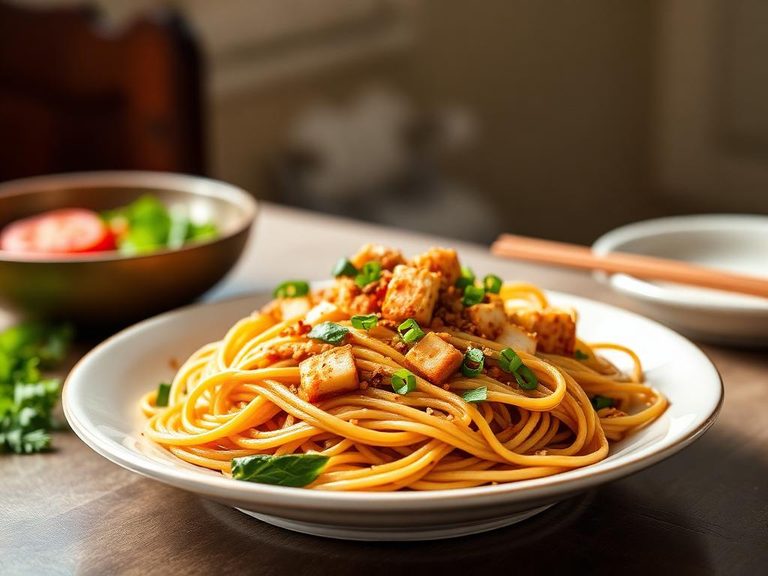
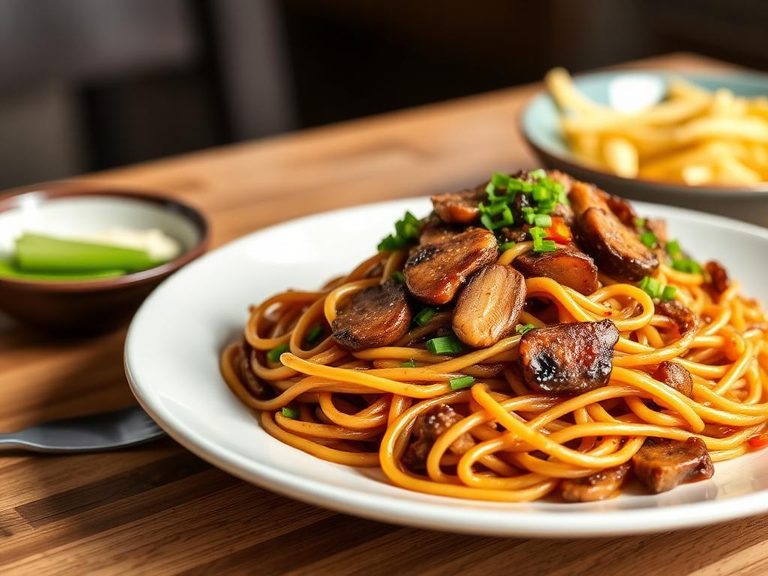
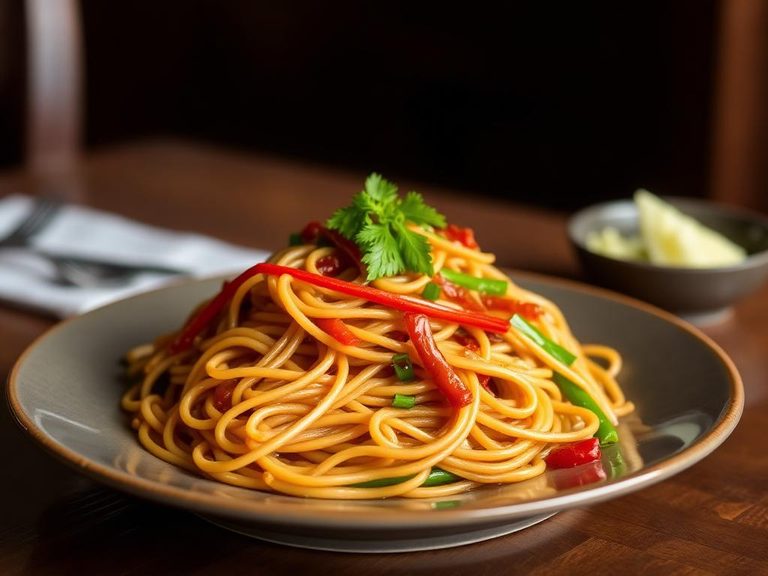
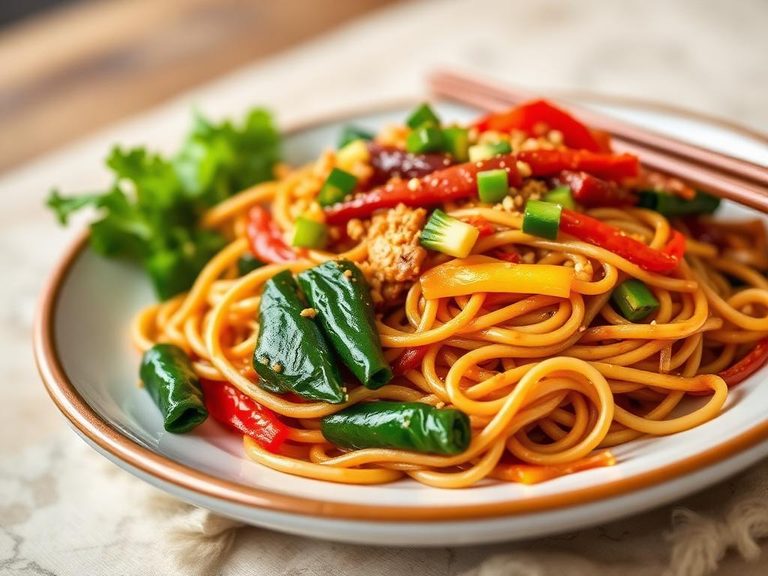
🌍 Where it's eaten
💡 Did you know?
The term 'lo mein' comes from the Cantonese 'lou min,' which means 'stirred noodles,' referring to the technique of tossing cooked noodles in sauce rather than stir-frying them raw.
Full nutrition (USDA data · scales with serving)
| Water | 71.3 g |
| Energy | 121 kcal |
| Protein | 4.8 g |
| Total lipid (fat) | 2.4 g |
| Carbohydrate, by difference | 20.2 g |
| Fiber, total dietary | 1.3 g |
| Total Sugars | 2.6 g |
| Calcium, Ca | 21.0 mg |
| Iron, Fe | 1.1 mg |
| Magnesium, Mg | 14.0 mg |
| Phosphorus, P | 45.0 mg |
| Potassium, K | 105 mg |
| Sodium, Na | 430 mg |
| Zinc, Zn | 0.36 mg |
| Copper, Cu | 0.06 mg |
| Selenium, Se | 11.7 ug |
| Vitamin C, total ascorbic acid | 1.7 mg |
| Thiamin | 0.05 mg |
| Riboflavin | 0.12 mg |
| Niacin | 0.81 mg |
| Vitamin B-6 | 0.07 mg |
| Folate, total | 28.0 ug |
| Folic acid | 0.00 ug |
| Folate, food | 28.0 ug |
| Folate, DFE | 28.0 ug |
| Choline, total | 8.9 mg |
| Vitamin B-12 | 0.00 ug |
| Vitamin B-12, added | 0.00 ug |
| Vitamin A, RAE | 9.0 ug |
| Retinol | 0.00 ug |
| Carotene, beta | 97.0 ug |
| Carotene, alpha | 21.0 ug |
| Cryptoxanthin, beta | 0.00 ug |
| Lycopene | 3.0 ug |
| Lutein + zeaxanthin | 112 ug |
| Vitamin E (alpha-tocopherol) | 0.30 mg |
| Vitamin E, added | 0.00 mg |
| Vitamin D (D2 + D3) | 0.10 ug |
| Vitamin K (phylloquinone) | 12.7 ug |
| Alcohol, ethyl | 0.00 g |
| Caffeine | 0.00 mg |
| Theobromine | 0.00 mg |
Fat & fatty acid profile (per 100g)
| Fatty acids, total saturated | 0.46 g |
| SFA 4:0 | 0.00 g |
| SFA 6:0 | 0.00 g |
| SFA 8:0 | 0.00 g |
| SFA 10:0 | 0.00 g |
| SFA 12:0 | 0.00 g |
| SFA 14:0 | 0.00 g |
| SFA 16:0 | 0.33 g |
| SFA 18:0 | 0.11 g |
| Fatty acids, total monounsaturated | 0.59 g |
| MUFA 16:1 | 0.01 g |
| MUFA 18:1 | 0.57 g |
| MUFA 20:1 | 0.01 g |
| MUFA 22:1 | 0.00 g |
| Fatty acids, total polyunsaturated | 1.3 g |
| PUFA 18:2 | 1.1 g |
| PUFA 18:3 | 0.14 g |
| PUFA 18:4 | 0.00 g |
| PUFA 20:4 | 0.00 g |
| PUFA 20:5 n-3 (EPA) | 0.00 g |
| PUFA 22:5 n-3 (DPA) | 0.00 g |
| PUFA 22:6 n-3 (DHA) | 0.00 g |
| Cholesterol | 0.00 mg |
Amino acid profile (per 100g)
Estimated from Restaurant, Chinese, chicken chow mein — USDA does not publish this profile for Lo mein.
| Tryptophan | 0.08 g |
| Threonine | 0.27 g |
| Isoleucine | 0.28 g |
| Leucine | 0.50 g |
| Lysine | 0.47 g |
| Methionine | 0.16 g |
| Cystine | 0.08 g |
| Phenylalanine | 0.25 g |
| Tyrosine | 0.22 g |
| Valine | 0.31 g |
| Arginine | 0.42 g |
| Histidine | 0.18 g |
| Alanine | 0.36 g |
| Aspartic acid | 0.60 g |
| Glutamic acid | 1.4 g |
| Glycine | 0.24 g |
| Proline | 0.35 g |
| Serine | 0.25 g |
FAQ
Is meatless lo mein a good source of protein?
By itself, it's typically low in protein (around 5g per serving). To boost it, add tofu, edamame, or a fried egg on top.
How can I make it healthier at home?
Use whole-wheat or buckwheat noodles, reduce sodium by using low-sodium tamari or coconut aminos, and load the dish with at least twice the volume of vegetables compared to noodles.
What's the difference between lo mein and chow mein?
Lo mein noodles are soft and tossed in sauce, while chow mein noodles are fried until crispy and are often drier.
Nutrient density (calculated · NRF9.3)
Nutrient Rich Foods index: beneficial nutrients (protein, fiber, vitamins, minerals) minus saturated fat, added sugar & sodium, per 100 kcal.
NRF9.3 index — Fulgoni, Keast & Drewnowski, 2009. Computed from USDA nutrients.
Weight-loss friendliness (composite index)
Energy density 1.21 kcal/g · 16% calories from protein · 1.3 g fiber · 2.6 g sugar per 100 g.
Composite of energy density (Rolls et al., 1999), protein & fiber satiety, minus sugar. A calculated heuristic — ranks satiety-per-calorie, not a clinical measure.
Dietary load (calculated from USDA values)
Potential renal acid load. Positive = acid-forming, negative = alkaline-forming.
Sodium-to-potassium ratio: 4.10 (lower is better — aim for ≤ 1)
Sodium:potassium per WHO potassium guidance. Computed from USDA nutrients.