

Chow mein or chop suey, meatless, no noodles
Common food

Photo: Wikipedia
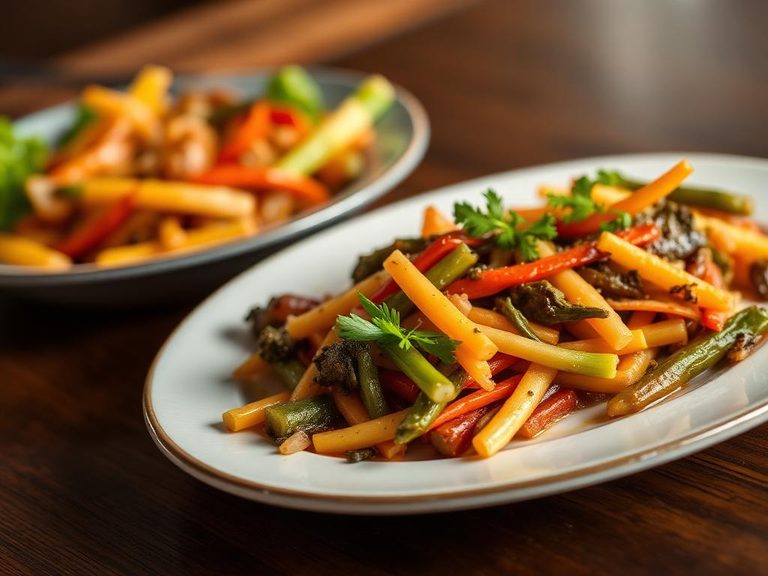
This is a stir-fried medley of crisp vegetables—typically celery, cabbage, bean sprouts, and water chestnuts—cooked without noodles or meat. It offers a satisfying crunch with a savory, umami-rich sauce that clings to each piece. At just 43 kcal per 100g, it's a light, fiber-rich side that delivers flavor without heaviness.
Calorie split: 12% protein · 53% carbs · 35% fat
↓ Full nutrition💚 Why it's loved
People love it for its satisfying crunch and the way it absorbs savory sauces, making a simple vegetable dish feel indulgent. It's a staple of Chinese-American takeout, offering a quick, customizable way to add vegetables to any meal.
⚠️ Watch-outs & how to enjoy it better
The primary downside is its often high sodium content from soy sauce and oyster sauce in the cooking liquid. To counteract this, you can request sauce on the side, use low-sodium tamari, or balance it with unsalted steamed rice or a protein like tofu or chicken.
Key benefits
- Very low calorie density
- Good source of dietary fiber
- Contains vitamins A and C from mixed vegetables
- Quick-cooking and versatile
- Naturally low in fat
🍽️ Popular dishes
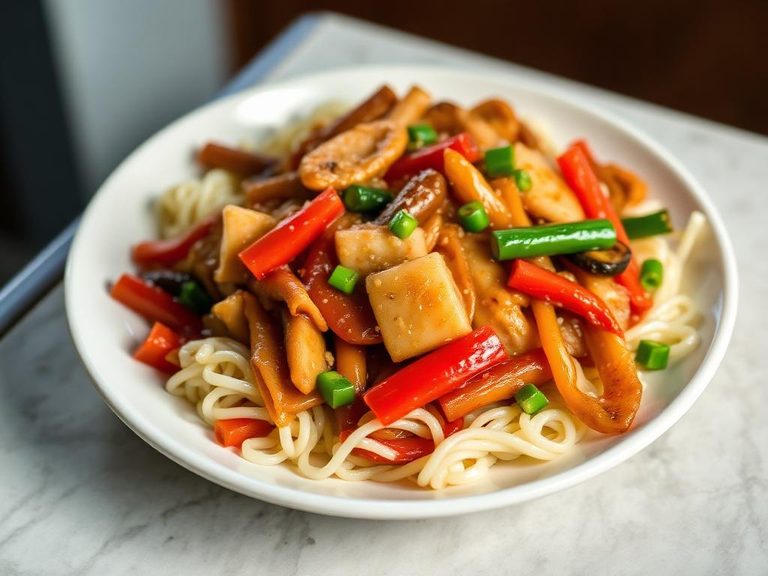
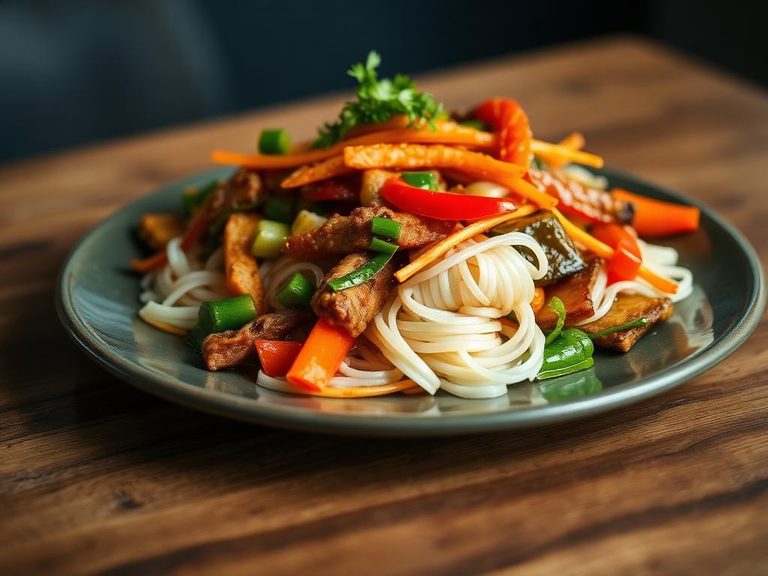
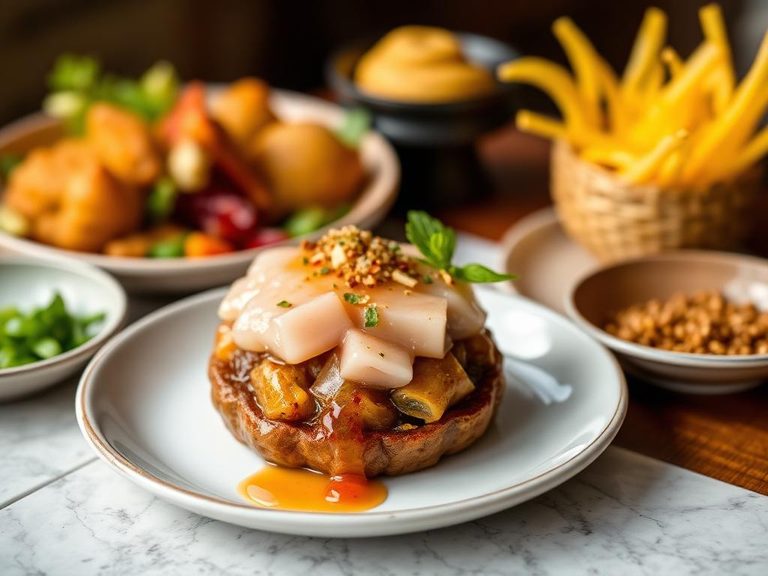
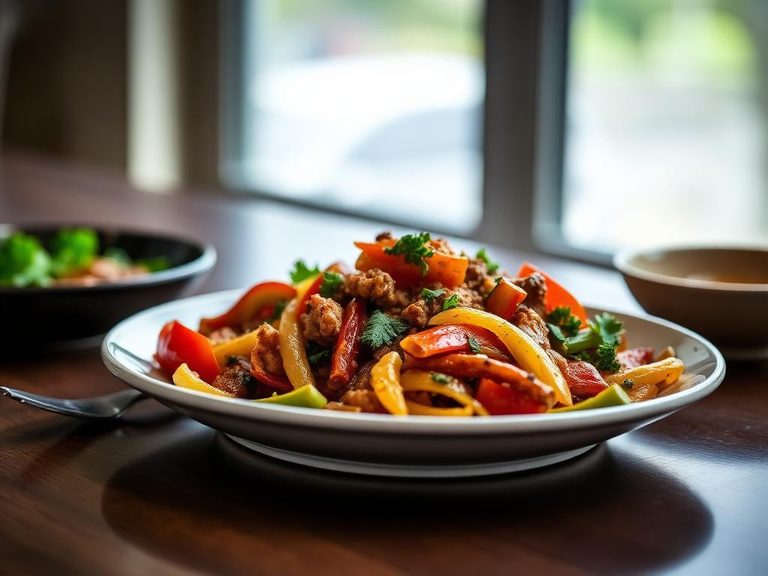
🌍 Where it's eaten
💡 Did you know?
The name 'chop suey' likely derives from the Cantonese 'tsap sui,' meaning 'miscellaneous leftovers,' reflecting its origins as a dish made from whatever vegetables were on hand.
Full nutrition (USDA data · scales with serving)
| Water | 90.1 g |
| Energy | 43.0 kcal |
| Protein | 1.3 g |
| Total lipid (fat) | 1.7 g |
| Carbohydrate, by difference | 5.7 g |
| Fiber, total dietary | 1.2 g |
| Total Sugars | 2.6 g |
| Calcium, Ca | 25.0 mg |
| Iron, Fe | 0.42 mg |
| Magnesium, Mg | 9.0 mg |
| Phosphorus, P | 30.0 mg |
| Potassium, K | 136 mg |
| Sodium, Na | 344 mg |
| Zinc, Zn | 0.19 mg |
| Copper, Cu | 0.03 mg |
| Selenium, Se | 0.40 ug |
| Vitamin C, total ascorbic acid | 7.2 mg |
| Thiamin | 0.02 mg |
| Riboflavin | 0.10 mg |
| Niacin | 0.51 mg |
| Vitamin B-6 | 0.09 mg |
| Folate, total | 40.0 ug |
| Folic acid | 0.00 ug |
| Folate, food | 40.0 ug |
| Folate, DFE | 40.0 ug |
| Choline, total | 15.8 mg |
| Vitamin B-12 | 0.00 ug |
| Vitamin B-12, added | 0.00 ug |
| Vitamin A, RAE | 13.0 ug |
| Retinol | 0.00 ug |
| Carotene, beta | 148 ug |
| Carotene, alpha | 28.0 ug |
| Cryptoxanthin, beta | 0.00 ug |
| Lycopene | 0.00 ug |
| Lutein + zeaxanthin | 178 ug |
| Vitamin E (alpha-tocopherol) | 0.50 mg |
| Vitamin E, added | 0.00 mg |
| Vitamin D (D2 + D3) | 0.00 ug |
| Vitamin K (phylloquinone) | 18.9 ug |
| Alcohol, ethyl | 0.00 g |
| Caffeine | 0.00 mg |
| Theobromine | 0.00 mg |
Fat & fatty acid profile (per 100g)
| Fatty acids, total saturated | 0.29 g |
| SFA 4:0 | 0.00 g |
| SFA 6:0 | 0.00 g |
| SFA 8:0 | 0.00 g |
| SFA 10:0 | 0.00 g |
| SFA 12:0 | 0.00 g |
| SFA 14:0 | 0.00 g |
| SFA 16:0 | 0.19 g |
| SFA 18:0 | 0.08 g |
| Fatty acids, total monounsaturated | 0.41 g |
| MUFA 16:1 | 0.00 g |
| MUFA 18:1 | 0.40 g |
| MUFA 20:1 | 0.00 g |
| MUFA 22:1 | 0.00 g |
| Fatty acids, total polyunsaturated | 0.92 g |
| PUFA 18:2 | 0.79 g |
| PUFA 18:3 | 0.13 g |
| PUFA 18:4 | 0.00 g |
| PUFA 20:4 | 0.00 g |
| PUFA 20:5 n-3 (EPA) | 0.00 g |
| PUFA 22:5 n-3 (DPA) | 0.00 g |
| PUFA 22:6 n-3 (DHA) | 0.00 g |
| Cholesterol | 0.00 mg |
Amino acid profile (per 100g)
Estimated from Restaurant, Chinese, chicken chow mein — USDA does not publish this profile for Chow mein or chop suey.
| Tryptophan | 0.08 g |
| Threonine | 0.27 g |
| Isoleucine | 0.28 g |
| Leucine | 0.50 g |
| Lysine | 0.47 g |
| Methionine | 0.16 g |
| Cystine | 0.08 g |
| Phenylalanine | 0.25 g |
| Tyrosine | 0.22 g |
| Valine | 0.31 g |
| Arginine | 0.42 g |
| Histidine | 0.18 g |
| Alanine | 0.36 g |
| Aspartic acid | 0.60 g |
| Glutamic acid | 1.4 g |
| Glycine | 0.24 g |
| Proline | 0.35 g |
| Serine | 0.25 g |
FAQ
Is chop suey the same as chow mein?
No. Chop suey is a vegetable stir-fry with a thickened sauce, while chow mein specifically includes noodles. Meatless chop suey focuses on the vegetables and sauce.
Why is it so low in calories?
It's primarily composed of water-rich vegetables like cabbage and celery, which have high volume but low caloric density. The cooking method uses minimal oil.
Can I make it at home?
Absolutely. Sauté aromatics like garlic and ginger, add your choice of firm vegetables (bell peppers, broccoli, carrots work well), and finish with a sauce of soy sauce, a touch of sugar, and cornstarch slurry for thickness.
Nutrient density (calculated · NRF9.3)
Nutrient Rich Foods index: beneficial nutrients (protein, fiber, vitamins, minerals) minus saturated fat, added sugar & sodium, per 100 kcal.
NRF9.3 index — Fulgoni, Keast & Drewnowski, 2009. Computed from USDA nutrients.
Weight-loss friendliness (composite index)
Energy density 0.43 kcal/g · 12% calories from protein · 1.2 g fiber · 2.6 g sugar per 100 g.
Composite of energy density (Rolls et al., 1999), protein & fiber satiety, minus sugar. A calculated heuristic — ranks satiety-per-calorie, not a clinical measure.
Dietary load (calculated from USDA values)
Potential renal acid load. Positive = acid-forming, negative = alkaline-forming.
Sodium-to-potassium ratio: 2.53 (lower is better — aim for ≤ 1)
Sodium:potassium per WHO potassium guidance. Computed from USDA nutrients.