

Hot chocolate / cocoa, dry mix, reduced sugar, made with non-dairy milk
Common food

Photo: Wikipedia
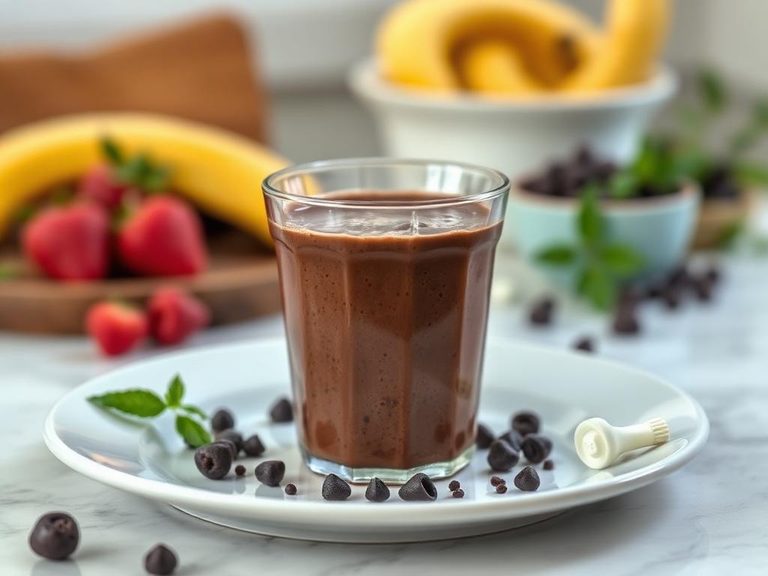
This is a powdered, reduced-sugar hot cocoa mix designed to be blended with non-dairy milk, creating a light, frothy beverage with a deep chocolate flavor. The taste is distinctly cocoa-forward, often with a subtle, earthy bitterness balanced by a mild sweetness, and a smooth, creamy texture when prepared. Nutritionally, it's a low-calorie, low-sugar option that provides a modest protein boost, making it a lighter alternative to traditional hot chocolate.
Calorie split: 16% protein · 58% carbs · 26% fat
↓ Full nutrition💚 Why it's loved
People love it for its comforting, nostalgic warmth and the ability to enjoy a rich chocolate flavor without the high sugar content of traditional mixes. It's incredibly versatile, easily customized with spices like cinnamon or a dash of vanilla, and fits seamlessly into a cozy, mindful routine.
⚠️ Watch-outs & how to enjoy it better
The reduced sugar can leave some finding the taste slightly bitter or less indulgent, and the use of non-dairy milk may not appeal to those who prefer the richness of dairy. Some blends may contain additives or thickeners that can cause digestive discomfort in sensitive individuals. To counteract this, pair it with a source of healthy fat (like a handful of nuts) to enhance satiety and balance the flavor, or choose a blend with minimal additives.
Key benefits
- Low in calories and sugar, suitable for calorie-conscious diets.
- Provides a modest protein boost (2.31g per 100g) from the mix and non-dairy milk.
- Contains dietary fiber (0.7g per 100g) for digestive support.
- Often fortified with vitamins and minerals like calcium and vitamin D when paired with non-dairy milk.
- A convenient, shelf-stable way to enjoy a warm, comforting beverage.
🍽️ Popular dishes




🌍 Where it's eaten
💡 Did you know?
The first recorded use of chocolate as a beverage was by the ancient Maya and Aztec civilizations, who mixed ground cacao beans with water, cornmeal, and chili peppers to create a frothy, bitter drink called 'xocolātl.'
Full nutrition (USDA data · scales with serving)
| Water | 86.4 g |
| Energy | 59.0 kcal |
| Protein | 2.3 g |
| Total lipid (fat) | 1.7 g |
| Carbohydrate, by difference | 8.7 g |
| Fiber, total dietary | 0.70 g |
| Total Sugars | 4.9 g |
| Calcium, Ca | 188 mg |
| Iron, Fe | 0.70 mg |
| Magnesium, Mg | 26.0 mg |
| Phosphorus, P | 105 mg |
| Potassium, K | 269 mg |
| Sodium, Na | 118 mg |
| Zinc, Zn | 0.46 mg |
| Copper, Cu | 0.10 mg |
| Selenium, Se | 2.0 ug |
| Vitamin C, total ascorbic acid | 0.00 mg |
| Thiamin | 0.04 mg |
| Riboflavin | 0.15 mg |
| Niacin | 0.18 mg |
| Vitamin B-6 | 0.04 mg |
| Folate, total | 5.0 ug |
| Folic acid | 0.00 ug |
| Folate, food | 5.0 ug |
| Folate, DFE | 5.0 ug |
| Choline, total | 15.6 mg |
| Vitamin B-12 | 0.44 ug |
| Vitamin B-12, added | 0.34 ug |
| Vitamin A, RAE | 33.0 ug |
| Retinol | 33.0 ug |
| Carotene, beta | 0.00 ug |
| Carotene, alpha | 0.00 ug |
| Cryptoxanthin, beta | 0.00 ug |
| Lycopene | 0.00 ug |
| Lutein + zeaxanthin | 4.0 ug |
| Vitamin E (alpha-tocopherol) | 1.9 mg |
| Vitamin E, added | 1.8 mg |
| Vitamin D (D2 + D3) | 0.90 ug |
| Vitamin K (phylloquinone) | 0.90 ug |
| Alcohol, ethyl | 0.00 g |
| Caffeine | 2.0 mg |
| Theobromine | 54.0 mg |
Fat & fatty acid profile (per 100g)
| Fatty acids, total saturated | 0.29 g |
| SFA 4:0 | 0.00 g |
| SFA 6:0 | 0.00 g |
| SFA 8:0 | 0.00 g |
| SFA 10:0 | 0.00 g |
| SFA 12:0 | 0.00 g |
| SFA 14:0 | 0.01 g |
| SFA 16:0 | 0.17 g |
| SFA 18:0 | 0.10 g |
| Fatty acids, total monounsaturated | 0.80 g |
| MUFA 16:1 | 0.01 g |
| MUFA 18:1 | 0.78 g |
| MUFA 20:1 | 0.01 g |
| MUFA 22:1 | 0.00 g |
| Fatty acids, total polyunsaturated | 0.47 g |
| PUFA 18:2 | 0.42 g |
| PUFA 18:3 | 0.06 g |
| PUFA 18:4 | 0.00 g |
| PUFA 20:4 | 0.00 g |
| PUFA 20:5 n-3 (EPA) | 0.00 g |
| PUFA 22:5 n-3 (DPA) | 0.00 g |
| PUFA 22:6 n-3 (DHA) | 0.00 g |
| Cholesterol | 0.00 mg |
Amino acid profile (per 100g)
Estimated from Milk, chocolate beverage, hot cocoa, homemade — USDA does not publish this profile for Hot chocolate / cocoa.
| Tryptophan | 0.04 g |
| Threonine | 0.10 g |
| Isoleucine | 0.17 g |
| Leucine | 0.30 g |
| Lysine | 0.21 g |
| Methionine | 0.08 g |
| Cystine | 0.10 g |
| Phenylalanine | 0.15 g |
| Tyrosine | 0.14 g |
| Valine | 0.20 g |
| Arginine | 0.10 g |
| Histidine | 0.07 g |
| Alanine | 0.10 g |
| Aspartic acid | 0.28 g |
| Glutamic acid | 0.72 g |
| Glycine | 0.06 g |
| Proline | 0.34 g |
| Serine | 0.18 g |
FAQ
How does the nutritional profile compare to regular hot chocolate?
Compared to standard hot chocolate mixes, this reduced-sugar version is significantly lower in calories (59 kcal vs. 100-150 kcal per 100g) and sugar (4.94g vs. 10-15g per 100g), while maintaining a similar protein and fat content. It's a lighter choice for those monitoring sugar intake.
Can I use this mix with regular dairy milk?
Yes, absolutely. While the product is designed for non-dairy milk, it works perfectly with cow's milk or any other milk of your choice. Using dairy milk will increase the calorie, protein, and fat content of the final drink.
Is this suitable for a vegan diet?
It depends on the specific brand and ingredients. Many reduced-sugar cocoa mixes are vegan, but you should always check the label for any dairy derivatives (like whey or casein) or other animal-derived additives. The mix itself is often plant-based, but the preparation with non-dairy milk makes it a vegan-friendly beverage.
Nutrient density (calculated · NRF9.3)
Nutrient Rich Foods index: beneficial nutrients (protein, fiber, vitamins, minerals) minus saturated fat, added sugar & sodium, per 100 kcal.
NRF9.3 index — Fulgoni, Keast & Drewnowski, 2009. Computed from USDA nutrients.
Weight-loss friendliness (composite index)
Energy density 0.59 kcal/g · 16% calories from protein · 0.7 g fiber · 4.9 g sugar per 100 g.
Composite of energy density (Rolls et al., 1999), protein & fiber satiety, minus sugar. A calculated heuristic — ranks satiety-per-calorie, not a clinical measure.
Dietary load (calculated from USDA values)
Potential renal acid load. Positive = acid-forming, negative = alkaline-forming.
Sodium-to-potassium ratio: 0.44 (lower is better — aim for ≤ 1)
Sodium:potassium per WHO potassium guidance. Computed from USDA nutrients.