

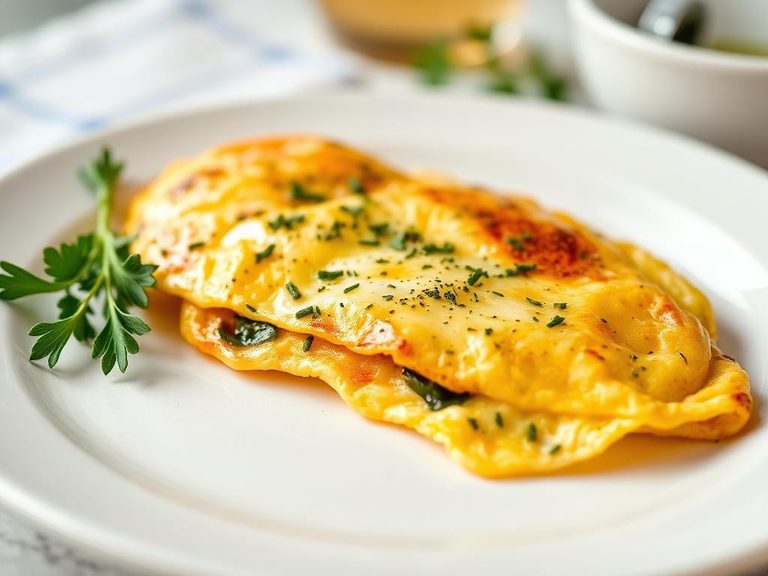
Egg omelet or scrambled egg, with meat, tomatoes, and dark-green vegetables, NS as to fat
Common food

Photo: Wikipedia
This is a hearty, savory scramble or folded omelet where fluffy eggs act as a golden canvas for savory meat, juicy tomatoes, and wilted dark greens. The texture is a satisfying contrast of soft, custardy egg, tender meat, and the slight bite of cooked vegetables. It's a protein-packed powerhouse, delivering over 11 grams of protein per 100 grams with minimal carbohydrates.
Calorie split: 26% protein · 3% carbs · 70% fat
↓ Full nutrition💚 Why it's loved
People love it for its incredible versatility and comforting, savory flavor that works for any meal. It's a classic, quick-cooking dish that transforms simple ingredients into a satisfying, protein-rich plate.
⚠️ Watch-outs & how to enjoy it better
The primary concern is the fat content, which can be significant depending on the meat cut and cooking oil used. To counteract this, choose lean meats like turkey or chicken breast, use a non-stick pan with minimal oil, and consider draining any excess grease after cooking the meat before adding the eggs.
Key benefits
- High-quality protein for muscle maintenance and satiety
- Rich in choline from eggs, essential for brain health
- Provides iron and B vitamins from the meat component
- Tomatoes offer lycopene, an antioxidant linked to heart health
- Dark greens contribute vitamins A, C, K, and folate
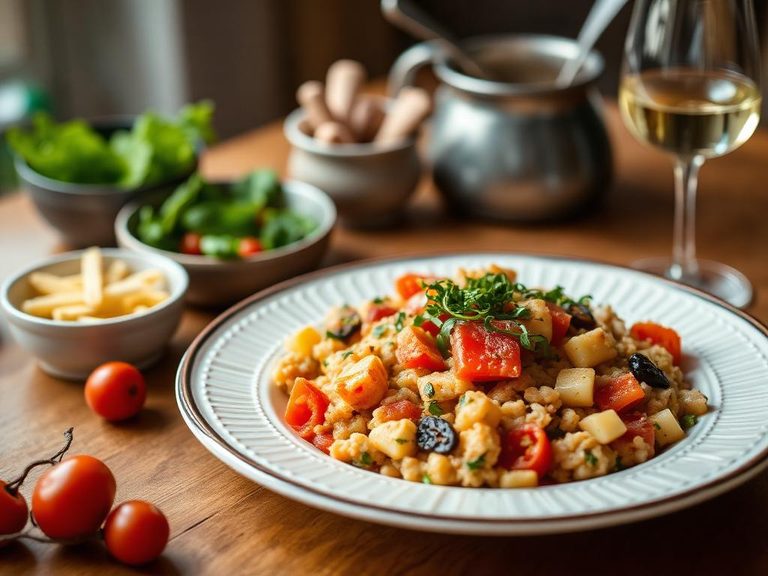
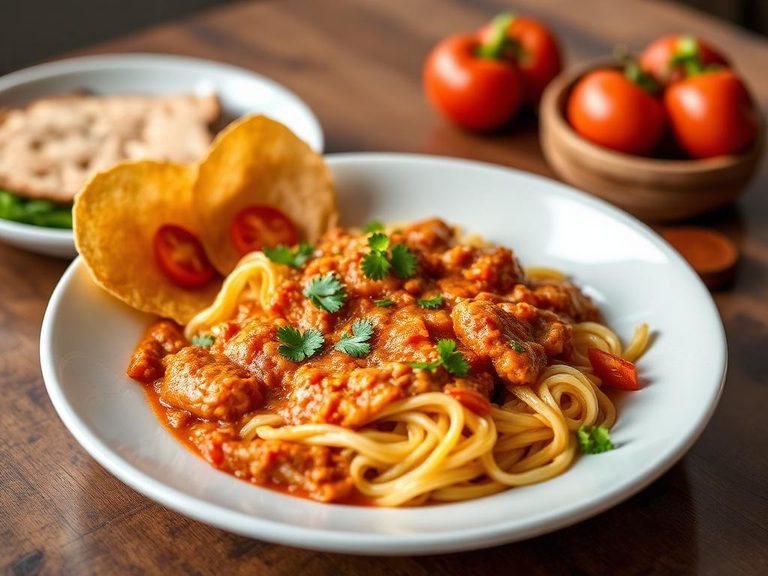
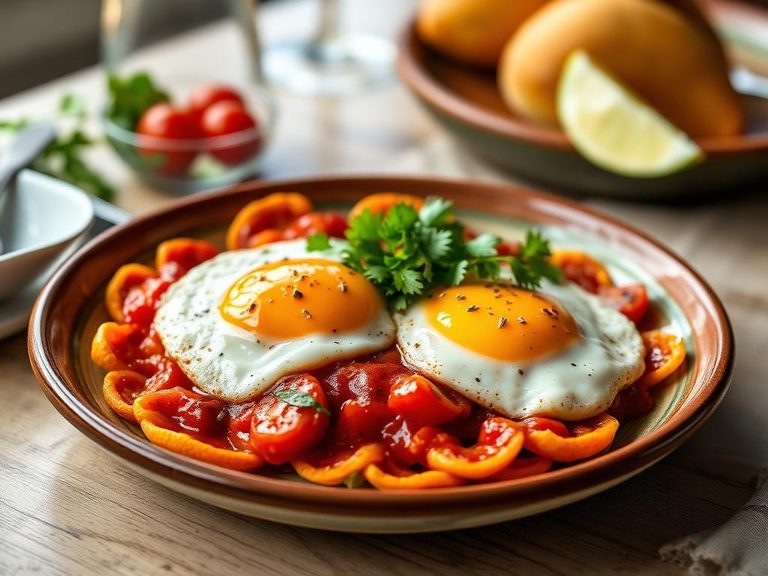
🍽️ Popular dishes
🌍 Where it's eaten
💡 Did you know?
The phrase 'N.S. as to fat' in nutrition databases stands for 'Not Specified as to fat,' meaning the analysis doesn't distinguish between saturated and unsaturated fats, but the total fat content is measured.
Full nutrition (USDA data · scales with serving)
| Water | 72.1 g |
| Energy | 174 kcal |
| Protein | 11.5 g |
| Total lipid (fat) | 13.6 g |
| Carbohydrate, by difference | 1.5 g |
| Fiber, total dietary | 0.20 g |
| Total Sugars | 0.52 g |
| Calcium, Ca | 42.0 mg |
| Iron, Fe | 1.4 mg |
| Magnesium, Mg | 16.0 mg |
| Phosphorus, P | 165 mg |
| Potassium, K | 178 mg |
| Sodium, Na | 318 mg |
| Zinc, Zn | 1.2 mg |
| Copper, Cu | 0.02 mg |
| Selenium, Se | 25.8 ug |
| Vitamin C, total ascorbic acid | 3.1 mg |
| Thiamin | 0.09 mg |
| Riboflavin | 0.33 mg |
| Niacin | 0.80 mg |
| Vitamin B-6 | 0.13 mg |
| Folate, total | 44.0 ug |
| Folic acid | 0.00 ug |
| Folate, food | 44.0 ug |
| Folate, DFE | 44.0 ug |
| Choline, total | 204 mg |
| Vitamin B-12 | 0.68 ug |
| Vitamin B-12, added | 0.00 ug |
| Vitamin A, RAE | 168 ug |
| Retinol | 150 ug |
| Carotene, beta | 203 ug |
| Carotene, alpha | 6.0 ug |
| Cryptoxanthin, beta | 10.0 ug |
| Lycopene | 150 ug |
| Lutein + zeaxanthin | 738 ug |
| Vitamin E (alpha-tocopherol) | 1.6 mg |
| Vitamin E, added | 0.00 mg |
| Vitamin D (D2 + D3) | 1.9 ug |
| Vitamin K (phylloquinone) | 28.4 ug |
| Alcohol, ethyl | 0.00 g |
| Caffeine | 0.00 mg |
| Theobromine | 0.00 mg |
Fat & fatty acid profile (per 100g)
| Fatty acids, total saturated | 4.1 g |
| SFA 4:0 | 0.03 g |
| SFA 6:0 | 0.02 g |
| SFA 8:0 | 0.01 g |
| SFA 10:0 | 0.03 g |
| SFA 12:0 | 0.04 g |
| SFA 14:0 | 0.16 g |
| SFA 16:0 | 2.7 g |
| SFA 18:0 | 1.0 g |
| Fatty acids, total monounsaturated | 5.0 g |
| MUFA 16:1 | 0.24 g |
| MUFA 18:1 | 4.7 g |
| MUFA 20:1 | 0.04 g |
| MUFA 22:1 | 0.00 g |
| Fatty acids, total polyunsaturated | 3.0 g |
| PUFA 18:2 | 2.5 g |
| PUFA 18:3 | 0.17 g |
| PUFA 18:4 | 0.00 g |
| PUFA 20:4 | 0.01 g |
| PUFA 20:5 n-3 (EPA) | 0.00 g |
| PUFA 22:5 n-3 (DPA) | 0.00 g |
| PUFA 22:6 n-3 (DHA) | 0.00 g |
| Cholesterol | 309 mg |
Amino acid profile (per 100g)
Estimated from Egg, whole, cooked, omelet — USDA does not publish this profile for Egg omelet or scrambled egg.
| Tryptophan | 0.14 g |
| Threonine | 0.47 g |
| Isoleucine | 0.56 g |
| Leucine | 0.91 g |
| Lysine | 0.77 g |
| Methionine | 0.32 g |
| Cystine | 0.23 g |
| Phenylalanine | 0.57 g |
| Tyrosine | 0.42 g |
| Valine | 0.72 g |
| Arginine | 0.69 g |
| Histidine | 0.26 g |
| Alanine | 0.62 g |
| Aspartic acid | 1.1 g |
| Glutamic acid | 1.4 g |
| Glycine | 0.36 g |
| Proline | 0.43 g |
| Serine | 0.82 g |
FAQ
How do I prevent the vegetables from making the eggs watery?
Sauté the tomatoes and greens separately first until their moisture has evaporated and they are slightly caramelized. Let them cool slightly before folding into the eggs.
Can I make this ahead for meal prep?
Yes, but the texture is best fresh. If reheating, do so gently in a skillet over medium-low heat or in the microwave at 50% power to avoid making the eggs rubbery.
What's the best way to fold it for an omelet versus a scramble?
For a scramble, gently push the eggs from the edges to the center as they set. For an omelet, let the base set fully, add fillings to one half, then carefully fold the other half over.
Nutrient density (calculated · NRF9.3)
Nutrient Rich Foods index: beneficial nutrients (protein, fiber, vitamins, minerals) minus saturated fat, added sugar & sodium, per 100 kcal.
NRF9.3 index — Fulgoni, Keast & Drewnowski, 2009. Computed from USDA nutrients.
Weight-loss friendliness (composite index)
Energy density 1.74 kcal/g · 26% calories from protein · 0.2 g fiber · 0.5 g sugar per 100 g.
Composite of energy density (Rolls et al., 1999), protein & fiber satiety, minus sugar. A calculated heuristic — ranks satiety-per-calorie, not a clinical measure.
Dietary load (calculated from USDA values)
Potential renal acid load. Positive = acid-forming, negative = alkaline-forming.
Sodium-to-potassium ratio: 1.79 (lower is better — aim for ≤ 1)
Sodium:potassium per WHO potassium guidance. Computed from USDA nutrients.