

Egg omelet or scrambled egg, with meat and vegetables other than dark-green and/or tomatoes, fat added
Common food
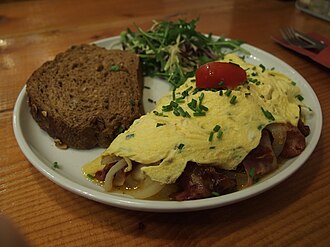
Photo: Wikipedia
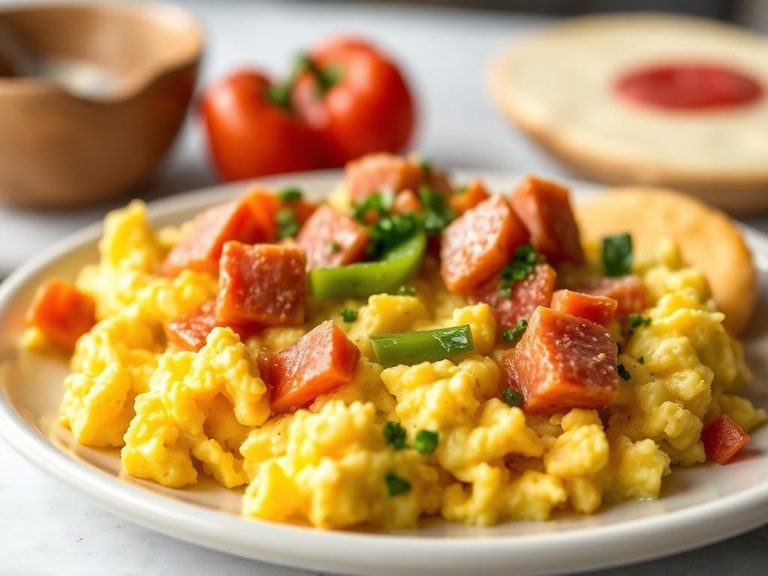
This is a hearty, savory dish of eggs scrambled or folded into an omelet, studded with diced meat (like ham, sausage, or bacon) and a mix of non-dark-green vegetables such as onions, bell peppers, or mushrooms. The texture is typically fluffy and tender, with a rich, savory flavor from the eggs and meat, balanced by the slight crunch and sweetness of the vegetables. Nutritionally, it's a protein-packed, low-carb option that provides substantial energy from its healthy fats.
Calorie split: 26% protein · 3% carbs · 70% fat
↓ Full nutrition💚 Why it's loved
People love it for its comforting, savory flavor and incredible versatility—it's a blank canvas that can be customized with any combination of meats and veggies. It's a staple in breakfast cultures worldwide, from American diners to European cafes, often symbolizing a hearty, satisfying start to the day.
⚠️ Watch-outs & how to enjoy it better
The added fats (like butter or oil) and processed meats can be high in saturated fat and sodium, which may concern those monitoring heart health or blood pressure. To counteract this, use a non-stick pan with minimal oil, choose lean meats like turkey or chicken, and pair it with a side of fresh fruit or a light salad to add fiber and balance the meal.
Key benefits
- High-quality protein from eggs and meat supports muscle maintenance.
- Low carbohydrate content makes it suitable for low-carb or keto diets.
- Provides essential vitamins and minerals like B12, selenium, and choline from eggs.
- Vegetables add fiber, antioxidants, and volume without significant calories.
- Versatile and quick to prepare, making it a practical meal option.
🍽️ Popular dishes
🌍 Where it's eaten
💡 Did you know?
The term 'omelet' is believed to have originated in France, but the dish itself has ancient roots—Romans were making egg-based dishes as early as the 1st century AD, often with herbs and spices.
Full nutrition (USDA data · scales with serving)
| Water | 72.3 g |
| Energy | 173 kcal |
| Protein | 11.3 g |
| Total lipid (fat) | 13.6 g |
| Carbohydrate, by difference | 1.5 g |
| Fiber, total dietary | 0.20 g |
| Total Sugars | 0.54 g |
| Calcium, Ca | 39.0 mg |
| Iron, Fe | 1.4 mg |
| Magnesium, Mg | 11.0 mg |
| Phosphorus, P | 170 mg |
| Potassium, K | 176 mg |
| Sodium, Na | 285 mg |
| Zinc, Zn | 1.2 mg |
| Copper, Cu | 0.05 mg |
| Selenium, Se | 28.1 ug |
| Vitamin C, total ascorbic acid | 0.80 mg |
| Thiamin | 0.08 mg |
| Riboflavin | 0.37 mg |
| Niacin | 0.96 mg |
| Vitamin B-6 | 0.11 mg |
| Folate, total | 44.0 ug |
| Folic acid | 0.00 ug |
| Folate, food | 44.0 ug |
| Folate, DFE | 44.0 ug |
| Choline, total | 211 mg |
| Vitamin B-12 | 0.68 ug |
| Vitamin B-12, added | 0.00 ug |
| Vitamin A, RAE | 158 ug |
| Retinol | 156 ug |
| Carotene, beta | 10.0 ug |
| Carotene, alpha | 0.00 ug |
| Cryptoxanthin, beta | 10.0 ug |
| Lycopene | 0.00 ug |
| Lutein + zeaxanthin | 382 ug |
| Vitamin E (alpha-tocopherol) | 1.5 mg |
| Vitamin E, added | 0.00 mg |
| Vitamin D (D2 + D3) | 2.0 ug |
| Vitamin K (phylloquinone) | 4.1 ug |
| Alcohol, ethyl | 0.00 g |
| Caffeine | 0.00 mg |
| Theobromine | 0.00 mg |
Fat & fatty acid profile (per 100g)
| Fatty acids, total saturated | 4.1 g |
| SFA 4:0 | 0.03 g |
| SFA 6:0 | 0.02 g |
| SFA 8:0 | 0.01 g |
| SFA 10:0 | 0.03 g |
| SFA 12:0 | 0.04 g |
| SFA 14:0 | 0.16 g |
| SFA 16:0 | 2.7 g |
| SFA 18:0 | 1.00 g |
| Fatty acids, total monounsaturated | 5.0 g |
| MUFA 16:1 | 0.23 g |
| MUFA 18:1 | 4.6 g |
| MUFA 20:1 | 0.03 g |
| MUFA 22:1 | 0.00 g |
| Fatty acids, total polyunsaturated | 3.0 g |
| PUFA 18:2 | 2.5 g |
| PUFA 18:3 | 0.17 g |
| PUFA 18:4 | 0.00 g |
| PUFA 20:4 | 0.01 g |
| PUFA 20:5 n-3 (EPA) | 0.00 g |
| PUFA 22:5 n-3 (DPA) | 0.00 g |
| PUFA 22:6 n-3 (DHA) | 0.00 g |
| Cholesterol | 320 mg |
Amino acid profile (per 100g)
Estimated from Egg, whole, cooked, omelet — USDA does not publish this profile for Egg omelet or scrambled egg.
| Tryptophan | 0.14 g |
| Threonine | 0.47 g |
| Isoleucine | 0.56 g |
| Leucine | 0.91 g |
| Lysine | 0.77 g |
| Methionine | 0.32 g |
| Cystine | 0.23 g |
| Phenylalanine | 0.57 g |
| Tyrosine | 0.42 g |
| Valine | 0.72 g |
| Arginine | 0.69 g |
| Histidine | 0.26 g |
| Alanine | 0.62 g |
| Aspartic acid | 1.1 g |
| Glutamic acid | 1.4 g |
| Glycine | 0.36 g |
| Proline | 0.43 g |
| Serine | 0.82 g |
FAQ
Is this dish suitable for a low-carb diet?
Yes, it's very low in carbs (only 1.51g per 100g), making it ideal for low-carb or ketogenic diets, especially when paired with non-starchy vegetables.
Can I make this without added fat?
You can reduce fat by using a non-stick pan and cooking spray, but some fat is usually needed to prevent sticking and add flavor. Opt for healthier fats like olive oil or avocado oil.
What vegetables work best in this dish?
Non-dark-green vegetables like onions, bell peppers, mushrooms, tomatoes (if not excluded), zucchini, or corn add flavor and texture without overpowering the eggs.
How can I increase the fiber content?
Add more vegetables like spinach (if allowed), broccoli, or carrots, or serve with a side of whole-grain toast or a high-fiber salad.
Nutrient density (calculated · NRF9.3)
Nutrient Rich Foods index: beneficial nutrients (protein, fiber, vitamins, minerals) minus saturated fat, added sugar & sodium, per 100 kcal.
NRF9.3 index — Fulgoni, Keast & Drewnowski, 2009. Computed from USDA nutrients.
Weight-loss friendliness (composite index)
Energy density 1.73 kcal/g · 26% calories from protein · 0.2 g fiber · 0.5 g sugar per 100 g.
Composite of energy density (Rolls et al., 1999), protein & fiber satiety, minus sugar. A calculated heuristic — ranks satiety-per-calorie, not a clinical measure.
Dietary load (calculated from USDA values)
Potential renal acid load. Positive = acid-forming, negative = alkaline-forming.
Sodium-to-potassium ratio: 1.62 (lower is better — aim for ≤ 1)
Sodium:potassium per WHO potassium guidance. Computed from USDA nutrients.