

Egg omelet or scrambled egg, with cheese, meat, tomatoes, and dark-green vegetables, no added fat
Common food

Photo: Wikipedia
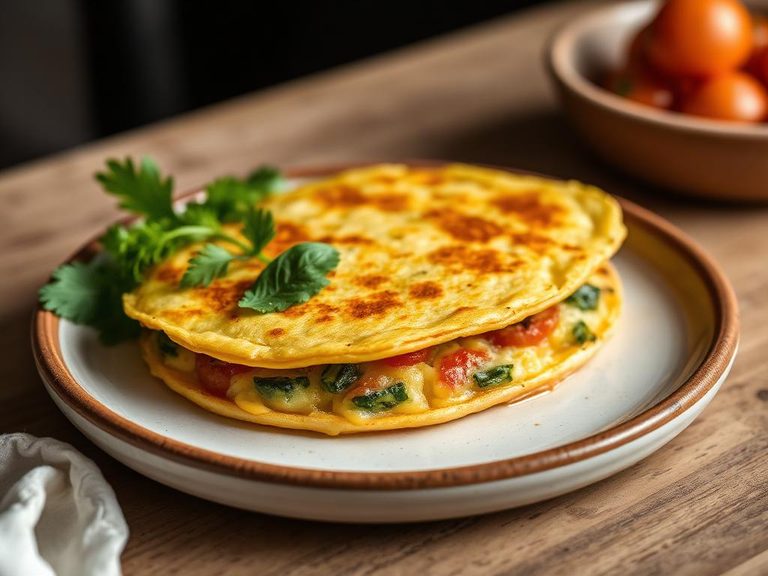
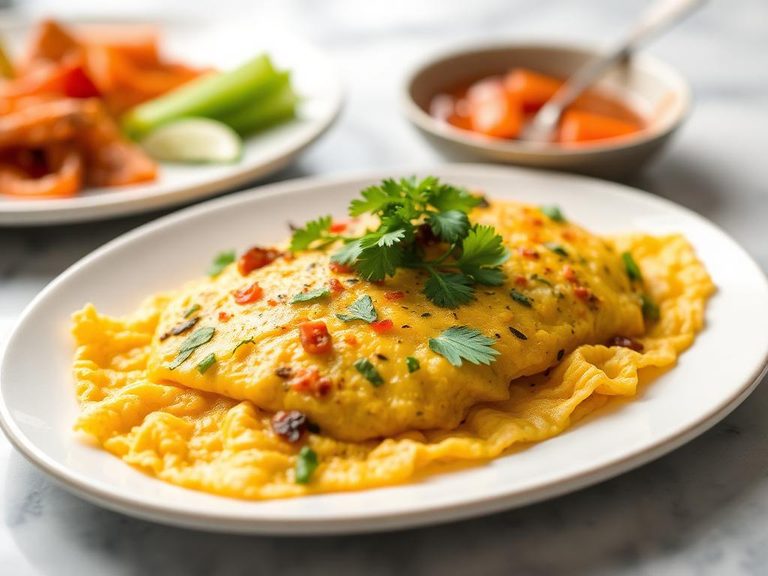
This is a hearty, protein-packed egg dish where fluffy scrambled eggs or a folded omelet are loaded with melted cheese, savory meat, juicy tomatoes, and wilted dark greens—all cooked without added fat. The texture is a satisfying mix of soft, custardy egg, gooey cheese, and tender vegetables, with a savory, umami-rich flavor profile. It delivers a substantial 12.6g of protein per 100g, making it a powerful, low-carb meal for sustained energy.
Calorie split: 31% protein · 5% carbs · 64% fat
↓ Full nutrition💚 Why it's loved
People adore this dish for its incredible versatility and satisfying, savory comfort—it’s a customizable one-pan meal that feels indulgent yet wholesome. It’s a beloved staple for quick, nutrient-dense breakfasts or dinners across many cultures.
⚠️ Watch-outs & how to enjoy it better
The high fat and cholesterol content from eggs, cheese, and meat may be a concern for some individuals managing heart health or specific dietary restrictions. The cheese and meat can also add significant sodium. To counteract this, use a moderate portion of cheese, opt for leaner meats like turkey, and ensure the rest of your day's meals are lower in sodium and saturated fat.
Key benefits
- Excellent source of complete protein for muscle maintenance and satiety.
- Very low in carbohydrates (1.89g per 100g), suitable for low-carb diets.
- Rich in vitamins A, C, and K from tomatoes and dark-green vegetables.
- Provides calcium from cheese and iron from meat and greens.
- High in healthy fats from eggs and cheese for nutrient absorption.
🍽️ Popular dishes

🌍 Where it's eaten
💡 Did you know?
The phrase 'good enough to eat an omelet off of' is an old compliment for a very clean surface, highlighting the omelet's classic status as a simple, perfect food.
Full nutrition (USDA data · scales with serving)
| Water | 72.3 g |
| Energy | 160 kcal |
| Protein | 12.6 g |
| Total lipid (fat) | 11.4 g |
| Carbohydrate, by difference | 1.9 g |
| Fiber, total dietary | 0.20 g |
| Total Sugars | 0.76 g |
| Calcium, Ca | 135 mg |
| Iron, Fe | 1.4 mg |
| Magnesium, Mg | 18.0 mg |
| Phosphorus, P | 214 mg |
| Potassium, K | 177 mg |
| Sodium, Na | 364 mg |
| Zinc, Zn | 1.4 mg |
| Copper, Cu | 0.02 mg |
| Selenium, Se | 26.6 ug |
| Vitamin C, total ascorbic acid | 3.1 mg |
| Thiamin | 0.08 mg |
| Riboflavin | 0.35 mg |
| Niacin | 0.55 mg |
| Vitamin B-6 | 0.09 mg |
| Folate, total | 45.0 ug |
| Folic acid | 0.00 ug |
| Folate, food | 45.0 ug |
| Folate, DFE | 45.0 ug |
| Choline, total | 199 mg |
| Vitamin B-12 | 0.79 ug |
| Vitamin B-12, added | 0.00 ug |
| Vitamin A, RAE | 173 ug |
| Retinol | 155 ug |
| Carotene, beta | 198 ug |
| Carotene, alpha | 6.0 ug |
| Cryptoxanthin, beta | 10.0 ug |
| Lycopene | 147 ug |
| Lutein + zeaxanthin | 724 ug |
| Vitamin E (alpha-tocopherol) | 0.99 mg |
| Vitamin E, added | 0.00 mg |
| Vitamin D (D2 + D3) | 2.2 ug |
| Vitamin K (phylloquinone) | 24.5 ug |
| Alcohol, ethyl | 0.00 g |
| Caffeine | 0.00 mg |
| Theobromine | 0.00 mg |
Fat & fatty acid profile (per 100g)
| Fatty acids, total saturated | 4.4 g |
| SFA 4:0 | 0.06 g |
| SFA 6:0 | 0.05 g |
| SFA 8:0 | 0.03 g |
| SFA 10:0 | 0.07 g |
| SFA 12:0 | 0.09 g |
| SFA 14:0 | 0.32 g |
| SFA 16:0 | 2.7 g |
| SFA 18:0 | 1.0 g |
| Fatty acids, total monounsaturated | 3.8 g |
| MUFA 16:1 | 0.25 g |
| MUFA 18:1 | 3.5 g |
| MUFA 20:1 | 0.02 g |
| MUFA 22:1 | 0.00 g |
| Fatty acids, total polyunsaturated | 1.6 g |
| PUFA 18:2 | 1.3 g |
| PUFA 18:3 | 0.04 g |
| PUFA 18:4 | 0.00 g |
| PUFA 20:4 | 0.01 g |
| PUFA 20:5 n-3 (EPA) | 0.00 g |
| PUFA 22:5 n-3 (DPA) | 0.00 g |
| PUFA 22:6 n-3 (DHA) | 0.00 g |
| Cholesterol | 306 mg |
Amino acid profile (per 100g)
Estimated from Egg, whole, cooked, omelet — USDA does not publish this profile for Egg omelet or scrambled egg.
| Tryptophan | 0.14 g |
| Threonine | 0.47 g |
| Isoleucine | 0.56 g |
| Leucine | 0.91 g |
| Lysine | 0.77 g |
| Methionine | 0.32 g |
| Cystine | 0.23 g |
| Phenylalanine | 0.57 g |
| Tyrosine | 0.42 g |
| Valine | 0.72 g |
| Arginine | 0.69 g |
| Histidine | 0.26 g |
| Alanine | 0.62 g |
| Aspartic acid | 1.1 g |
| Glutamic acid | 1.4 g |
| Glycine | 0.36 g |
| Proline | 0.43 g |
| Serine | 0.82 g |
FAQ
Can I make this without cheese to reduce fat?
Yes, absolutely. Omitting the cheese significantly reduces the fat and calorie content while keeping the high protein from the eggs, meat, and vegetables.
What are the best dark-green vegetables to use?
Spinach, kale, Swiss chard, and arugula are excellent choices. They wilt down nicely, blend well with the eggs, and add robust nutrients.
How do I prevent the eggs from becoming watery from the tomatoes?
Dice the tomatoes and gently sauté them first to cook off some excess moisture before adding the beaten eggs to the pan.
Nutrient density (calculated · NRF9.3)
Nutrient Rich Foods index: beneficial nutrients (protein, fiber, vitamins, minerals) minus saturated fat, added sugar & sodium, per 100 kcal.
NRF9.3 index — Fulgoni, Keast & Drewnowski, 2009. Computed from USDA nutrients.
Weight-loss friendliness (composite index)
Energy density 1.60 kcal/g · 32% calories from protein · 0.2 g fiber · 0.8 g sugar per 100 g.
Composite of energy density (Rolls et al., 1999), protein & fiber satiety, minus sugar. A calculated heuristic — ranks satiety-per-calorie, not a clinical measure.
Dietary load (calculated from USDA values)
Potential renal acid load. Positive = acid-forming, negative = alkaline-forming.
Sodium-to-potassium ratio: 2.06 (lower is better — aim for ≤ 1)
Sodium:potassium per WHO potassium guidance. Computed from USDA nutrients.