

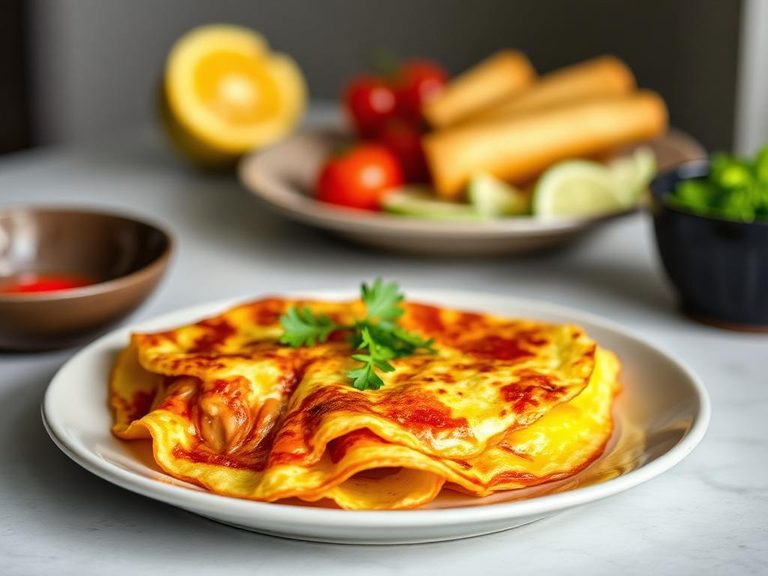
Egg omelet or scrambled egg, with cheese, made with cooking spray
Common food

Photo: Wikipedia
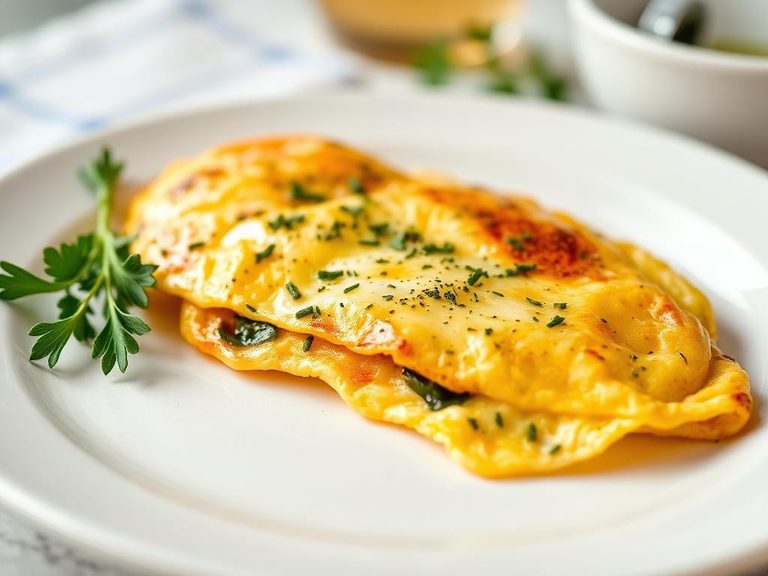
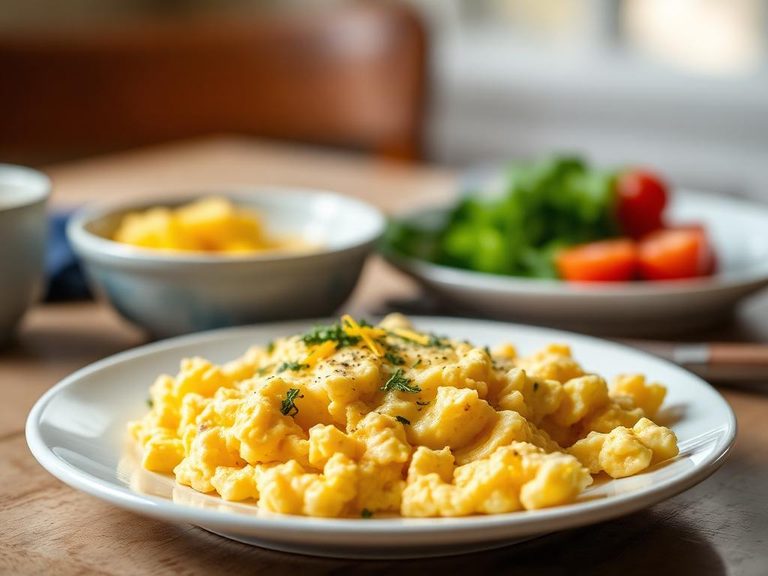
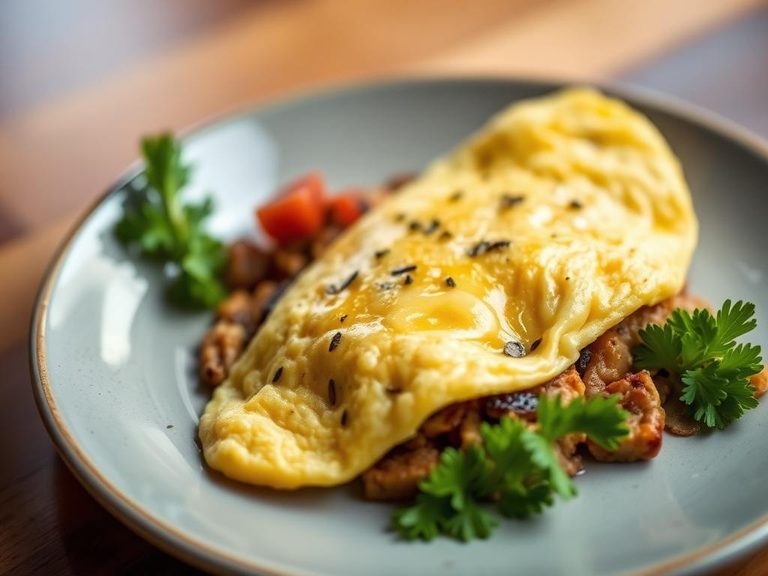
A fluffy, savory disk or pile of beaten eggs cooked with minimal fat, enriched with melted cheese for a rich, salty, and creamy flavor profile. The texture is tender and slightly springy, with the cheese adding a gooey, satisfying contrast. This high-protein, low-carb staple is a powerhouse of satiety, providing essential amino acids and healthy fats in a compact, satisfying package.
Calorie split: 30% protein · 4% carbs · 66% fat
↓ Full nutrition💚 Why it's loved
People adore this dish for its comforting, familiar taste and incredible versatility—it can be a simple breakfast, a quick lunch, or a savory snack, often customized with herbs, spices, or additional fillings. Its cultural ubiquity across global cuisines, from the French omelette to the American diner scramble, makes it a universally beloved comfort food.
⚠️ Watch-outs & how to enjoy it better
While nutritious, the dish can be high in saturated fat and cholesterol depending on the cheese and egg quantity, which may concern those managing heart health. To mitigate this, use a moderate portion of cheese, opt for a lower-fat variety like part-skim mozzarella, and pair the dish with a side of high-fiber vegetables like spinach or broccoli to balance the meal and slow digestion.
Key benefits
- Excellent source of high-quality protein for muscle maintenance and satiety.
- Very low in carbohydrates, making it ideal for low-carb or ketogenic diets.
- Rich in choline, a nutrient crucial for brain health and liver function.
- Contains essential vitamins like B12 and riboflavin (B2) for energy metabolism.
- Quick and versatile to prepare, offering a balanced meal in minutes.
🍽️ Popular dishes
🌍 Where it's eaten
💡 Did you know?
The world's largest omelet, made with 160,000 eggs, was cooked in Portugal in 2012, weighing over 6.5 tons and requiring a giant pan over 10 meters wide.
Full nutrition (USDA data · scales with serving)
| Water | 70.5 g |
| Energy | 176 kcal |
| Protein | 13.3 g |
| Total lipid (fat) | 12.9 g |
| Carbohydrate, by difference | 1.6 g |
| Fiber, total dietary | 0.00 g |
| Total Sugars | 0.53 g |
| Calcium, Ca | 158 mg |
| Iron, Fe | 1.5 mg |
| Magnesium, Mg | 13.0 mg |
| Phosphorus, P | 233 mg |
| Potassium, K | 133 mg |
| Sodium, Na | 341 mg |
| Zinc, Zn | 1.5 mg |
| Copper, Cu | 0.00 mg |
| Selenium, Se | 29.6 ug |
| Vitamin C, total ascorbic acid | 0.00 mg |
| Thiamin | 0.06 mg |
| Riboflavin | 0.39 mg |
| Niacin | 0.01 mg |
| Vitamin B-6 | 0.06 mg |
| Folate, total | 48.0 ug |
| Folic acid | 0.00 ug |
| Folate, food | 48.0 ug |
| Folate, DFE | 48.0 ug |
| Choline, total | 233 mg |
| Vitamin B-12 | 0.89 ug |
| Vitamin B-12, added | 0.00 ug |
| Vitamin A, RAE | 189 ug |
| Retinol | 188 ug |
| Carotene, beta | 10.0 ug |
| Carotene, alpha | 0.00 ug |
| Cryptoxanthin, beta | 12.0 ug |
| Lycopene | 0.00 ug |
| Lutein + zeaxanthin | 435 ug |
| Vitamin E (alpha-tocopherol) | 0.99 mg |
| Vitamin E, added | 0.00 mg |
| Vitamin D (D2 + D3) | 2.6 ug |
| Vitamin K (phylloquinone) | 0.60 ug |
| Alcohol, ethyl | 0.00 g |
| Caffeine | 0.00 mg |
| Theobromine | 0.00 mg |
Fat & fatty acid profile (per 100g)
| Fatty acids, total saturated | 4.9 g |
| SFA 4:0 | 0.08 g |
| SFA 6:0 | 0.06 g |
| SFA 8:0 | 0.04 g |
| SFA 10:0 | 0.09 g |
| SFA 12:0 | 0.11 g |
| SFA 14:0 | 0.37 g |
| SFA 16:0 | 3.0 g |
| SFA 18:0 | 1.1 g |
| Fatty acids, total monounsaturated | 4.4 g |
| MUFA 16:1 | 0.27 g |
| MUFA 18:1 | 4.1 g |
| MUFA 20:1 | 0.02 g |
| MUFA 22:1 | 0.00 g |
| Fatty acids, total polyunsaturated | 1.9 g |
| PUFA 18:2 | 1.5 g |
| PUFA 18:3 | 0.09 g |
| PUFA 18:4 | 0.00 g |
| PUFA 20:4 | 0.01 g |
| PUFA 20:5 n-3 (EPA) | 0.00 g |
| PUFA 22:5 n-3 (DPA) | 0.00 g |
| PUFA 22:6 n-3 (DHA) | 0.00 g |
| Cholesterol | 365 mg |
Amino acid profile (per 100g)
Estimated from Egg, whole, cooked, omelet — USDA does not publish this profile for Egg omelet or scrambled egg.
| Tryptophan | 0.14 g |
| Threonine | 0.47 g |
| Isoleucine | 0.56 g |
| Leucine | 0.91 g |
| Lysine | 0.77 g |
| Methionine | 0.32 g |
| Cystine | 0.23 g |
| Phenylalanine | 0.57 g |
| Tyrosine | 0.42 g |
| Valine | 0.72 g |
| Arginine | 0.69 g |
| Histidine | 0.26 g |
| Alanine | 0.62 g |
| Aspartic acid | 1.1 g |
| Glutamic acid | 1.4 g |
| Glycine | 0.36 g |
| Proline | 0.43 g |
| Serine | 0.82 g |
FAQ
Is this dish suitable for a low-carb diet?
Yes, with only 1.65g of carbs per 100g, it is an excellent choice for low-carb and ketogenic diets, providing substantial protein and fat without significant carbohydrates.
How can I make this dish healthier?
Use cooking spray or a small amount of olive oil, choose lower-fat cheese, and add vegetables like spinach, peppers, or tomatoes to increase fiber and nutrient content.
What is the best cheese to use for this dish?
Cheddar, Swiss, or mozzarella are popular choices for their melting properties and flavor, but you can use any cheese that melts well, such as Gruyère or feta for a tangier taste.
Nutrient density (calculated · NRF9.3)
Nutrient Rich Foods index: beneficial nutrients (protein, fiber, vitamins, minerals) minus saturated fat, added sugar & sodium, per 100 kcal.
NRF9.3 index — Fulgoni, Keast & Drewnowski, 2009. Computed from USDA nutrients.
Weight-loss friendliness (composite index)
Energy density 1.76 kcal/g · 30% calories from protein · 0.0 g fiber · 0.5 g sugar per 100 g.
Composite of energy density (Rolls et al., 1999), protein & fiber satiety, minus sugar. A calculated heuristic — ranks satiety-per-calorie, not a clinical measure.
Dietary load (calculated from USDA values)
Potential renal acid load. Positive = acid-forming, negative = alkaline-forming.
Sodium-to-potassium ratio: 2.56 (lower is better — aim for ≤ 1)
Sodium:potassium per WHO potassium guidance. Computed from USDA nutrients.