

Doughnut, NFS
Common food
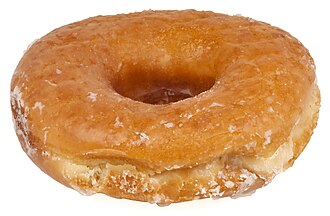
Photo: Wikipedia
A classic doughnut, NFS (not further specified), is a ring-shaped or filled pastry, typically deep-fried to a golden-brown exterior that yields to a soft, airy, and slightly chewy interior. Its flavor profile is a simple, sweet canvas, often enhanced by a sugary glaze or a dusting of powdered sugar. Nutritionally, it is a dense source of energy, providing 426 kcal per 100g, with the majority of calories coming from refined carbohydrates and fats.
Calorie split: 5% protein · 47% carbs · 48% fat
↓ Full nutrition💚 Why it's loved
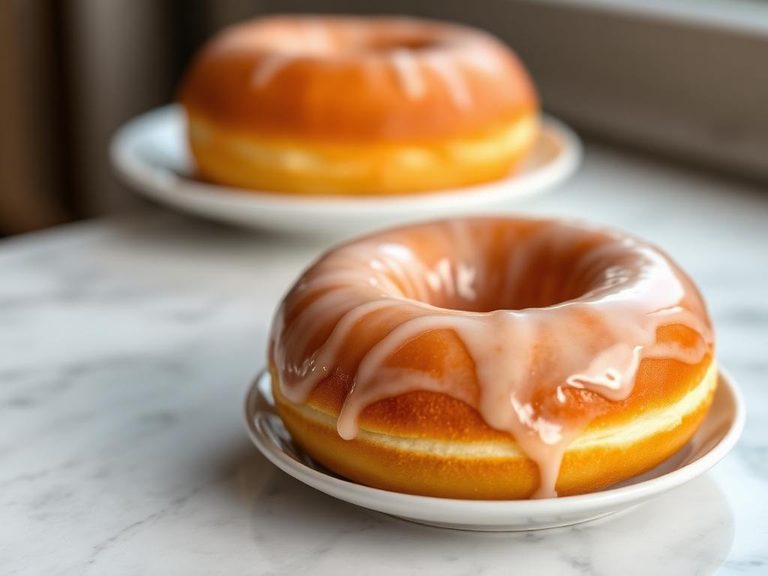
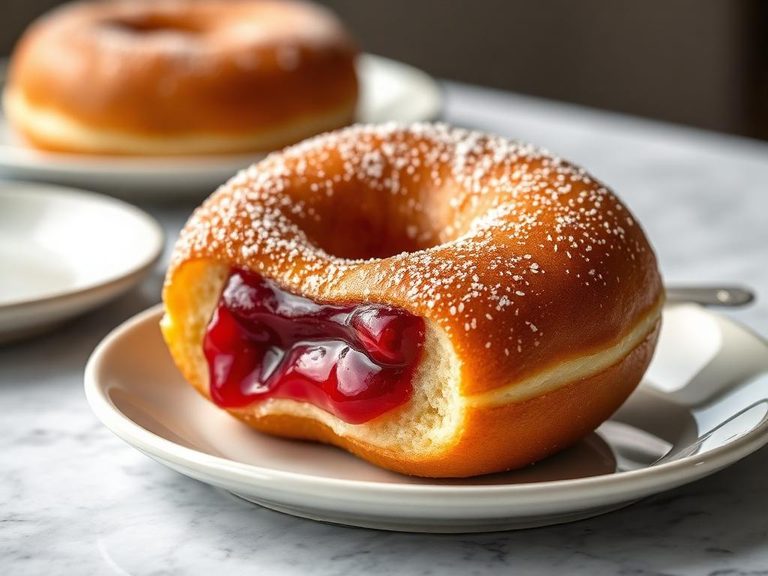
People love doughnuts for their immediate, comforting sweetness and the satisfying textural contrast between a crisp or glazed exterior and a soft, pillowy inside. Their versatility is a huge draw, available in countless varieties from classic glazed and chocolate-frosted to filled with jelly or cream, making them a beloved treat for breakfast, dessert, or a snack.
⚠️ Watch-outs & how to enjoy it better
The primary downside is the high content of refined carbs and added sugars (23.51g per 100g), which can cause rapid blood-sugar spikes and subsequent energy crashes. They are also calorie-dense with significant fat, making overconsumption a concern for weight management. To counteract this, pair a doughnut with a source of protein (like Greek yogurt or eggs) or healthy fat (like nuts) to slow sugar absorption, and practice strict portion control by choosing a mini or single doughnut.
Key benefits
- Quick source of energy from carbohydrates and fats
- Provides a small amount of protein (5.52g per 100g)
- Contains trace amounts of dietary fiber (1.8g per 100g)
- A familiar comfort food that can boost mood
🍽️ Popular dishes



🌍 Where it's eaten
💡 Did you know?
The hole in the center of a ring doughnut is widely credited to have been popularized in the 19th century to ensure the dough would cook evenly all the way through, preventing a raw, doughy center.
Full nutrition (USDA data · scales with serving)
| Water | 20.6 g |
| Energy | 426 kcal |
| Protein | 5.5 g |
| Total lipid (fat) | 22.9 g |
| Carbohydrate, by difference | 49.5 g |
| Fiber, total dietary | 1.8 g |
| Total Sugars | 23.5 g |
| Calcium, Ca | 69.0 mg |
| Iron, Fe | 2.4 mg |
| Magnesium, Mg | 16.0 mg |
| Phosphorus, P | 178 mg |
| Potassium, K | 113 mg |
| Sodium, Na | 378 mg |
| Zinc, Zn | 0.54 mg |
| Copper, Cu | 0.09 mg |
| Selenium, Se | 12.5 ug |
| Vitamin C, total ascorbic acid | 0.60 mg |
| Thiamin | 0.34 mg |
| Riboflavin | 0.23 mg |
| Niacin | 2.6 mg |
| Vitamin B-6 | 0.04 mg |
| Folate, total | 96.0 ug |
| Folic acid | 69.0 ug |
| Folate, food | 27.0 ug |
| Folate, DFE | 144 ug |
| Choline, total | 31.8 mg |
| Vitamin B-12 | 0.08 ug |
| Vitamin B-12, added | 0.00 ug |
| Vitamin A, RAE | 4.0 ug |
| Retinol | 4.0 ug |
| Carotene, beta | 2.0 ug |
| Carotene, alpha | 0.00 ug |
| Cryptoxanthin, beta | 0.00 ug |
| Lycopene | 0.00 ug |
| Lutein + zeaxanthin | 27.0 ug |
| Vitamin E (alpha-tocopherol) | 1.6 mg |
| Vitamin E, added | 0.00 mg |
| Vitamin D (D2 + D3) | 0.00 ug |
| Vitamin K (phylloquinone) | 10.3 ug |
| Alcohol, ethyl | 0.00 g |
| Caffeine | 0.00 mg |
| Theobromine | 0.00 mg |
Fat & fatty acid profile (per 100g)
| Fatty acids, total saturated | 9.9 g |
| SFA 4:0 | 0.00 g |
| SFA 6:0 | 0.00 g |
| SFA 8:0 | 0.01 g |
| SFA 10:0 | 0.02 g |
| SFA 12:0 | 0.11 g |
| SFA 14:0 | 0.21 g |
| SFA 16:0 | 8.0 g |
| SFA 18:0 | 1.3 g |
| Fatty acids, total monounsaturated | 7.6 g |
| MUFA 16:1 | 0.04 g |
| MUFA 18:1 | 7.5 g |
| MUFA 20:1 | 0.05 g |
| MUFA 22:1 | 0.00 g |
| Fatty acids, total polyunsaturated | 3.6 g |
| PUFA 18:2 | 3.4 g |
| PUFA 18:3 | 0.22 g |
| PUFA 18:4 | 0.00 g |
| PUFA 20:4 | 0.01 g |
| PUFA 20:5 n-3 (EPA) | 0.00 g |
| PUFA 22:5 n-3 (DPA) | 0.00 g |
| PUFA 22:6 n-3 (DHA) | 0.01 g |
| Cholesterol | 20.0 mg |
Amino acid profile (per 100g)
Estimated from Doughnuts, yeast-leavened, with creme filling — USDA does not publish this profile for Doughnut.
| Tryptophan | 0.08 g |
| Threonine | 0.21 g |
| Isoleucine | 0.27 g |
| Leucine | 0.48 g |
| Lysine | 0.24 g |
| Methionine | 0.12 g |
| Cystine | 0.13 g |
| Phenylalanine | 0.31 g |
| Tyrosine | 0.20 g |
| Valine | 0.30 g |
| Arginine | 0.27 g |
| Histidine | 0.15 g |
| Alanine | 0.24 g |
| Aspartic acid | 0.38 g |
| Glutamic acid | 1.9 g |
| Glycine | 0.22 g |
| Proline | 0.63 g |
| Serine | 0.33 g |
FAQ
What is the difference between a doughnut and a donut?
There is no difference in the food itself. 'Doughnut' is the traditional, standard spelling, while 'donut' is an Americanized, simplified version that gained popularity in the 20th century.
Are baked doughnuts healthier than fried?
Baked doughnuts generally have less fat and fewer calories than their deep-fried counterparts because they use less oil. However, they can still be high in sugar and refined flour, so the nutritional improvement is moderate.
Why do some doughnuts have a greasy texture?
A greasy texture often results from frying at too low a temperature, which allows the dough to absorb excess oil. It can also indicate the dough was over-proofed, creating a structure that soaks up more fat during frying.
Nutrient density (calculated · NRF9.3)
Nutrient Rich Foods index: beneficial nutrients (protein, fiber, vitamins, minerals) minus saturated fat, added sugar & sodium, per 100 kcal.
NRF9.3 index — Fulgoni, Keast & Drewnowski, 2009. Computed from USDA nutrients.
Weight-loss friendliness (composite index)
Energy density 4.26 kcal/g · 5% calories from protein · 1.8 g fiber · 23.5 g sugar per 100 g.
Composite of energy density (Rolls et al., 1999), protein & fiber satiety, minus sugar. A calculated heuristic — ranks satiety-per-calorie, not a clinical measure.
Dietary load (calculated from USDA values)
Potential renal acid load. Positive = acid-forming, negative = alkaline-forming.
Sodium-to-potassium ratio: 3.35 (lower is better — aim for ≤ 1)
Sodium:potassium per WHO potassium guidance. Computed from USDA nutrients.