

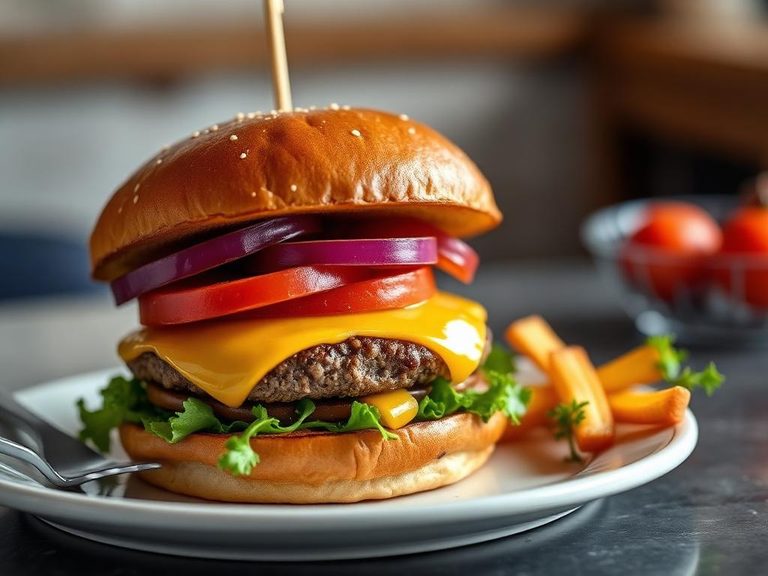
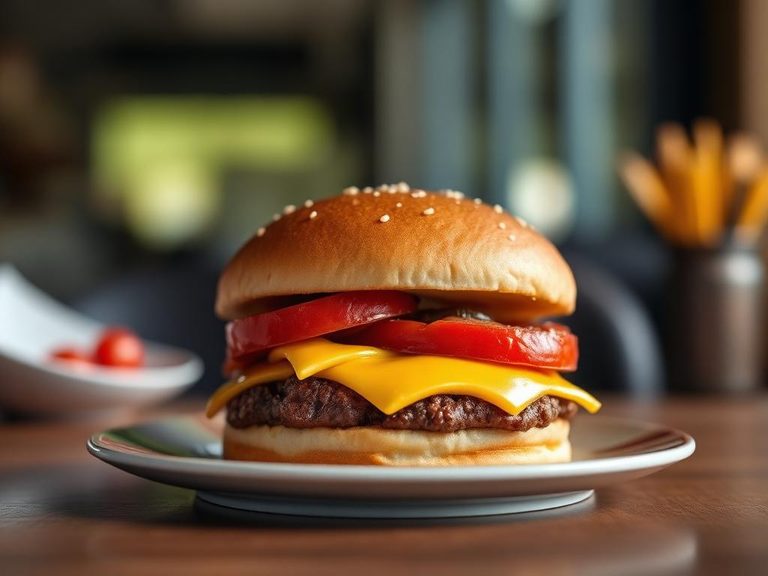
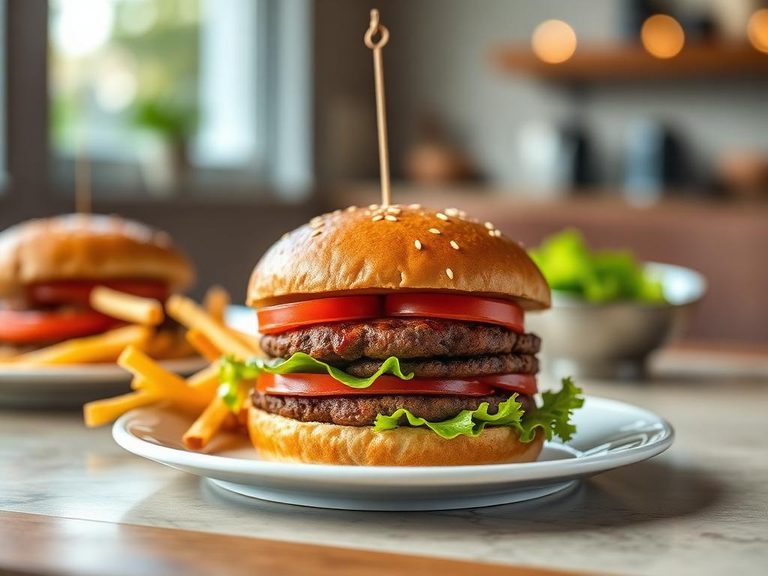
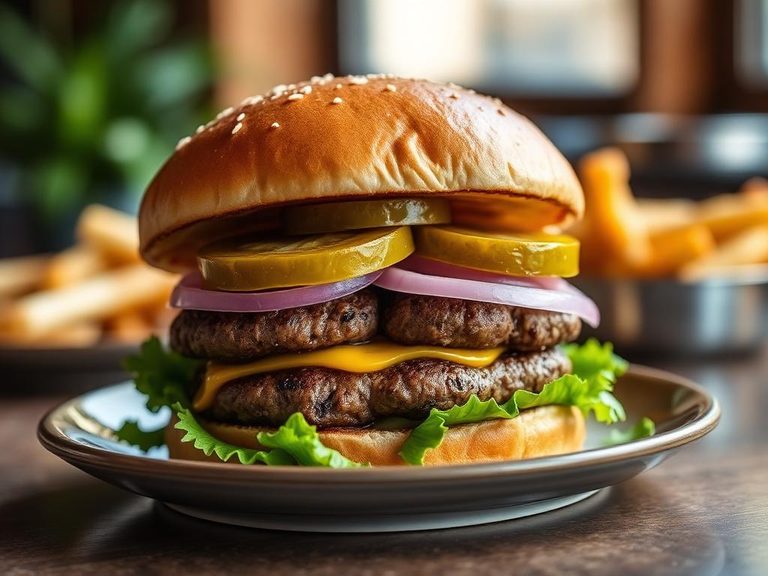
Double hamburger, on wheat bun, 2 small patties
Common food

Photo: Wikipedia
A classic double hamburger on a wheat bun delivers a satisfyingly hearty bite, with two small, savory beef patties nestled between a soft, slightly nutty whole-wheat bun. The texture is a pleasing contrast of tender, juicy meat and the bun's subtle chew, while the nutrition profile offers a solid protein punch (19.65g per 100g) alongside moderate fat and carbs. It's a straightforward, no-frills comfort food that balances indulgence with a touch of whole-grain substance.
Calorie split: 28% protein · 18% carbs · 54% fat
↓ Full nutrition💚 Why it's loved
People love this double hamburger for its satisfying, meaty flavor and the comforting, familiar texture of a well-toasted wheat bun—it's a staple of casual American dining that feels both indulgent and substantial. Its simplicity makes it a go-to for quick meals, while the double patty ensures it's filling enough to curb hunger without feeling overly heavy.
⚠️ Watch-outs & how to enjoy it better
The high fat and sodium content can be a concern for those watching heart health or blood pressure, and the refined carbs in the bun may cause blood-sugar spikes for some. To counteract, pair it with a side of leafy greens or a vinegar-based dressing to slow digestion, and opt for a smaller portion or skip high-sugar condiments like ketchup to reduce glycemic impact.
Key benefits
- High protein content supports muscle maintenance and satiety.
- Whole-wheat bun provides more fiber and nutrients than white bread.
- Moderate calorie density (285 kcal/100g) allows for portion control.
- Versatile base for adding vegetables or condiments to boost nutrition.
🍽️ Popular dishes
🌍 Where it's eaten
💡 Did you know?
The hamburger's name likely derives from the German city of Hamburg, where minced beef patties were popularized in the 19th century before being adapted into the modern sandwich in the United States.
Full nutrition (USDA data · scales with serving)
| Water | 48.9 g |
| Energy | 285 kcal |
| Protein | 19.6 g |
| Total lipid (fat) | 16.7 g |
| Carbohydrate, by difference | 12.9 g |
| Fiber, total dietary | 1.5 g |
| Total Sugars | 1.5 g |
| Calcium, Ca | 54.0 mg |
| Iron, Fe | 2.6 mg |
| Magnesium, Mg | 30.0 mg |
| Phosphorus, P | 171 mg |
| Potassium, K | 271 mg |
| Sodium, Na | 328 mg |
| Zinc, Zn | 3.8 mg |
| Copper, Cu | 0.11 mg |
| Selenium, Se | 23.2 ug |
| Vitamin C, total ascorbic acid | 0.00 mg |
| Thiamin | 0.13 mg |
| Riboflavin | 0.19 mg |
| Niacin | 5.2 mg |
| Vitamin B-6 | 0.35 mg |
| Folate, total | 36.0 ug |
| Folic acid | 4.0 ug |
| Folate, food | 31.0 ug |
| Folate, DFE | 38.0 ug |
| Choline, total | 59.1 mg |
| Vitamin B-12 | 1.9 ug |
| Vitamin B-12, added | 0.00 ug |
| Vitamin A, RAE | 0.00 ug |
| Retinol | 0.00 ug |
| Carotene, beta | 0.00 ug |
| Carotene, alpha | 0.00 ug |
| Cryptoxanthin, beta | 0.00 ug |
| Lycopene | 0.00 ug |
| Lutein + zeaxanthin | 18.0 ug |
| Vitamin E (alpha-tocopherol) | 0.10 mg |
| Vitamin E, added | 0.00 mg |
| Vitamin D (D2 + D3) | 0.10 ug |
| Vitamin K (phylloquinone) | 3.2 ug |
| Alcohol, ethyl | 0.00 g |
| Caffeine | 0.00 mg |
| Theobromine | 0.00 mg |
Fat & fatty acid profile (per 100g)
| Fatty acids, total saturated | 6.5 g |
| SFA 4:0 | 0.00 g |
| SFA 6:0 | 0.00 g |
| SFA 8:0 | 0.00 g |
| SFA 10:0 | 0.00 g |
| SFA 12:0 | 0.00 g |
| SFA 14:0 | 0.49 g |
| SFA 16:0 | 3.6 g |
| SFA 18:0 | 2.0 g |
| Fatty acids, total monounsaturated | 6.8 g |
| MUFA 16:1 | 0.49 g |
| MUFA 18:1 | 6.2 g |
| MUFA 20:1 | 0.03 g |
| MUFA 22:1 | 0.00 g |
| Fatty acids, total polyunsaturated | 0.91 g |
| PUFA 18:2 | 0.82 g |
| PUFA 18:3 | 0.07 g |
| PUFA 18:4 | 0.00 g |
| PUFA 20:4 | 0.00 g |
| PUFA 20:5 n-3 (EPA) | 0.00 g |
| PUFA 22:5 n-3 (DPA) | 0.01 g |
| PUFA 22:6 n-3 (DHA) | 0.00 g |
| Cholesterol | 60.0 mg |
Amino acid profile (per 100g)
Estimated from Fast foods, hamburger; single, regular patty; double decker bun with condiments and special sauce — USDA does not publish this profile for Double hamburger.
| Tryptophan | 0.11 g |
| Threonine | 0.39 g |
| Isoleucine | 0.43 g |
| Leucine | 0.77 g |
| Lysine | 0.64 g |
| Methionine | 0.21 g |
| Cystine | 0.15 g |
| Phenylalanine | 0.44 g |
| Tyrosine | 0.22 g |
| Valine | 0.50 g |
| Arginine | 0.59 g |
| Histidine | 0.28 g |
| Alanine | 0.64 g |
| Aspartic acid | 0.74 g |
| Glutamic acid | 2.4 g |
| Glycine | 0.75 g |
| Proline | 0.81 g |
| Serine | 0.42 g |
FAQ
How does the wheat bun affect the nutritional profile compared to a white bun?
A wheat bun typically offers more fiber (1.5g per 100g in this case) and a lower glycemic index than white bread, which can help stabilize blood sugar levels and provide sustained energy.
Is this double hamburger suitable for a high-protein diet?
Yes, with 19.65g of protein per 100g, it's a solid protein source, though you may want to pair it with additional vegetables or a side salad to balance the meal and increase fiber intake.
Can I reduce the fat content while keeping the flavor?
You can use leaner ground beef (e.g., 90/10) for the patties, skip high-fat condiments like mayo, and add fresh toppings like lettuce, tomato, and onion to enhance flavor without extra fat.
Nutrient density (calculated · NRF9.3)
Nutrient Rich Foods index: beneficial nutrients (protein, fiber, vitamins, minerals) minus saturated fat, added sugar & sodium, per 100 kcal.
NRF9.3 index — Fulgoni, Keast & Drewnowski, 2009. Computed from USDA nutrients.
Weight-loss friendliness (composite index)
Energy density 2.85 kcal/g · 28% calories from protein · 1.5 g fiber · 1.5 g sugar per 100 g.
Composite of energy density (Rolls et al., 1999), protein & fiber satiety, minus sugar. A calculated heuristic — ranks satiety-per-calorie, not a clinical measure.
Dietary load (calculated from USDA values)
Potential renal acid load. Positive = acid-forming, negative = alkaline-forming.
Sodium-to-potassium ratio: 1.21 (lower is better — aim for ≤ 1)
Sodium:potassium per WHO potassium guidance. Computed from USDA nutrients.