

Coffee, macchiato
Common food
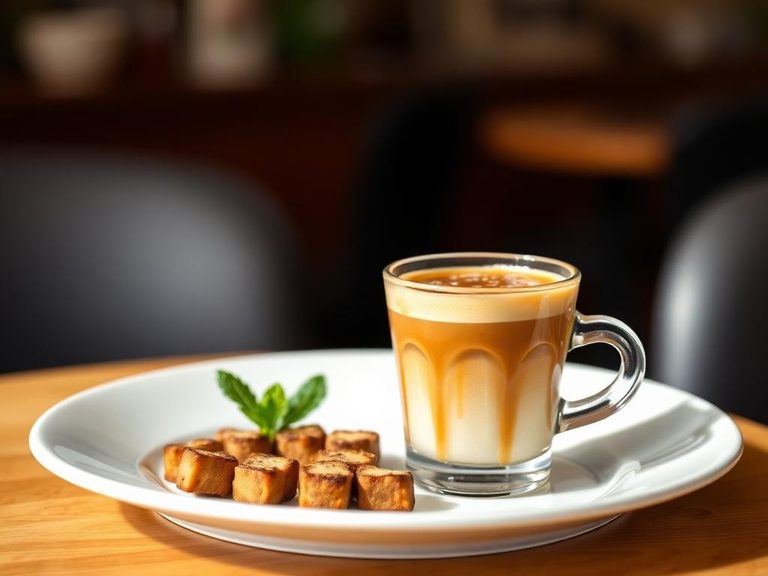
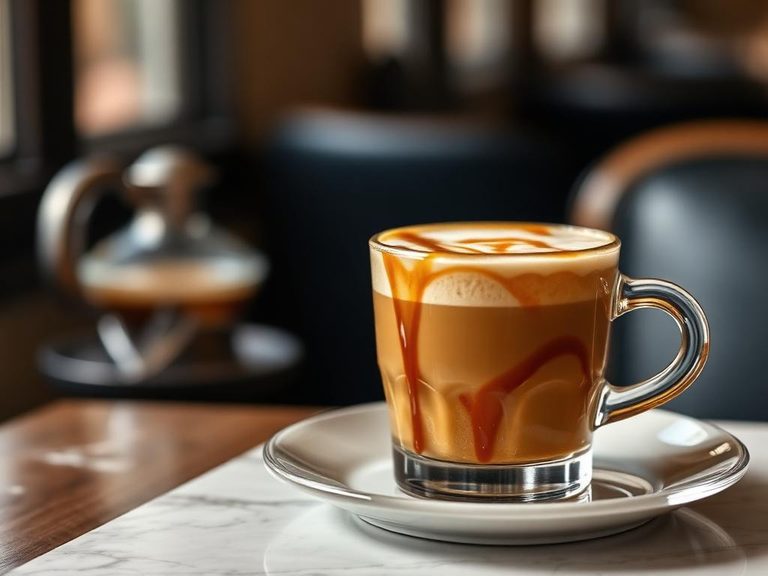
A macchiato is a classic Italian espresso drink 'stained' or 'marked' with a small dollop of steamed milk or milk foam. It delivers a bold, intense coffee flavor with a smooth, creamy texture from the milk, offering a concentrated yet balanced taste. At only 23 kcal per 100g, it is a very low-calorie beverage, with minimal protein, carbs, and fat.
Calorie split: 20% protein · 47% carbs · 32% fat
↓ Full nutrition💚 Why it's loved
People love the macchiato for its rich, espresso-forward flavor that isn't diluted by too much milk, offering a perfect balance of bitterness and creaminess. It's a versatile, quick pick-me-up deeply rooted in Italian coffee culture, appreciated for its simplicity and sophistication.
⚠️ Watch-outs & how to enjoy it better
The strong, concentrated espresso can be too bitter for some palates, and the caffeine may cause jitters or disrupt sleep in sensitive individuals. To counteract bitterness, you can ask for a slightly longer pull or a touch of steamed milk; for caffeine sensitivity, opt for a smaller size or enjoy it earlier in the day.
Key benefits
- Low-calorie, low-fat coffee option
- Provides a quick caffeine boost for alertness
- Contains antioxidants from espresso
- Simple, minimal-ingredient preparation
- Can be enjoyed as a low-sugar treat
🍽️ Popular dishes


🌍 Where it's eaten
💡 Did you know?
The word 'macchiato' literally means 'stained' or 'marked' in Italian, referring to the visual effect of the milk 'staining' the dark espresso.
Full nutrition (USDA data · scales with serving)
| Water | 94.9 g |
| Energy | 23.0 kcal |
| Protein | 1.2 g |
| Total lipid (fat) | 0.83 g |
| Carbohydrate, by difference | 2.7 g |
| Fiber, total dietary | 0.00 g |
| Total Sugars | 1.6 g |
| Calcium, Ca | 43.0 mg |
| Iron, Fe | 0.09 mg |
| Magnesium, Mg | 58.0 mg |
| Phosphorus, P | 38.0 mg |
| Potassium, K | 129 mg |
| Sodium, Na | 22.0 mg |
| Zinc, Zn | 0.18 mg |
| Copper, Cu | 0.03 mg |
| Selenium, Se | 0.60 ug |
| Vitamin C, total ascorbic acid | 0.20 mg |
| Thiamin | 0.02 mg |
| Riboflavin | 0.16 mg |
| Niacin | 3.5 mg |
| Vitamin B-6 | 0.02 mg |
| Folate, total | 1.0 ug |
| Folic acid | 0.00 ug |
| Folate, food | 1.0 ug |
| Folate, DFE | 1.0 ug |
| Choline, total | 7.1 mg |
| Vitamin B-12 | 0.15 ug |
| Vitamin B-12, added | 0.00 ug |
| Vitamin A, RAE | 19.0 ug |
| Retinol | 19.0 ug |
| Carotene, beta | 1.0 ug |
| Carotene, alpha | 0.00 ug |
| Cryptoxanthin, beta | 0.00 ug |
| Lycopene | 0.00 ug |
| Lutein + zeaxanthin | 0.00 ug |
| Vitamin E (alpha-tocopherol) | 0.02 mg |
| Vitamin E, added | 0.00 mg |
| Vitamin D (D2 + D3) | 0.40 ug |
| Vitamin K (phylloquinone) | 0.10 ug |
| Alcohol, ethyl | 0.00 g |
| Caffeine | 142 mg |
| Theobromine | 0.00 mg |
Fat & fatty acid profile (per 100g)
| Fatty acids, total saturated | 0.47 g |
| SFA 4:0 | 0.01 g |
| SFA 6:0 | 0.01 g |
| SFA 8:0 | 0.01 g |
| SFA 10:0 | 0.02 g |
| SFA 12:0 | 0.02 g |
| SFA 14:0 | 0.07 g |
| SFA 16:0 | 0.22 g |
| SFA 18:0 | 0.07 g |
| Fatty acids, total monounsaturated | 0.15 g |
| MUFA 16:1 | 0.01 g |
| MUFA 18:1 | 0.15 g |
| MUFA 20:1 | 0.00 g |
| MUFA 22:1 | 0.00 g |
| Fatty acids, total polyunsaturated | 0.09 g |
| PUFA 18:2 | 0.09 g |
| PUFA 18:3 | 0.00 g |
| PUFA 18:4 | 0.00 g |
| PUFA 20:4 | 0.00 g |
| PUFA 20:5 n-3 (EPA) | 0.00 g |
| PUFA 22:5 n-3 (DPA) | 0.00 g |
| PUFA 22:6 n-3 (DHA) | 0.00 g |
| Cholesterol | 3.0 mg |
Amino acid profile (per 100g)
Estimated from Cream, fluid, light (coffee cream or table cream) — USDA does not publish this profile for Coffee.
| Tryptophan | 0.07 g |
| Threonine | 0.13 g |
| Isoleucine | 0.15 g |
| Leucine | 0.24 g |
| Lysine | 0.13 g |
| Methionine | 0.07 g |
| Cystine | 0.01 g |
| Phenylalanine | 0.14 g |
| Tyrosine | 0.14 g |
| Valine | 0.18 g |
| Arginine | 0.07 g |
| Histidine | 0.07 g |
| Alanine | 0.09 g |
| Aspartic acid | 0.22 g |
| Glutamic acid | 0.59 g |
| Glycine | 0.07 g |
| Proline | 0.31 g |
| Serine | 0.10 g |
FAQ
What is the difference between a macchiato and a latte?
A macchiato is espresso 'stained' with a small amount of milk foam or steamed milk, while a latte is espresso with a larger proportion of steamed milk and a thin layer of foam, making it milder and creamier.
Is a macchiato high in calories?
No, a traditional espresso macchiato is very low in calories, typically around 23 kcal per 100g, as it contains mostly espresso and a small amount of milk.
Can I drink a macchiato if I'm lactose intolerant?
Traditional macchiato contains dairy milk, but you can request it with lactose-free milk or plant-based alternatives like oat or almond milk to avoid lactose.
Nutrient density (calculated · NRF9.3)
Nutrient Rich Foods index: beneficial nutrients (protein, fiber, vitamins, minerals) minus saturated fat, added sugar & sodium, per 100 kcal.
NRF9.3 index — Fulgoni, Keast & Drewnowski, 2009. Computed from USDA nutrients.
Weight-loss friendliness (composite index)
Energy density 0.23 kcal/g · 21% calories from protein · 0.0 g fiber · 1.6 g sugar per 100 g.
Composite of energy density (Rolls et al., 1999), protein & fiber satiety, minus sugar. A calculated heuristic — ranks satiety-per-calorie, not a clinical measure.
Dietary load (calculated from USDA values)
Potential renal acid load. Positive = acid-forming, negative = alkaline-forming.
Sodium-to-potassium ratio: 0.17 (lower is better — aim for ≤ 1)
Sodium:potassium per WHO potassium guidance. Computed from USDA nutrients.