

Chicken thigh, fried, coated, skin / coating not eaten, from fast food
Common food

Photo: Wikipedia
This is a juicy chicken thigh, deboned and fried in a crispy, seasoned coating, typically served without the skin. The bite offers a satisfying crunch giving way to tender, flavorful dark meat. Nutritionally, it's a solid source of protein with a moderate fat content, providing substantial energy per 100g.
Calorie split: 36% protein · 12% carbs · 53% fat
↓ Full nutrition💚 Why it's loved
People adore the perfect contrast between the shatteringly crisp coating and the succulent, juicy meat inside. It's a universal comfort food, adaptable to countless spice blends and dipping sauces, making it a crowd-pleasing staple in fast food and home kitchens alike.
⚠️ Watch-outs & how to enjoy it better
The frying process adds significant calories, fat, and often sodium, which can be a concern for those managing weight or heart health. The coating can also be a source of refined carbs. To counteract, pair it with a large, fiber-rich salad or steamed vegetables to increase fullness and nutrient intake, and practice portion control by choosing a single piece as part of a balanced meal.
Key benefits
- High-quality protein source for muscle maintenance.
- Rich in iron and zinc, important minerals from dark meat.
- Provides energy-dense calories from protein and fat.
- Contains B vitamins like niacin and B6 for metabolism.
🍽️ Popular dishes
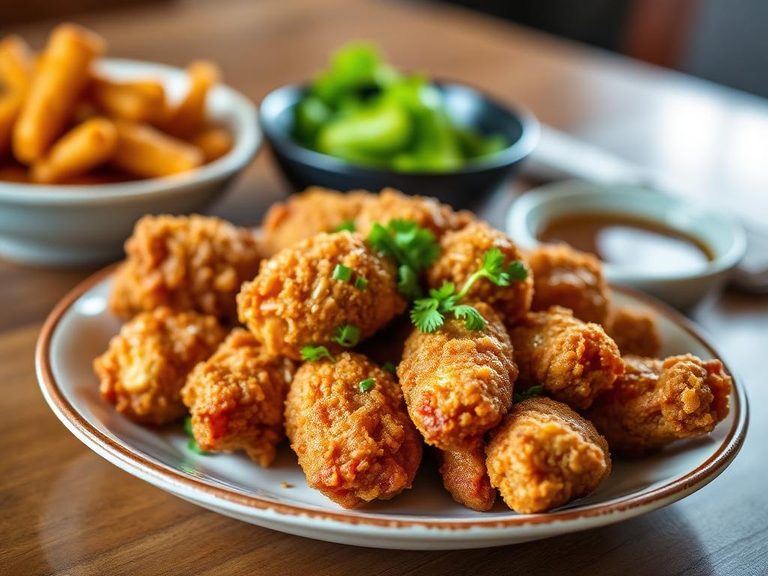

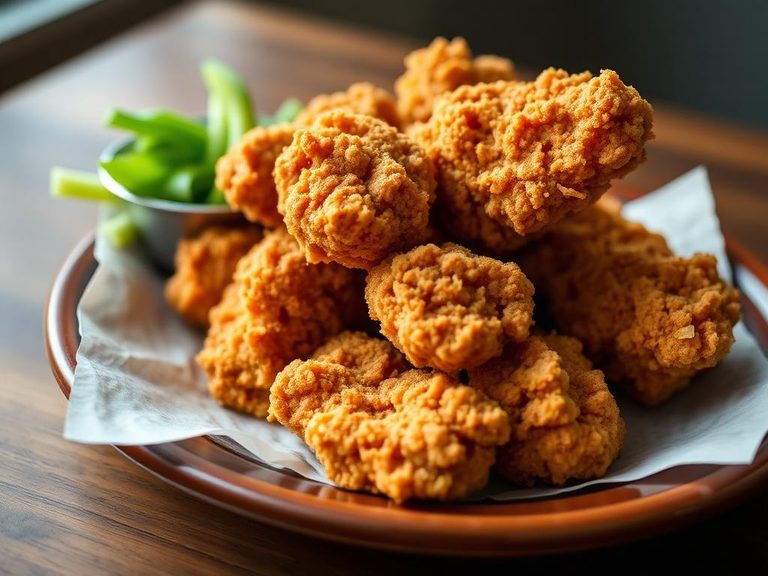

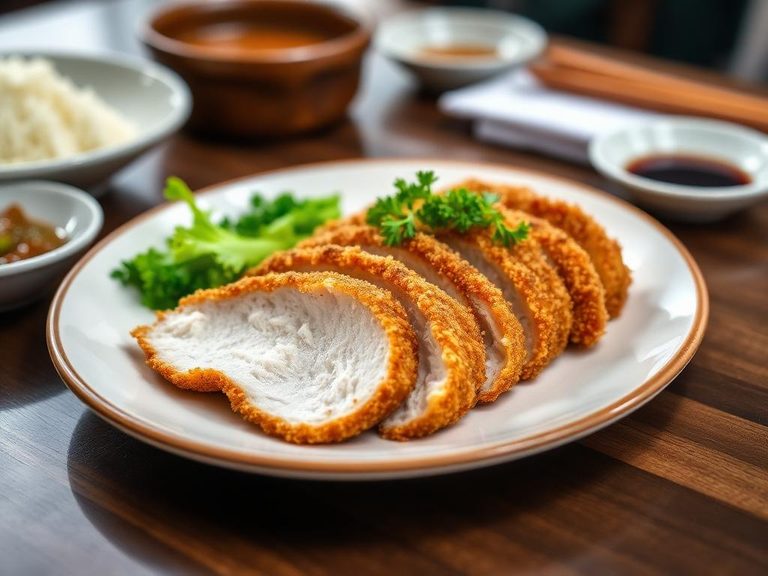
🌍 Where it's eaten
💡 Did you know?
The science behind the perfect crispy coating often involves a double-dredge in seasoned flour and buttermilk or egg wash, creating microscopic air pockets that fry into an extra crunchy shell.
Full nutrition (USDA data · scales with serving)
| Water | 59.3 g |
| Energy | 218 kcal |
| Protein | 19.4 g |
| Total lipid (fat) | 12.8 g |
| Carbohydrate, by difference | 6.3 g |
| Fiber, total dietary | 0.20 g |
| Total Sugars | 0.10 g |
| Calcium, Ca | 27.0 mg |
| Iron, Fe | 1.2 mg |
| Magnesium, Mg | 19.0 mg |
| Phosphorus, P | 175 mg |
| Potassium, K | 210 mg |
| Sodium, Na | 613 mg |
| Zinc, Zn | 1.6 mg |
| Copper, Cu | 0.08 mg |
| Selenium, Se | 25.6 ug |
| Vitamin C, total ascorbic acid | 0.00 mg |
| Thiamin | 0.15 mg |
| Riboflavin | 0.31 mg |
| Niacin | 5.1 mg |
| Vitamin B-6 | 0.17 mg |
| Folate, total | 22.0 ug |
| Folic acid | 10.0 ug |
| Folate, food | 12.0 ug |
| Folate, DFE | 29.0 ug |
| Choline, total | 96.6 mg |
| Vitamin B-12 | 0.41 ug |
| Vitamin B-12, added | 0.00 ug |
| Vitamin A, RAE | 11.0 ug |
| Retinol | 11.0 ug |
| Carotene, beta | 0.00 ug |
| Carotene, alpha | 0.00 ug |
| Cryptoxanthin, beta | 0.00 ug |
| Lycopene | 0.00 ug |
| Lutein + zeaxanthin | 5.0 ug |
| Vitamin E (alpha-tocopherol) | 1.3 mg |
| Vitamin E, added | 0.00 mg |
| Vitamin D (D2 + D3) | 0.20 ug |
| Vitamin K (phylloquinone) | 5.2 ug |
| Alcohol, ethyl | 0.00 g |
| Caffeine | 0.00 mg |
| Theobromine | 0.00 mg |
Fat & fatty acid profile (per 100g)
| Fatty acids, total saturated | 2.7 g |
| SFA 4:0 | 0.00 g |
| SFA 6:0 | 0.00 g |
| SFA 8:0 | 0.00 g |
| SFA 10:0 | 0.00 g |
| SFA 12:0 | 0.00 g |
| SFA 14:0 | 0.05 g |
| SFA 16:0 | 2.0 g |
| SFA 18:0 | 0.60 g |
| Fatty acids, total monounsaturated | 5.3 g |
| MUFA 16:1 | 0.41 g |
| MUFA 18:1 | 4.8 g |
| MUFA 20:1 | 0.08 g |
| MUFA 22:1 | 0.00 g |
| Fatty acids, total polyunsaturated | 3.2 g |
| PUFA 18:2 | 2.8 g |
| PUFA 18:3 | 0.30 g |
| PUFA 18:4 | 0.00 g |
| PUFA 20:4 | 0.06 g |
| PUFA 20:5 n-3 (EPA) | 0.00 g |
| PUFA 22:5 n-3 (DPA) | 0.01 g |
| PUFA 22:6 n-3 (DHA) | 0.00 g |
| Cholesterol | 102 mg |
Amino acid profile (per 100g)
Estimated from Chicken, broilers or fryers, dark meat, thigh, meat only, raw — USDA does not publish this profile for Chicken thigh.
| Tryptophan | 0.22 g |
| Threonine | 0.93 g |
| Isoleucine | 0.94 g |
| Leucine | 1.7 g |
| Lysine | 1.9 g |
| Methionine | 0.56 g |
| Cystine | 0.23 g |
| Phenylalanine | 0.79 g |
| Tyrosine | 0.74 g |
| Valine | 0.96 g |
| Arginine | 1.4 g |
| Histidine | 0.59 g |
| Alanine | 1.2 g |
| Aspartic acid | 1.9 g |
| Glutamic acid | 3.2 g |
| Glycine | 0.90 g |
| Proline | 0.79 g |
| Serine | 0.82 g |
FAQ
Is the nutritional info different if I eat the coating?
Yes. The values provided are for the meat only, with the coating/skin not eaten. Consuming the coating adds calories, carbs, fat, and sodium.
Why is it higher in fat than chicken breast?
Chicken thigh is dark meat, which contains more myoglobin and naturally has a higher fat content than lean white breast meat, contributing to its juiciness and flavor.
How can I make a healthier version at home?
You can bake or air-fry the coated thigh to reduce added oil. Use whole-grain breadcrumbs or almond flour for the coating, and season with herbs and spices instead of excess salt.
Nutrient density (calculated · NRF9.3)
Nutrient Rich Foods index: beneficial nutrients (protein, fiber, vitamins, minerals) minus saturated fat, added sugar & sodium, per 100 kcal.
NRF9.3 index — Fulgoni, Keast & Drewnowski, 2009. Computed from USDA nutrients.
Weight-loss friendliness (composite index)
Energy density 2.18 kcal/g · 36% calories from protein · 0.2 g fiber · 0.1 g sugar per 100 g.
Composite of energy density (Rolls et al., 1999), protein & fiber satiety, minus sugar. A calculated heuristic — ranks satiety-per-calorie, not a clinical measure.
Dietary load (calculated from USDA values)
Potential renal acid load. Positive = acid-forming, negative = alkaline-forming.
Sodium-to-potassium ratio: 2.92 (lower is better — aim for ≤ 1)
Sodium:potassium per WHO potassium guidance. Computed from USDA nutrients.