

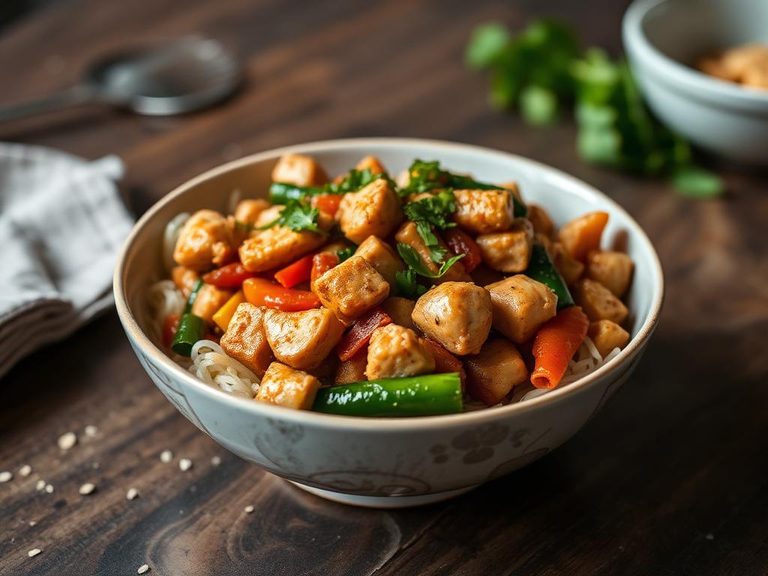
Chicken or turkey, rice, and vegetables including carrots, broccoli, and/or dark-green leafy; tomato-based sauce
Common food

Photo: Wikipedia
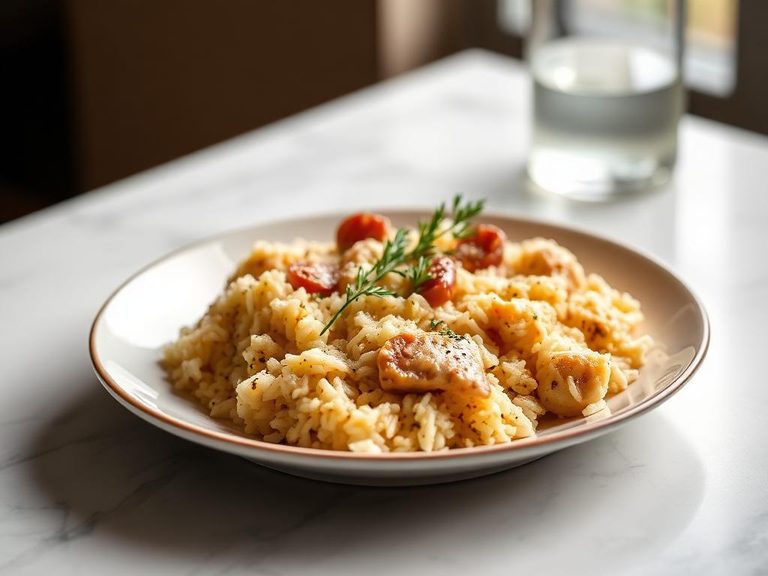
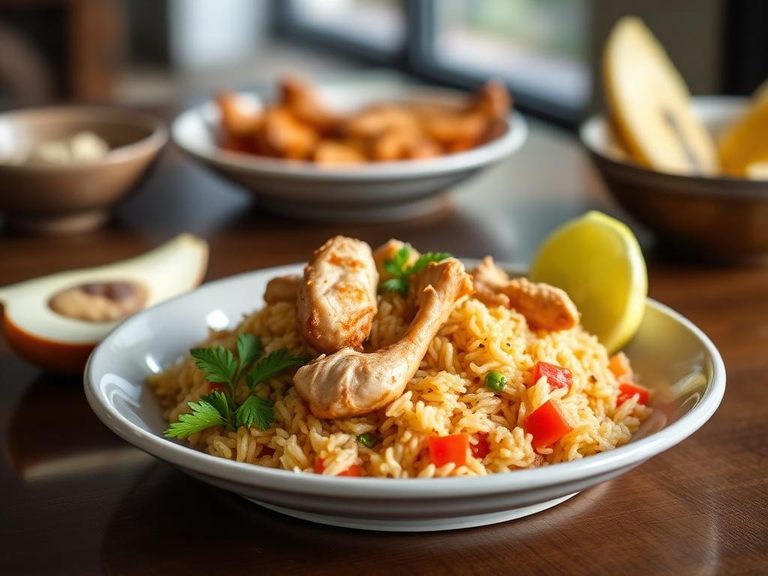
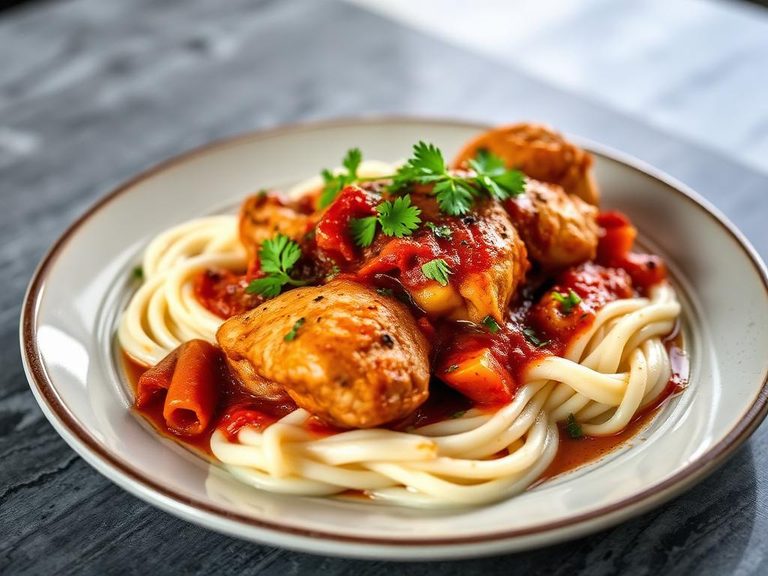
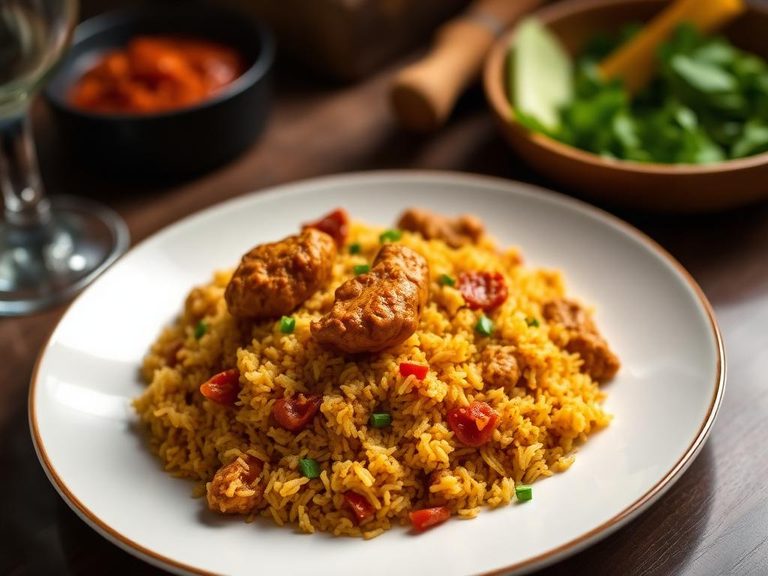
A comforting, savory bowl of tender chicken or turkey, fluffy rice, and vibrant vegetables like carrots, broccoli, or dark greens, all coated in a rich, tangy tomato sauce. It's a balanced, one-pot-style meal with a soft, hearty texture and a mild, savory flavor profile. Nutritionally, it offers a solid protein-to-calorie ratio, making it a satisfying and wholesome choice.
Calorie split: 16% protein · 46% carbs · 38% fat
↓ Full nutrition💚 Why it's loved
People love it for its comforting, familiar flavors and the ease of having protein, carbs, and vegetables in one cohesive dish. It's incredibly versatile, adapting to whatever vegetables or spices are on hand, and is a staple in home cooking across many cultures.
⚠️ Watch-outs & how to enjoy it better
The tomato-based sauce can be high in sodium, and the white rice may cause blood-sugar spikes for some. To counteract, opt for low-sodium sauce or make your own, and consider mixing in brown rice or quinoa for added fiber. Those with nightshade sensitivities should be cautious with the tomato base.
Key benefits
- Provides lean protein from poultry for muscle maintenance.
- Offers complex carbs from rice for sustained energy.
- Contains fiber and vitamins from mixed vegetables.
- Low in sugar, supporting stable blood sugar levels.
- Relatively low in calories per 100g for a complete meal.
🍽️ Popular dishes
🌍 Where it's eaten
💡 Did you know?
The combination of tomatoes, rice, and chicken is a global culinary constant, appearing in dishes from Spanish paella to Senegalese thieboudienne, often independently developed as a practical way to create a balanced meal.
Full nutrition (USDA data · scales with serving)
| Water | 73.0 g |
| Energy | 130 kcal |
| Protein | 5.3 g |
| Total lipid (fat) | 5.5 g |
| Carbohydrate, by difference | 14.8 g |
| Fiber, total dietary | 1.1 g |
| Total Sugars | 1.4 g |
| Calcium, Ca | 16.0 mg |
| Iron, Fe | 0.98 mg |
| Magnesium, Mg | 14.0 mg |
| Phosphorus, P | 64.0 mg |
| Potassium, K | 159 mg |
| Sodium, Na | 345 mg |
| Zinc, Zn | 0.54 mg |
| Copper, Cu | 0.08 mg |
| Selenium, Se | 6.7 ug |
| Vitamin C, total ascorbic acid | 5.5 mg |
| Thiamin | 0.09 mg |
| Riboflavin | 0.06 mg |
| Niacin | 2.0 mg |
| Vitamin B-6 | 0.12 mg |
| Folate, total | 35.0 ug |
| Folic acid | 24.0 ug |
| Folate, food | 11.0 ug |
| Folate, DFE | 52.0 ug |
| Choline, total | 14.4 mg |
| Vitamin B-12 | 0.05 ug |
| Vitamin B-12, added | 0.00 ug |
| Vitamin A, RAE | 85.0 ug |
| Retinol | 1.0 ug |
| Carotene, beta | 836 ug |
| Carotene, alpha | 326 ug |
| Cryptoxanthin, beta | 1.0 ug |
| Lycopene | 3641 ug |
| Lutein + zeaxanthin | 161 ug |
| Vitamin E (alpha-tocopherol) | 1.5 mg |
| Vitamin E, added | 0.00 mg |
| Vitamin D (D2 + D3) | 0.00 ug |
| Vitamin K (phylloquinone) | 14.0 ug |
| Alcohol, ethyl | 0.00 g |
| Caffeine | 0.00 mg |
| Theobromine | 0.00 mg |
Fat & fatty acid profile (per 100g)
| Fatty acids, total saturated | 0.85 g |
| SFA 4:0 | 0.00 g |
| SFA 6:0 | 0.00 g |
| SFA 8:0 | 0.00 g |
| SFA 10:0 | 0.00 g |
| SFA 12:0 | 0.00 g |
| SFA 14:0 | 0.01 g |
| SFA 16:0 | 0.63 g |
| SFA 18:0 | 0.17 g |
| Fatty acids, total monounsaturated | 2.3 g |
| MUFA 16:1 | 0.08 g |
| MUFA 18:1 | 2.1 g |
| MUFA 20:1 | 0.03 g |
| MUFA 22:1 | 0.00 g |
| Fatty acids, total polyunsaturated | 1.9 g |
| PUFA 18:2 | 1.7 g |
| PUFA 18:3 | 0.21 g |
| PUFA 18:4 | 0.00 g |
| PUFA 20:4 | 0.00 g |
| PUFA 20:5 n-3 (EPA) | 0.00 g |
| PUFA 22:5 n-3 (DPA) | 0.00 g |
| PUFA 22:6 n-3 (DHA) | 0.00 g |
| Cholesterol | 15.0 mg |
Amino acid profile (per 100g)
Estimated from Turnover, chicken- or turkey-, and vegetable-filled, reduced fat, frozen — USDA does not publish this profile for Chicken or turkey.
| Tryptophan | 0.16 g |
| Threonine | 0.41 g |
| Isoleucine | 0.47 g |
| Leucine | 0.80 g |
| Lysine | 0.61 g |
| Methionine | 0.23 g |
| Cystine | 0.13 g |
| Phenylalanine | 0.47 g |
| Tyrosine | 0.37 g |
| Valine | 0.53 g |
| Arginine | 0.51 g |
| Histidine | 0.30 g |
| Alanine | 0.45 g |
| Aspartic acid | 0.80 g |
| Glutamic acid | 2.2 g |
| Glycine | 0.38 g |
| Proline | 0.87 g |
| Serine | 0.42 g |
| Hydroxyproline | 0.00 g |
FAQ
Is this a good meal for weight management?
Yes, at 130 kcal per 100g, it's relatively low in calories for a complete meal. The protein and fiber help promote fullness, but watch portion sizes of rice and the sauce's sodium content.
Can I make this dish ahead of time?
Absolutely. It's an excellent meal-prep option. Store in airtight containers for up to 3-4 days in the fridge. The flavors often meld and improve overnight.
How can I increase the fiber content?
Use brown rice, wild rice, or quinoa instead of white rice. You can also add more vegetables like beans, peas, or extra leafy greens to boost the fiber significantly.
Nutrient density (calculated · NRF9.3)
Nutrient Rich Foods index: beneficial nutrients (protein, fiber, vitamins, minerals) minus saturated fat, added sugar & sodium, per 100 kcal.
NRF9.3 index — Fulgoni, Keast & Drewnowski, 2009. Computed from USDA nutrients.
Weight-loss friendliness (composite index)
Energy density 1.30 kcal/g · 16% calories from protein · 1.1 g fiber · 1.4 g sugar per 100 g.
Composite of energy density (Rolls et al., 1999), protein & fiber satiety, minus sugar. A calculated heuristic — ranks satiety-per-calorie, not a clinical measure.
Dietary load (calculated from USDA values)
Potential renal acid load. Positive = acid-forming, negative = alkaline-forming.
Sodium-to-potassium ratio: 2.17 (lower is better — aim for ≤ 1)
Sodium:potassium per WHO potassium guidance. Computed from USDA nutrients.