

Chicken or turkey, potatoes, and vegetables excluding carrots, broccoli, and dark-green leafy; tomato-based sauce
Common food
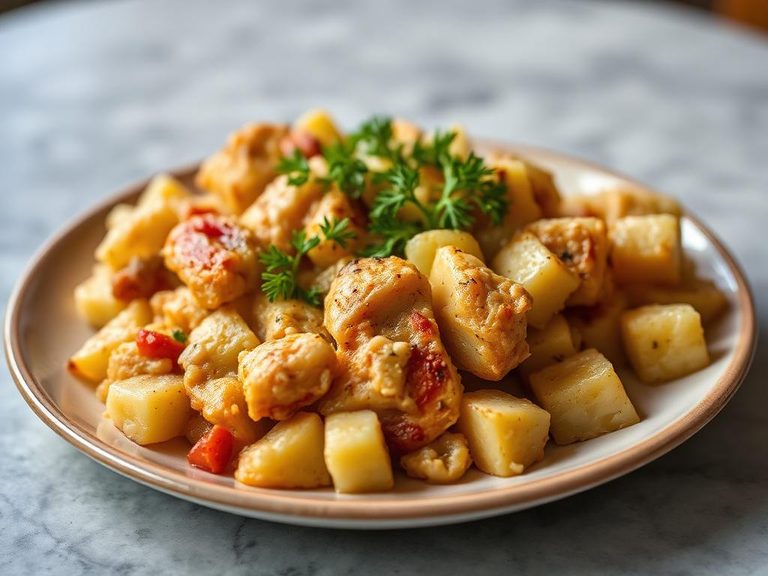
This is a hearty, comforting stew or casserole featuring tender chunks of chicken or turkey, soft potatoes, and a medley of vegetables like carrots, celery, and onions, all simmered in a savory, tangy tomato-based sauce. The texture is satisfyingly chunky with a rich, umami-laced broth, while the protein provides a lean, substantial base. Nutritionally, it's a balanced, low-calorie meal that delivers solid protein and fiber without excess fat.
Calorie split: 15% protein · 37% carbs · 48% fat
↓ Full nutrition💚 Why it's loved
People adore this dish for its deep, savory flavors and the way the tomato sauce brightens the earthy potatoes and mild poultry. It's a versatile one-pot wonder that embodies home cooking across many cultures, from American chicken cacciatore to Mediterranean-style stews.
⚠️ Watch-outs & how to enjoy it better
The tomato base can be acidic, potentially triggering heartburn or discomfort for those with GERD. To counteract this, add a pinch of sugar or a dollop of dairy (like yogurt) to balance acidity. Also, be mindful of sodium in canned tomatoes or broths; opt for low-sodium versions and season with herbs instead.
Key benefits
- High-quality lean protein supports muscle maintenance.
- Tomato sauce provides lycopene, an antioxidant linked to heart health.
- Fiber from vegetables and potatoes aids digestion and promotes fullness.
- Low in saturated fat, making it heart-friendly.
- Naturally gluten-free if prepared without flour thickeners.
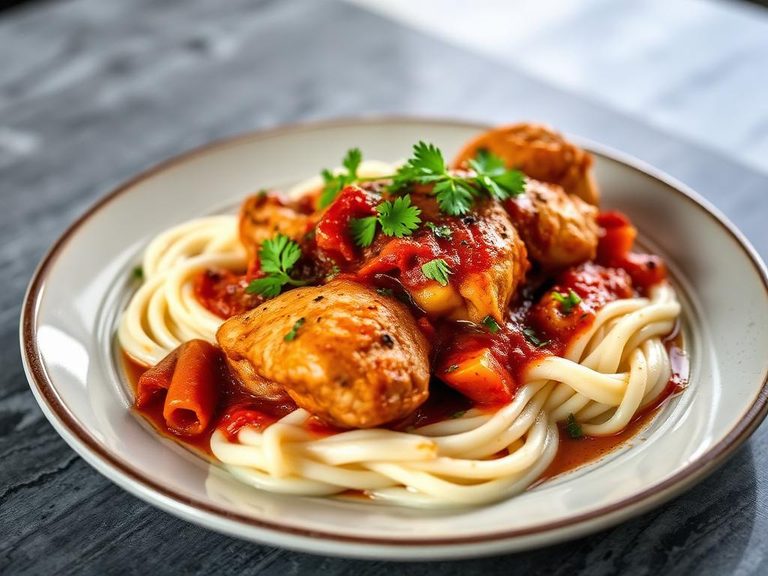
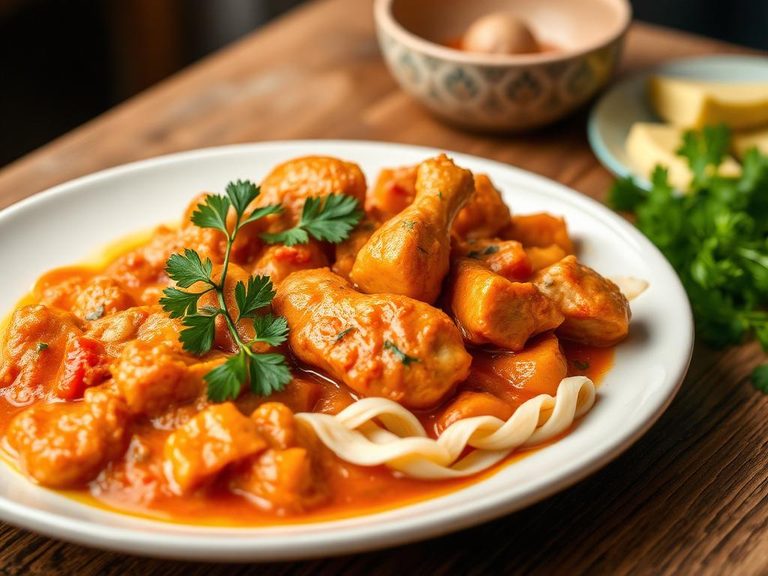
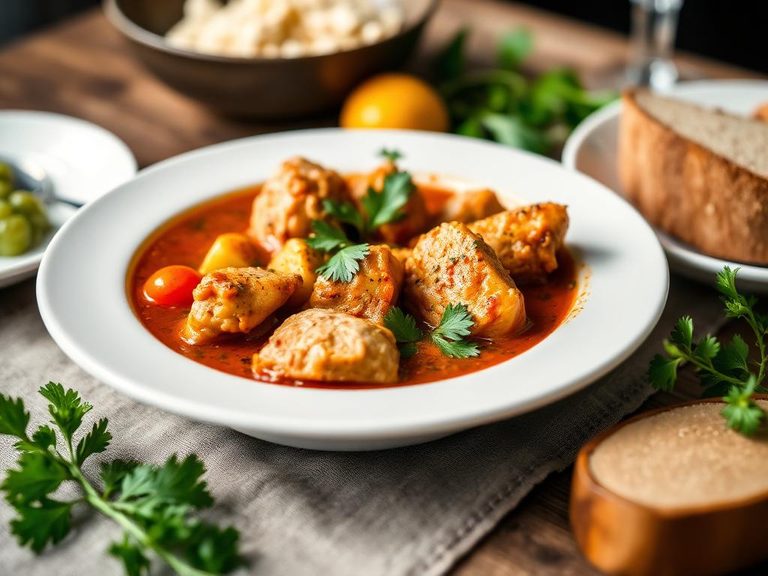
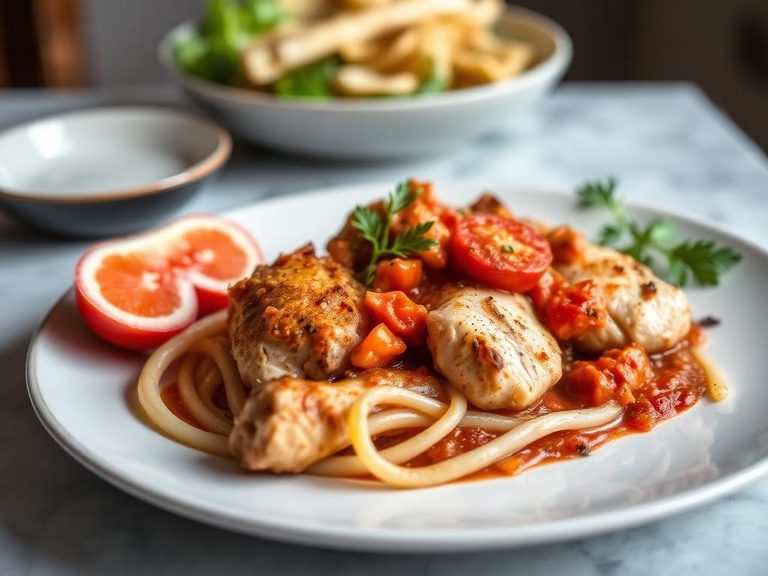
🍽️ Popular dishes
🌍 Where it's eaten
💡 Did you know?
The classic 'hunter-style' (cacciatore) preparation originally used whatever game was available, but modern versions almost always feature chicken or turkey as a more accessible substitute.
Full nutrition (USDA data · scales with serving)
| Water | 74.5 g |
| Energy | 128 kcal |
| Protein | 4.8 g |
| Total lipid (fat) | 7.0 g |
| Carbohydrate, by difference | 12.2 g |
| Fiber, total dietary | 1.6 g |
| Total Sugars | 1.7 g |
| Calcium, Ca | 13.0 mg |
| Iron, Fe | 0.58 mg |
| Magnesium, Mg | 20.0 mg |
| Phosphorus, P | 64.0 mg |
| Potassium, K | 287 mg |
| Sodium, Na | 335 mg |
| Zinc, Zn | 0.46 mg |
| Copper, Cu | 0.12 mg |
| Selenium, Se | 3.5 ug |
| Vitamin C, total ascorbic acid | 5.6 mg |
| Thiamin | 0.06 mg |
| Riboflavin | 0.06 mg |
| Niacin | 1.9 mg |
| Vitamin B-6 | 0.19 mg |
| Folate, total | 12.0 ug |
| Folic acid | 0.00 ug |
| Folate, food | 12.0 ug |
| Folate, DFE | 12.0 ug |
| Choline, total | 19.8 mg |
| Vitamin B-12 | 0.05 ug |
| Vitamin B-12, added | 0.00 ug |
| Vitamin A, RAE | 9.0 ug |
| Retinol | 1.0 ug |
| Carotene, beta | 91.0 ug |
| Carotene, alpha | 6.0 ug |
| Cryptoxanthin, beta | 11.0 ug |
| Lycopene | 3582 ug |
| Lutein + zeaxanthin | 112 ug |
| Vitamin E (alpha-tocopherol) | 1.6 mg |
| Vitamin E, added | 0.00 mg |
| Vitamin D (D2 + D3) | 0.00 ug |
| Vitamin K (phylloquinone) | 11.0 ug |
| Alcohol, ethyl | 0.00 g |
| Caffeine | 0.00 mg |
| Theobromine | 0.00 mg |
Fat & fatty acid profile (per 100g)
| Fatty acids, total saturated | 1.0 g |
| SFA 4:0 | 0.00 g |
| SFA 6:0 | 0.00 g |
| SFA 8:0 | 0.00 g |
| SFA 10:0 | 0.00 g |
| SFA 12:0 | 0.00 g |
| SFA 14:0 | 0.01 g |
| SFA 16:0 | 0.77 g |
| SFA 18:0 | 0.21 g |
| Fatty acids, total monounsaturated | 2.9 g |
| MUFA 16:1 | 0.08 g |
| MUFA 18:1 | 2.8 g |
| MUFA 20:1 | 0.04 g |
| MUFA 22:1 | 0.00 g |
| Fatty acids, total polyunsaturated | 2.5 g |
| PUFA 18:2 | 2.2 g |
| PUFA 18:3 | 0.28 g |
| PUFA 18:4 | 0.00 g |
| PUFA 20:4 | 0.00 g |
| PUFA 20:5 n-3 (EPA) | 0.00 g |
| PUFA 22:5 n-3 (DPA) | 0.00 g |
| PUFA 22:6 n-3 (DHA) | 0.00 g |
| Cholesterol | 14.0 mg |
Amino acid profile (per 100g)
Estimated from Turnover, chicken- or turkey-, and vegetable-filled, reduced fat, frozen — USDA does not publish this profile for Chicken or turkey.
| Tryptophan | 0.16 g |
| Threonine | 0.41 g |
| Isoleucine | 0.47 g |
| Leucine | 0.80 g |
| Lysine | 0.61 g |
| Methionine | 0.23 g |
| Cystine | 0.13 g |
| Phenylalanine | 0.47 g |
| Tyrosine | 0.37 g |
| Valine | 0.53 g |
| Arginine | 0.51 g |
| Histidine | 0.30 g |
| Alanine | 0.45 g |
| Aspartic acid | 0.80 g |
| Glutamic acid | 2.2 g |
| Glycine | 0.38 g |
| Proline | 0.87 g |
| Serine | 0.42 g |
| Hydroxyproline | 0.00 g |
FAQ
Can I use other meats besides chicken or turkey?
Yes, this style of stew is very adaptable. Pork, rabbit, or even firm fish like cod can work well, adjusting cooking times accordingly.
Is this dish suitable for meal prep?
Absolutely. The flavors often improve after a day in the fridge. Store in airtight containers for up to 4 days; the potatoes may soften slightly.
How can I make the sauce thicker?
You can simmer it uncovered to reduce, or mix a small amount of cornstarch with cold water and stir it in at the end. Some recipes also add a spoonful of tomato paste for richness.
Nutrient density (calculated · NRF9.3)
Nutrient Rich Foods index: beneficial nutrients (protein, fiber, vitamins, minerals) minus saturated fat, added sugar & sodium, per 100 kcal.
NRF9.3 index — Fulgoni, Keast & Drewnowski, 2009. Computed from USDA nutrients.
Weight-loss friendliness (composite index)
Energy density 1.28 kcal/g · 15% calories from protein · 1.6 g fiber · 1.7 g sugar per 100 g.
Composite of energy density (Rolls et al., 1999), protein & fiber satiety, minus sugar. A calculated heuristic — ranks satiety-per-calorie, not a clinical measure.
Dietary load (calculated from USDA values)
Potential renal acid load. Positive = acid-forming, negative = alkaline-forming.
Sodium-to-potassium ratio: 1.17 (lower is better — aim for ≤ 1)
Sodium:potassium per WHO potassium guidance. Computed from USDA nutrients.