

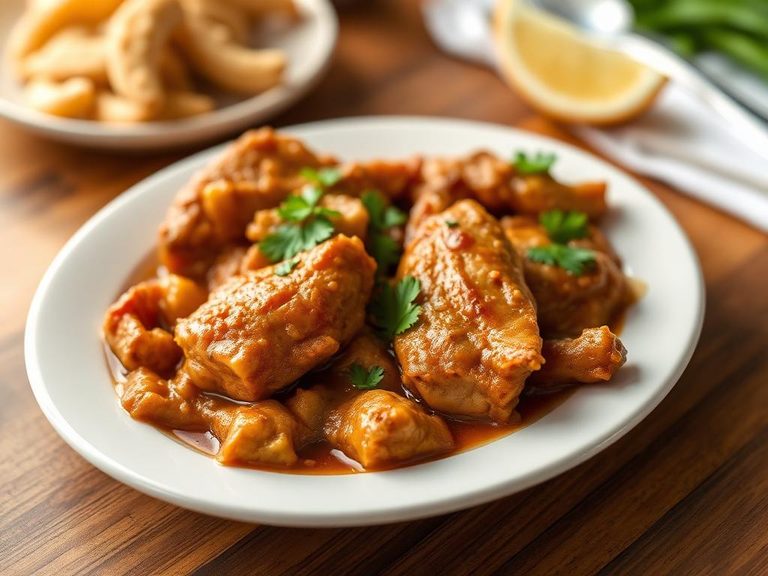
Chicken or turkey fricassee, with sauce, no potatoes, potatoes reported separately, Puerto Rican style
Common food

Photo: Wikipedia
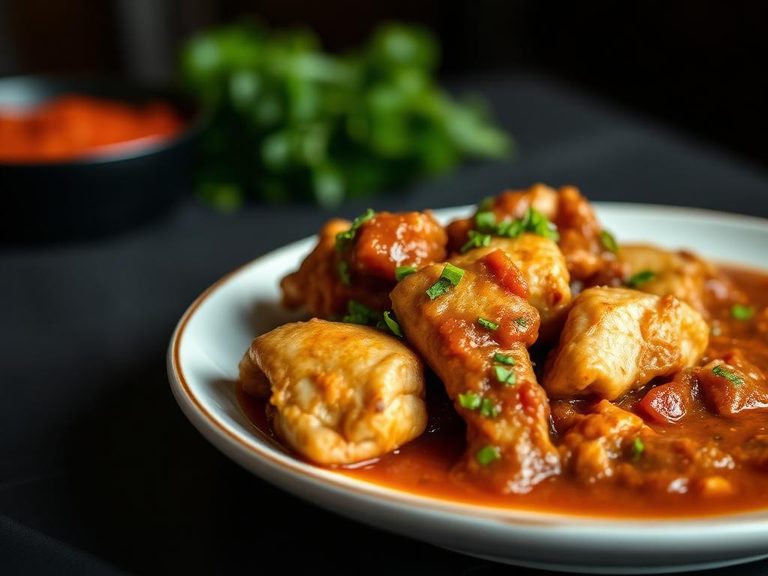
This is a savory, slow-simmered Puerto Rican stew of chicken or turkey, cooked in a rich, aromatic sauce of sofrito, olives, and capers. The meat becomes incredibly tender, while the sauce delivers a complex, savory, and slightly briny flavor profile. It's a high-protein, moderate-fat dish with minimal carbohydrates.
Calorie split: 30% protein · 6% carbs · 64% fat
↓ Full nutrition💚 Why it's loved
People cherish it for its deep, comforting flavor that represents the heart of Puerto Rican home cooking. The sauce is a perfect vehicle for rice, and the dish is celebrated for turning simple poultry into something rich and celebratory.
⚠️ Watch-outs & how to enjoy it better
The sauce can be high in sodium due to olives, capers, and salt, which may concern those managing blood pressure. To counteract this, rinse canned olives/capers before use and use low-sodium broth. The fat content, while flavorful, is significant; pairing with a large portion of fiber-rich vegetables like steamed broccoli can help balance the meal.
Key benefits
- Excellent source of lean protein for muscle maintenance.
- Rich in iron and B vitamins from the poultry.
- Contains heart-healthy monounsaturated fats from olives.
- Low in carbohydrates, suitable for low-carb dietary patterns.
- Provides flavor without added sugars.
🍽️ Popular dishes
🌍 Where it's eaten
💡 Did you know?
The 'sofrito' base—a blend of peppers, onions, garlic, and cilantro—is the non-negotiable flavor foundation of this dish and countless other Puerto Rican recipes.
Full nutrition (USDA data · scales with serving)
| Water | 68.5 g |
| Energy | 183 kcal |
| Protein | 14.0 g |
| Total lipid (fat) | 13.1 g |
| Carbohydrate, by difference | 2.5 g |
| Fiber, total dietary | 0.70 g |
| Total Sugars | 1.2 g |
| Calcium, Ca | 17.0 mg |
| Iron, Fe | 0.71 mg |
| Magnesium, Mg | 17.0 mg |
| Phosphorus, P | 129 mg |
| Potassium, K | 219 mg |
| Sodium, Na | 593 mg |
| Zinc, Zn | 0.98 mg |
| Copper, Cu | 0.07 mg |
| Selenium, Se | 12.6 ug |
| Vitamin C, total ascorbic acid | 10.1 mg |
| Thiamin | 0.11 mg |
| Riboflavin | 0.11 mg |
| Niacin | 3.9 mg |
| Vitamin B-6 | 0.20 mg |
| Folate, total | 9.0 ug |
| Folic acid | 0.00 ug |
| Folate, food | 9.0 ug |
| Folate, DFE | 9.0 ug |
| Choline, total | 40.6 mg |
| Vitamin B-12 | 0.22 ug |
| Vitamin B-12, added | 0.00 ug |
| Vitamin A, RAE | 11.0 ug |
| Retinol | 4.0 ug |
| Carotene, beta | 91.0 ug |
| Carotene, alpha | 3.0 ug |
| Cryptoxanthin, beta | 3.0 ug |
| Lycopene | 1440 ug |
| Lutein + zeaxanthin | 87.0 ug |
| Vitamin E (alpha-tocopherol) | 2.5 mg |
| Vitamin E, added | 0.00 mg |
| Vitamin D (D2 + D3) | 0.10 ug |
| Vitamin K (phylloquinone) | 6.2 ug |
| Alcohol, ethyl | 0.00 g |
| Caffeine | 0.00 mg |
| Theobromine | 0.00 mg |
Fat & fatty acid profile (per 100g)
| Fatty acids, total saturated | 2.4 g |
| SFA 4:0 | 0.00 g |
| SFA 6:0 | 0.00 g |
| SFA 8:0 | 0.00 g |
| SFA 10:0 | 0.00 g |
| SFA 12:0 | 0.00 g |
| SFA 14:0 | 0.02 g |
| SFA 16:0 | 1.8 g |
| SFA 18:0 | 0.42 g |
| Fatty acids, total monounsaturated | 8.2 g |
| MUFA 16:1 | 0.32 g |
| MUFA 18:1 | 7.8 g |
| MUFA 20:1 | 0.04 g |
| MUFA 22:1 | 0.00 g |
| Fatty acids, total polyunsaturated | 1.4 g |
| PUFA 18:2 | 1.3 g |
| PUFA 18:3 | 0.09 g |
| PUFA 18:4 | 0.00 g |
| PUFA 20:4 | 0.02 g |
| PUFA 20:5 n-3 (EPA) | 0.00 g |
| PUFA 22:5 n-3 (DPA) | 0.00 g |
| PUFA 22:6 n-3 (DHA) | 0.00 g |
| Cholesterol | 52.0 mg |
Amino acid profile (per 100g)
Estimated from Turnover, chicken- or turkey-, and vegetable-filled, reduced fat, frozen — USDA does not publish this profile for Chicken or turkey fricassee.
| Tryptophan | 0.16 g |
| Threonine | 0.41 g |
| Isoleucine | 0.47 g |
| Leucine | 0.80 g |
| Lysine | 0.61 g |
| Methionine | 0.23 g |
| Cystine | 0.13 g |
| Phenylalanine | 0.47 g |
| Tyrosine | 0.37 g |
| Valine | 0.53 g |
| Arginine | 0.51 g |
| Histidine | 0.30 g |
| Alanine | 0.45 g |
| Aspartic acid | 0.80 g |
| Glutamic acid | 2.2 g |
| Glycine | 0.38 g |
| Proline | 0.87 g |
| Serine | 0.42 g |
| Hydroxyproline | 0.00 g |
FAQ
What's the difference between fricassee and a regular stew?
Fricassee is a method where meat is first browned and then braised in a sauce, resulting in very tender meat and a rich, integrated gravy. It's often lighter in color than a heavily browned stew.
Can I use chicken thighs instead of breasts?
Absolutely. In fact, chicken thighs are traditional and preferred by many for their richer flavor and ability to stay moist during the long simmering process.
Is this dish spicy?
Traditional Puerto Rican fricassee is savory and aromatic, not typically spicy-hot. Heat is usually added at the table with a drizzle of 'pique' (hot sauce) if desired.
Nutrient density (calculated · NRF9.3)
Nutrient Rich Foods index: beneficial nutrients (protein, fiber, vitamins, minerals) minus saturated fat, added sugar & sodium, per 100 kcal.
NRF9.3 index — Fulgoni, Keast & Drewnowski, 2009. Computed from USDA nutrients.
Weight-loss friendliness (composite index)
Energy density 1.83 kcal/g · 31% calories from protein · 0.7 g fiber · 1.2 g sugar per 100 g.
Composite of energy density (Rolls et al., 1999), protein & fiber satiety, minus sugar. A calculated heuristic — ranks satiety-per-calorie, not a clinical measure.
Dietary load (calculated from USDA values)
Potential renal acid load. Positive = acid-forming, negative = alkaline-forming.
Sodium-to-potassium ratio: 2.71 (lower is better — aim for ≤ 1)
Sodium:potassium per WHO potassium guidance. Computed from USDA nutrients.