

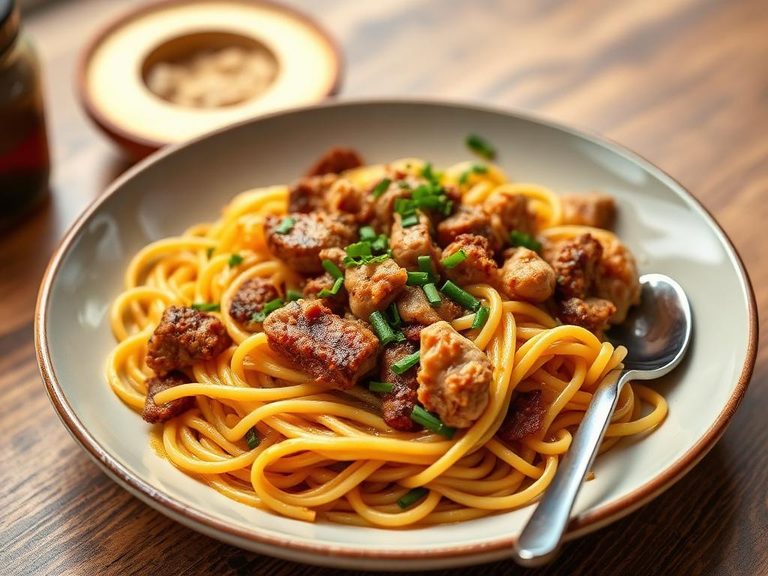
Chicken or turkey and noodles, no sauce
Common food

Photo: Wikipedia
A comforting, savory dish of tender chicken or turkey breast tossed with soft egg noodles, seasoned simply without a heavy sauce. The texture is soft and satisfying, with the noodles absorbing the subtle meaty flavors and light broth. At 148 kcal per 100g, it offers a balanced mix of protein and carbs, making it a light yet filling meal option.
Calorie split: 21% protein · 42% carbs · 37% fat
↓ Full nutrition💚 Why it's loved
People love it for its nostalgic, home-cooked appeal and mild, comforting flavor that suits all ages. Its simplicity makes it a versatile canvas for adding herbs, spices, or vegetables to suit personal tastes.
⚠️ Watch-outs & how to enjoy it better
The dish can be high in sodium if prepared with salty broths or processed noodles, which may concern those watching blood pressure. To counteract, use low-sodium broth, add fresh herbs for flavor, and pair with a side of vegetables to boost fiber and balance the meal.
Key benefits
- Provides lean protein for muscle maintenance and satiety.
- Offers a moderate carbohydrate source for energy.
- Low in sugar and fiber, making it easy to digest.
- Versatile base that can be seasoned or paired with vegetables.
- Comforting and familiar, often used in home cooking.
🍽️ Popular dishes
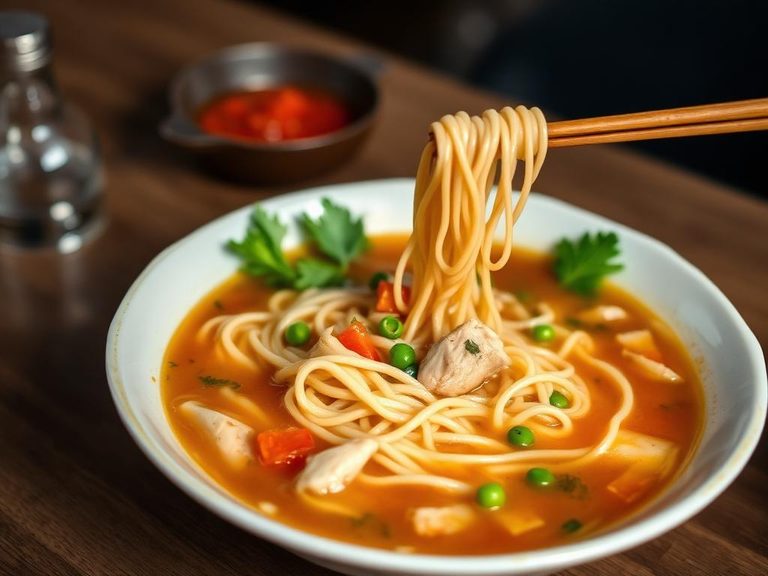
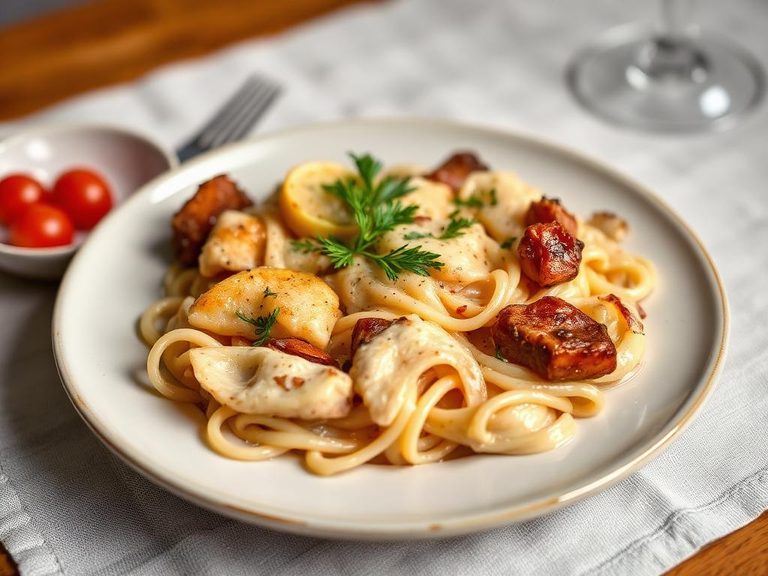
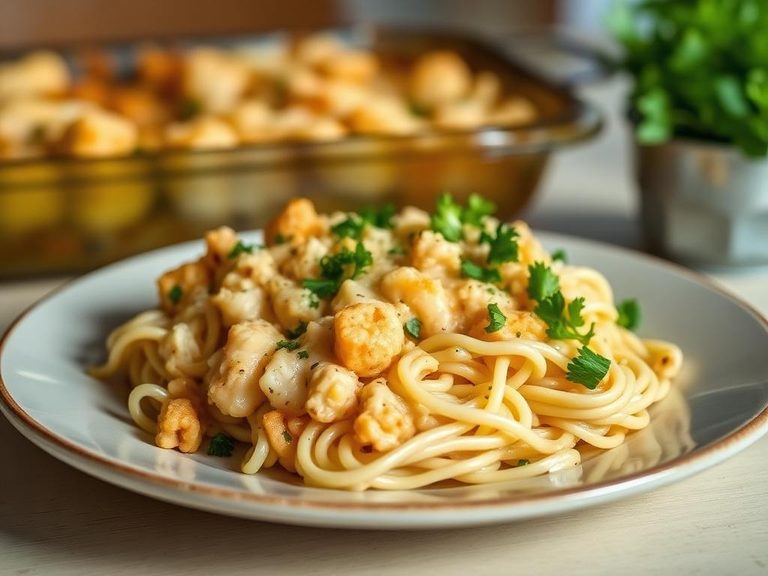
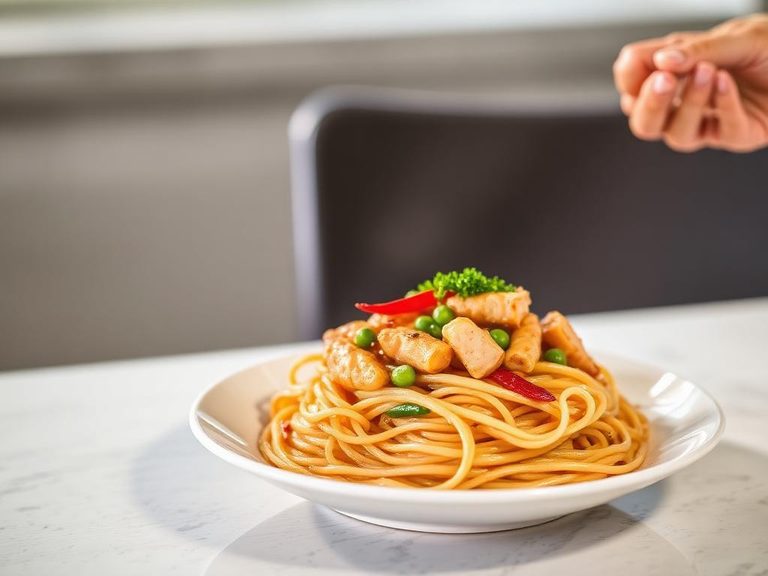
🌍 Where it's eaten
💡 Did you know?
The phrase 'chicken soup for the soul' originated from a 1993 book series, but chicken noodle soup has been a medicinal remedy in many cultures for centuries, often called 'Jewish penicillin' for its perceived healing properties.
Full nutrition (USDA data · scales with serving)
| Water | 69.4 g |
| Energy | 148 kcal |
| Protein | 7.7 g |
| Total lipid (fat) | 6.1 g |
| Carbohydrate, by difference | 15.5 g |
| Fiber, total dietary | 0.70 g |
| Total Sugars | 0.25 g |
| Calcium, Ca | 11.0 mg |
| Iron, Fe | 1.0 mg |
| Magnesium, Mg | 17.0 mg |
| Phosphorus, P | 91.0 mg |
| Potassium, K | 75.0 mg |
| Sodium, Na | 353 mg |
| Zinc, Zn | 0.70 mg |
| Copper, Cu | 0.07 mg |
| Selenium, Se | 19.1 ug |
| Vitamin C, total ascorbic acid | 0.00 mg |
| Thiamin | 0.19 mg |
| Riboflavin | 0.12 mg |
| Niacin | 2.7 mg |
| Vitamin B-6 | 0.07 mg |
| Folate, total | 53.0 ug |
| Folic acid | 47.0 ug |
| Folate, food | 6.0 ug |
| Folate, DFE | 86.0 ug |
| Choline, total | 28.0 mg |
| Vitamin B-12 | 0.12 ug |
| Vitamin B-12, added | 0.00 ug |
| Vitamin A, RAE | 5.0 ug |
| Retinol | 5.0 ug |
| Carotene, beta | 1.0 ug |
| Carotene, alpha | 0.00 ug |
| Cryptoxanthin, beta | 0.00 ug |
| Lycopene | 0.00 ug |
| Lutein + zeaxanthin | 23.0 ug |
| Vitamin E (alpha-tocopherol) | 0.88 mg |
| Vitamin E, added | 0.00 mg |
| Vitamin D (D2 + D3) | 0.10 ug |
| Vitamin K (phylloquinone) | 3.7 ug |
| Alcohol, ethyl | 0.00 g |
| Caffeine | 0.00 mg |
| Theobromine | 0.00 mg |
Fat & fatty acid profile (per 100g)
| Fatty acids, total saturated | 1.0 g |
| SFA 4:0 | 0.00 g |
| SFA 6:0 | 0.00 g |
| SFA 8:0 | 0.00 g |
| SFA 10:0 | 0.00 g |
| SFA 12:0 | 0.00 g |
| SFA 14:0 | 0.01 g |
| SFA 16:0 | 0.80 g |
| SFA 18:0 | 0.20 g |
| Fatty acids, total monounsaturated | 2.4 g |
| MUFA 16:1 | 0.13 g |
| MUFA 18:1 | 2.3 g |
| MUFA 20:1 | 0.03 g |
| MUFA 22:1 | 0.00 g |
| Fatty acids, total polyunsaturated | 1.9 g |
| PUFA 18:2 | 1.7 g |
| PUFA 18:3 | 0.19 g |
| PUFA 18:4 | 0.00 g |
| PUFA 20:4 | 0.01 g |
| PUFA 20:5 n-3 (EPA) | 0.00 g |
| PUFA 22:5 n-3 (DPA) | 0.00 g |
| PUFA 22:6 n-3 (DHA) | 0.00 g |
| Cholesterol | 39.0 mg |
Amino acid profile (per 100g)
Estimated from Turnover, chicken- or turkey-, and vegetable-filled, reduced fat, frozen — USDA does not publish this profile for Chicken or turkey and noodles.
| Tryptophan | 0.16 g |
| Threonine | 0.41 g |
| Isoleucine | 0.47 g |
| Leucine | 0.80 g |
| Lysine | 0.61 g |
| Methionine | 0.23 g |
| Cystine | 0.13 g |
| Phenylalanine | 0.47 g |
| Tyrosine | 0.37 g |
| Valine | 0.53 g |
| Arginine | 0.51 g |
| Histidine | 0.30 g |
| Alanine | 0.45 g |
| Aspartic acid | 0.80 g |
| Glutamic acid | 2.2 g |
| Glycine | 0.38 g |
| Proline | 0.87 g |
| Serine | 0.42 g |
| Hydroxyproline | 0.00 g |
FAQ
Is chicken or turkey and noodles a good source of protein?
Yes, it provides 7.73g of protein per 100g, which supports muscle repair and helps keep you full.
Can I make this dish healthier?
Absolutely—use whole-grain noodles, add vegetables like carrots or spinach, and opt for low-sodium broth to reduce salt intake.
Is this dish suitable for people with gluten intolerance?
Traditional noodles contain gluten, but you can substitute with gluten-free noodles made from rice or chickpeas to make it suitable.
Nutrient density (calculated · NRF9.3)
Nutrient Rich Foods index: beneficial nutrients (protein, fiber, vitamins, minerals) minus saturated fat, added sugar & sodium, per 100 kcal.
NRF9.3 index — Fulgoni, Keast & Drewnowski, 2009. Computed from USDA nutrients.
Weight-loss friendliness (composite index)
Energy density 1.48 kcal/g · 21% calories from protein · 0.7 g fiber · 0.3 g sugar per 100 g.
Composite of energy density (Rolls et al., 1999), protein & fiber satiety, minus sugar. A calculated heuristic — ranks satiety-per-calorie, not a clinical measure.
Dietary load (calculated from USDA values)
Potential renal acid load. Positive = acid-forming, negative = alkaline-forming.
Sodium-to-potassium ratio: 4.71 (lower is better — aim for ≤ 1)
Sodium:potassium per WHO potassium guidance. Computed from USDA nutrients.