

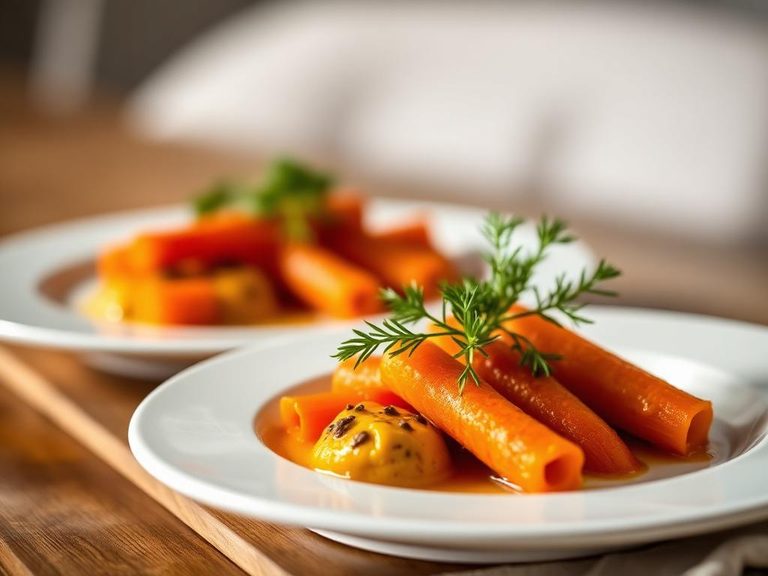
Carrots, fresh, cooked with oil
Common food

Photo: Wikipedia
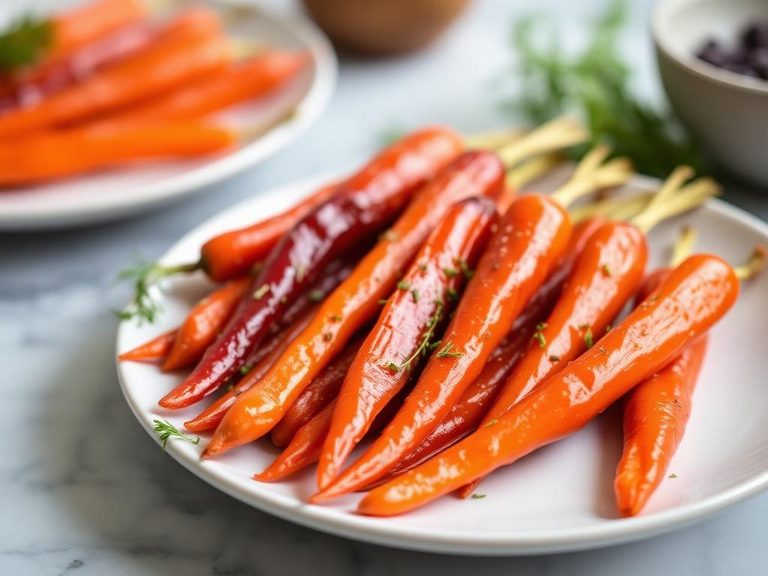
Carrots, fresh and cooked with oil, transform from crisp and earthy to tender, sweet, and slightly caramelized, with the oil lending a silky mouthfeel and enhancing the absorption of fat-soluble vitamins. This simple preparation elevates the carrot's natural sugars, creating a rich, savory-sweet side dish. Nutritionally, the added fat significantly boosts the bioavailability of beta-carotene, a precursor to vitamin A.
Calorie split: 5% protein · 55% carbs · 40% fat
↓ Full nutrition💚 Why it's loved
People love this preparation for its deep, concentrated sweetness and satisfying, tender texture that contrasts beautifully with a crisp raw carrot. It's a beloved, versatile side that pairs seamlessly with everything from roast chicken to hearty stews, forming a cornerstone of home cooking across many cultures.
⚠️ Watch-outs & how to enjoy it better
The natural sugars in carrots can cause a quicker blood sugar rise compared to non-starchy vegetables, so those monitoring glycemic response should be mindful of portion size. To counteract this, always pair with a source of protein or healthy fat (which the cooking oil already provides) and consider serving alongside a larger portion of leafy greens or a protein-rich main to balance the meal.
Key benefits
- Excellent source of beta-carotene, converted to vitamin A for vision and immune health.
- Cooking with oil increases absorption of fat-soluble vitamins (A, K, E).
- Provides dietary fiber for digestive health and satiety.
- Contains antioxidants like lutein and lycopene.
- Low in calories while being nutrient-dense.
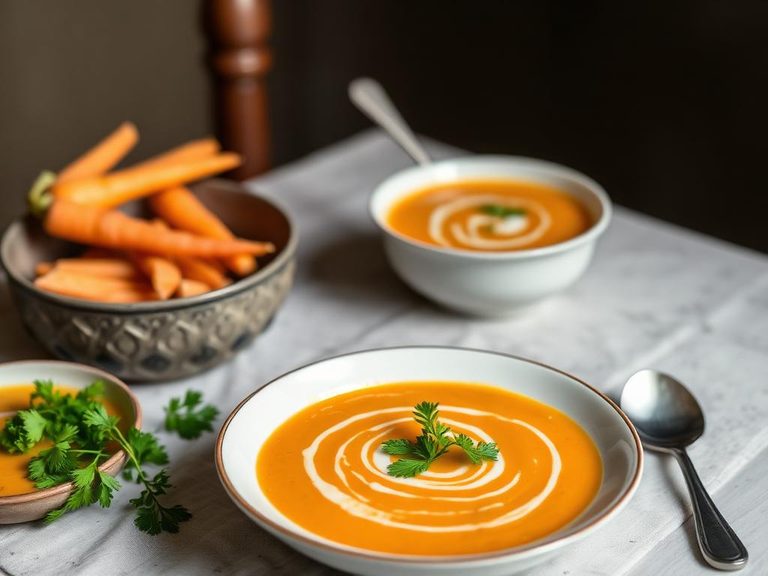
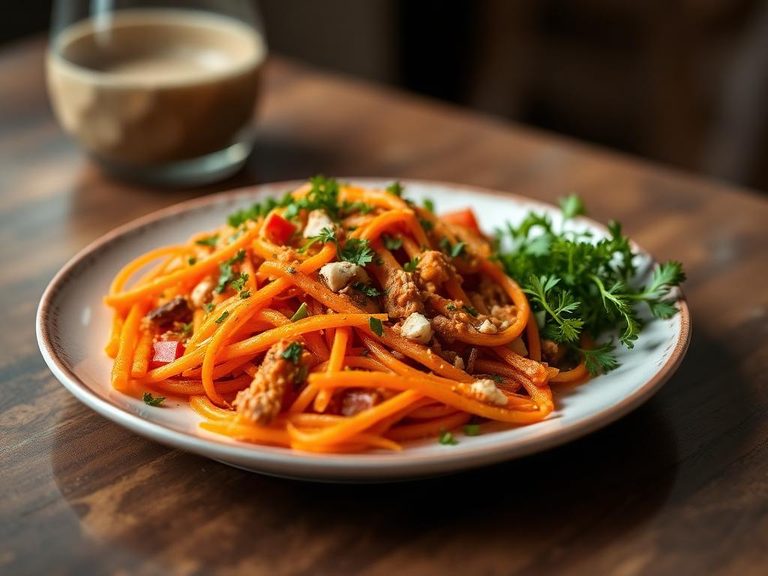
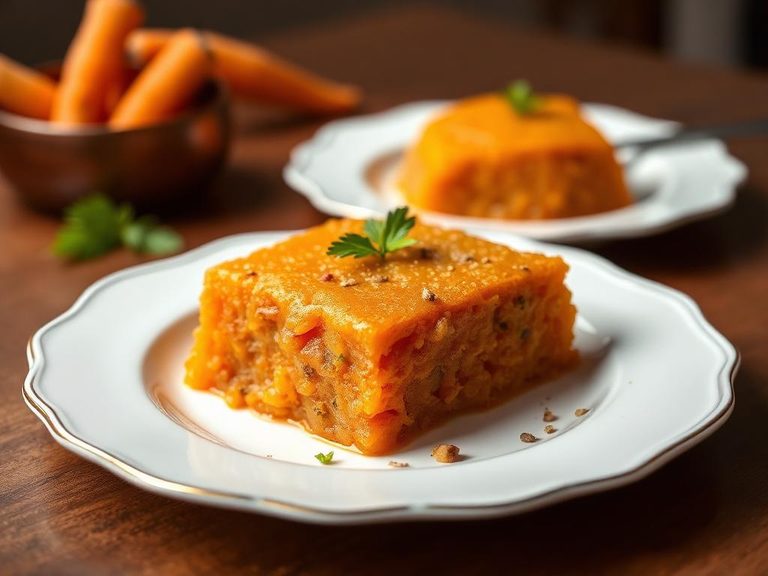
🍽️ Popular dishes
🌍 Where it's eaten
💡 Did you know?
The beta-carotene in carrots is more bioavailable when cooked and consumed with fat than when eaten raw, meaning your body can actually use more of the nutrient from this prepared dish.
Full nutrition (USDA data · scales with serving)
| Water | 84.3 g |
| Energy | 76.0 kcal |
| Protein | 0.95 g |
| Total lipid (fat) | 3.4 g |
| Carbohydrate, by difference | 10.4 g |
| Fiber, total dietary | 3.1 g |
| Total Sugars | 4.8 g |
| Calcium, Ca | 30.0 mg |
| Iron, Fe | 0.16 mg |
| Magnesium, Mg | 12.0 mg |
| Phosphorus, P | 40.0 mg |
| Potassium, K | 282 mg |
| Sodium, Na | 205 mg |
| Zinc, Zn | 0.24 mg |
| Copper, Cu | 0.06 mg |
| Selenium, Se | 0.00 ug |
| Vitamin C, total ascorbic acid | 5.1 mg |
| Thiamin | 0.06 mg |
| Riboflavin | 0.09 mg |
| Niacin | 1.3 mg |
| Vitamin B-6 | 0.13 mg |
| Folate, total | 32.0 ug |
| Folic acid | 0.00 ug |
| Folate, food | 32.0 ug |
| Folate, DFE | 32.0 ug |
| Choline, total | 8.9 mg |
| Vitamin B-12 | 0.00 ug |
| Vitamin B-12, added | 0.00 ug |
| Vitamin A, RAE | 800 ug |
| Retinol | 0.00 ug |
| Carotene, beta | 7937 ug |
| Carotene, alpha | 3331 ug |
| Cryptoxanthin, beta | 0.00 ug |
| Lycopene | 1.0 ug |
| Lutein + zeaxanthin | 245 ug |
| Vitamin E (alpha-tocopherol) | 1.2 mg |
| Vitamin E, added | 0.00 mg |
| Vitamin D (D2 + D3) | 0.00 ug |
| Vitamin K (phylloquinone) | 16.4 ug |
| Alcohol, ethyl | 0.00 g |
| Caffeine | 0.00 mg |
| Theobromine | 0.00 mg |
Fat & fatty acid profile (per 100g)
| Fatty acids, total saturated | 0.44 g |
| SFA 4:0 | 0.00 g |
| SFA 6:0 | 0.00 g |
| SFA 8:0 | 0.00 g |
| SFA 10:0 | 0.00 g |
| SFA 12:0 | 0.00 g |
| SFA 14:0 | 0.00 g |
| SFA 16:0 | 0.32 g |
| SFA 18:0 | 0.09 g |
| Fatty acids, total monounsaturated | 1.3 g |
| MUFA 16:1 | 0.01 g |
| MUFA 18:1 | 1.3 g |
| MUFA 20:1 | 0.02 g |
| MUFA 22:1 | 0.00 g |
| Fatty acids, total polyunsaturated | 1.3 g |
| PUFA 18:2 | 1.1 g |
| PUFA 18:3 | 0.13 g |
| PUFA 18:4 | 0.00 g |
| PUFA 20:4 | 0.00 g |
| PUFA 20:5 n-3 (EPA) | 0.00 g |
| PUFA 22:5 n-3 (DPA) | 0.00 g |
| PUFA 22:6 n-3 (DHA) | 0.00 g |
| Cholesterol | 0.00 mg |
Amino acid profile (per 100g)
Estimated from Carrots, canned, no salt added, drained solids — USDA does not publish this profile for Carrots.
| Tryptophan | 0.01 g |
| Threonine | 0.02 g |
| Isoleucine | 0.03 g |
| Leucine | 0.03 g |
| Lysine | 0.03 g |
| Methionine | 0.00 g |
| Cystine | 0.01 g |
| Phenylalanine | 0.02 g |
| Tyrosine | 0.01 g |
| Valine | 0.03 g |
| Arginine | 0.03 g |
| Histidine | 0.01 g |
| Alanine | 0.04 g |
| Aspartic acid | 0.08 g |
| Glutamic acid | 0.12 g |
| Glycine | 0.02 g |
| Proline | 0.02 g |
| Serine | 0.02 g |
FAQ
Does cooking carrots reduce their nutritional value?
Cooking can reduce heat-sensitive nutrients like vitamin C, but it significantly increases the bioavailability of beta-carotene and other antioxidants by breaking down plant cell walls. The addition of oil further enhances the absorption of fat-soluble vitamins.
What type of oil is best for cooking carrots?
Neutral oils with a high smoke point like avocado, grapeseed, or light olive oil are excellent for sautéing or roasting. For flavor, a small amount of butter or extra virgin olive oil can be added at the end of cooking.
How can I prevent carrots from becoming too soft or mushy?
Cut them into uniform pieces for even cooking. Sauté over medium-high heat for a slight caramelization before reducing heat, or roast at a high temperature (400°F/200°C). Add a splash of water or broth only if needed, and cook just until fork-tender.
Nutrient density (calculated · NRF9.3)
Nutrient Rich Foods index: beneficial nutrients (protein, fiber, vitamins, minerals) minus saturated fat, added sugar & sodium, per 100 kcal.
NRF9.3 index — Fulgoni, Keast & Drewnowski, 2009. Computed from USDA nutrients.
Weight-loss friendliness (composite index)
Energy density 0.76 kcal/g · 5% calories from protein · 3.1 g fiber · 4.8 g sugar per 100 g.
Composite of energy density (Rolls et al., 1999), protein & fiber satiety, minus sugar. A calculated heuristic — ranks satiety-per-calorie, not a clinical measure.
Dietary load (calculated from USDA values)
Potential renal acid load. Positive = acid-forming, negative = alkaline-forming.
Sodium-to-potassium ratio: 0.73 (lower is better — aim for ≤ 1)
Sodium:potassium per WHO potassium guidance. Computed from USDA nutrients.